Logistics
For most UK sportswear and footwear brands, Bigblue is the closest fit among the six fulfilment companies compared here: Bigblue, ShipBob UK, fulfilmentcrowd, Meteor Space, Prolog Fulfilment and Huboo. In Bigblue's returns portal the shopper chooses an exchange, store credit or a refund. Bigblue grades 100% of returns within 24 hours and restocks 100% within 48 hours, scans every unit five times, and adds shifts on demand for a drop. It runs 11 warehouses across 5 countries (France, Spain, Italy, the United Kingdom and Germany). If your range includes heavy gym equipment, look at fulfilmentcrowd, which lists specialist handling for it. If you sell replica shirts printed with names and numbers, Prolog offers that personalisation.
Sportswear returns are, above all, a sizing problem. A shopper who orders the same trainer in two sizes has already decided to send one back, and your warehouse decides whether that parcel ends up as a refund or as a second sale. All facts are as of October 2026. Details on the other five providers come from their own websites, Companies House and the trade press; Bigblue's figures come from its own performance data and published customer stories. Anything a provider does not publish is marked as a question to settle in writing.
Key takeaways
- Fit drives the returns. Clothing return rates average 23.6% of ecommerce orders in the UK, according to ZigZag's 2025/2026 Annual Returns Report, produced with Retail Economics. In Ingrid's Return Economics 2026, size and fit explained 52.9% of UK returns in fashion, sportswear and accessories between September and December 2025.
- Exchanges are rarest in the UK. In Loop's analysis of Shopify merchants from January to August 2025, UK merchants had a 17.5% return rate and 5.8% exchange adoption, the lowest of the regions surveyed, and retained only 21.9% of returned revenue through exchanges or other alternatives to a refund, reported by eCommerceNews UK.
- Charging for returns is now common. Of the 100 UK clothing and footwear retailers benchmarked by Retail Economics and ZigZag, 42% charge for returns (excluding delivery fees), rising to 80% in young fashion, and only 24 offer returns that are completely free.
- The refund clock starts before the parcel lands. Under regulation 34 of the Consumer Contracts Regulations 2013, the refund is due within 14 days of getting the goods back or of the shopper's proof of sending, whichever comes first. A pair that takes three weeks to reach sellable stock has been refunded long before it is back on sale.
- EU parcels now pay duty, and a handling fee is coming. Since 1 July 2026 the EU has charged a temporary €3 customs duty per tariff line on parcels worth up to €150 sold from outside the EU, and a €2 Union handling fee per item is expected from 1 November 2026, according to the European Commission's guidance for trade. Under IOSS, British-made goods pay the €3 too.
- Exchanges pay back. At CAVAL, a French sneaker and apparel brand that ships with Bigblue, customers who exchange through Bigblue's store credit spend on average 47% more than their initial purchase, according to its customer story.
Why sportswear and footwear are a special case for a 3PL
A running shoe in twelve sizes and three colourways is 36 SKUs that look almost identical on a shelf, and a size run of leggings adds another dozen. Each order from a range like that tests picking accuracy, because a wrong size shipped is a return created by the warehouse rather than by the customer.
The second difference is the calendar. Much of a sportswear year turns on a few dates: a collection launch, a collaboration, a limited release, a new team kit, the weeks around a major tournament, then Black Friday. Fitness brands get a second peak in January, when New Year resolutions kick in: UK online sales of exercise equipment, from resistance bands to sports shoes, rose 60% in January 2024 compared with December, according to Adobe Analytics figures reported by Retail Week. A fulfilment company that performs well on an average Tuesday can still lose the season on the one afternoon a drop sells out.
The third is the box. A shoebox is part of the product. If a shipping label goes straight onto it, it arrives marked, and if the pair comes back, it is harder to sell as new. The fourth is the channel mix: brands that supply sports retailers or run their own stores need wholesale orders and online orders to draw on the same stock, or size 9 sells out online while it sits on a pallet bound for a stockist.
Finally, there is the worn return. Trainers that come back after a run, or leggings that have been through the wash, are a familiar problem. UK law lets you deduct the loss in value in that case, but only if the warehouse can show the condition the item arrived in (see the section on UK law below).
Seven questions to put to any fulfilment partner
Put these to every provider in writing, before the commercial conversation starts.
- Can a shopper swap a size without asking for a refund first? Ask to see the customer's screen, not only the admin panel, and ask whether the exchange checks live stock for the new size before it is confirmed.
- How many hours from arrival to sellable stock? Ask for two numbers: the time to grade a return and the time to put it back on sale. ‘Promptly’ is not a number.
- Is the shoebox overboxed? Ask whether shoes in their branded box ship inside an outer carton, and whether that rule is written into your packing instructions.
- What is the plan for drop day? Ask for the daily order capacity, the notice needed to add shifts, the time needed to book in a delivery before a launch, how stock is reserved for a presale, and the despatch cut-off on a normal day and on launch day.
- Can the same stock serve stockists? Ask whether wholesale and D2C orders run in one system, whether EDI orders and advance shipping notices are supported, and how each retailer's labelling and delivery-booking rules are recorded.
- Which return carrier is set up for your UK customers, and where do they drop parcels off? Ask every provider, Bigblue included, which carrier your UK customers' returns travel with, whether the drop-off is a locker, a parcel shop, a Post Office or a home collection, and whether printerless returns work with that carrier.
- How are EU customers served? Ask whether EU orders ship from stock held inside the EU or cross the border parcel by parcel, who declares the duty and the handling fee, and where an EU customer sends a pair back.
1. Bigblue
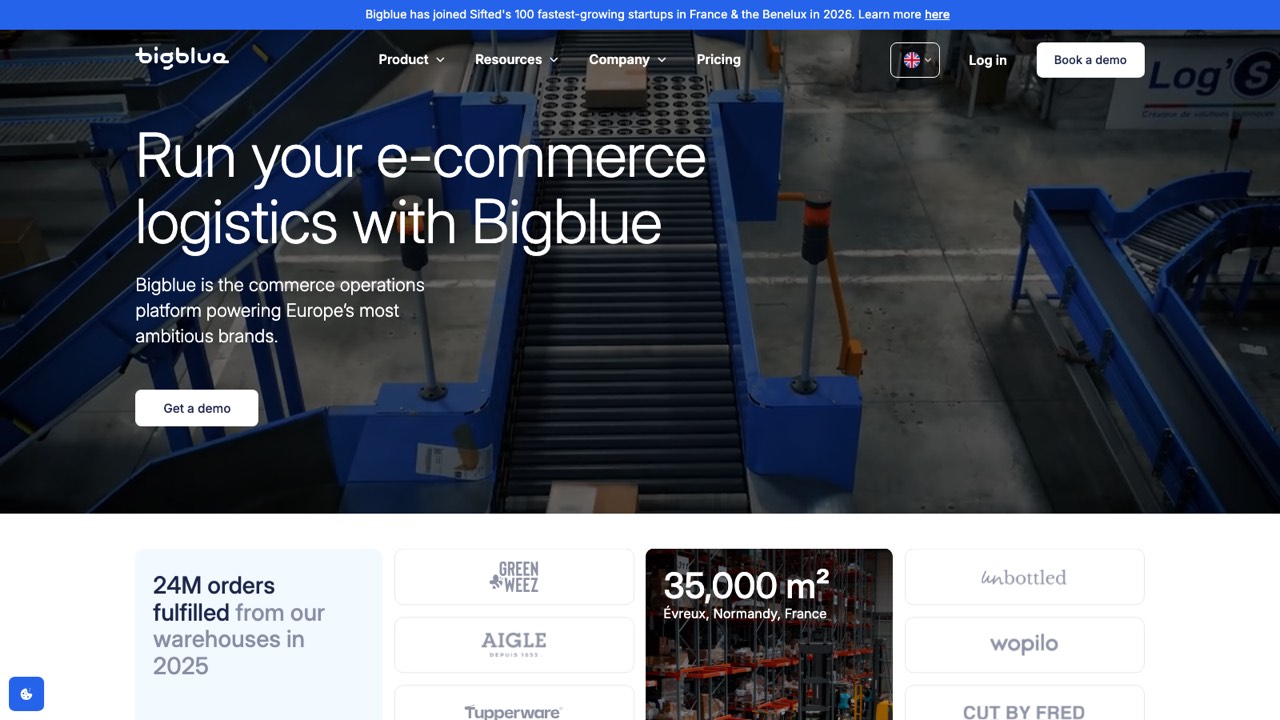
Bigblue is a European 3PL with its own software, Atlas (Warehouse Management System) for the warehouse and Voyager (Transport Management System) for shipping, and 11 warehouses across 5 countries (France, Spain, Italy, the United Kingdom and Germany). More than 600 brands ship with Bigblue.
Strengths
- A returns portal built around the exchange. The shopper logs in with an order number and a postcode and chooses an exchange, store credit or a refund. Where the return carrier set for your account supports it, the parcel is dropped off without a printer by showing a barcode at the carrier point. Returns use one carrier per merchant, so confirm which one serves your UK customers.
- Store credit sent at the first scan. Store credit is issued as a Shopify gift card worth the unit price as soon as the return carrier scans the parcel, so the customer can order the right size before the return reaches the warehouse.
- A fixed grading scale. Atlas (Warehouse Management System) grades every return A (resale-ready), B (minor damage), C (major damage) or D (unsalvageable), with a 10% spot-check audit. Bigblue grades 100% of returns within 24 hours and restocks 100% within 48 hours, which keeps a returned pair on sale while the style is still current.
- Stock reserved by channel and for presales. Inventory can be reserved for your site, your stores, wholesale or a marketplace, and allocated virtually for a presale launch, so a stockist order does not eat into the sizes held back for your own release. Extra shifts are added on demand at peak.
- Wholesale from the same stock. Wholesale picking and store replenishment run from the same stock and on the same platform as your D2C orders, with retailer instructions pre-filled for each stockist. More than half of Bigblue's customers run B2B and B2C together.
- Accuracy across size runs. Every unit is scanned five times, and the preparation error rate is below 0.01%. Atlas (Warehouse Management System) tracks a separate figure for picking, at 99.8% accuracy.
- UK delivery. Next-day delivery in the UK, with 98% of UK parcels delivered at the first attempt on Bigblue's carrier offer. Carriers listed on its integrations page include Royal Mail and DPD, and Voyager (Transport Management System) chooses the carrier parcel by parcel. Branded tracking cuts ‘where is my order?’ tickets by 50%.
- Shop and marketplace connections. Shopify connects in under 30 seconds, and the published integrations include Shopify Plus, WooCommerce, Magento, BigCommerce, Wix, PrestaShop and Amazon, plus Gorgias, Zendesk and Klaviyo.
- Launch-ready packing. Kitting and bundles, branded packaging, samples and flyers printed in the warehouse, and personalisation rules for first orders, VIP customers and birthdays, plus plastic-free packaging and reusable Hipli packaging.
Proof from sport and streetwear. CAVAL, a French brand of asymmetrical sneakers and apparel, reports 95% customer delivery satisfaction, halved its support tickets with Bigblue's tracking and Gorgias integration, and sees customers spend 47% more when they exchange through store credit, according to its customer story. SmartWorkout, a home training equipment brand, can use Bigblue's warehouses in France and the UK and recorded a 22% rise in product page conversion with Fast Tags, which show the delivery date on the product page. Bigblue also ships for Scuffers and Cold Culture, two Spanish streetwear brands, and for Velites, the Spanish brand named Official Apparel, Footwear, Grips and Jump Rope Partner of the 2026 CrossFit Games.
Best for. Sportswear, footwear and accessory brands shipping parcels in the UK and across Europe that want one fulfilment partner for size exchanges, launch days and stockists.
Continuity signal. Bigblue handles 24 million parcels a year for more than 600 brands and is a member of the Shopify Fulfillment Network. Ask for the written site list and the exit clause, exactly as you would with the other five names here.
2. ShipBob UK
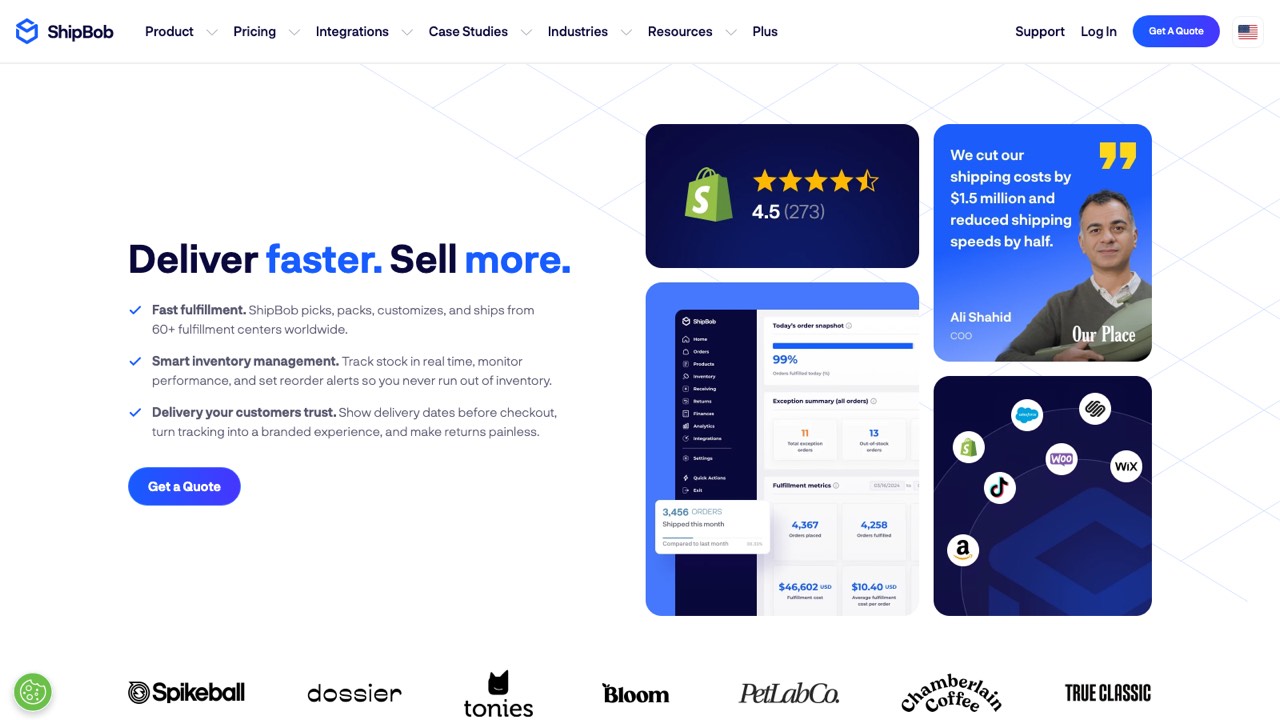
ShipBob is an American fulfilment network. Its UK locations page lists Manchester, Birmingham, Kettering and Oxford, with a receiving hub near Kettering, and European sites in Weert and Waddinxveen (the Netherlands) and Alcalá de Henares (Spain).
Strengths
- A dedicated sports and fitness page that covers launches, with rapid SKU activation so new styles move into active inventory quickly, according to the provider.
- UK, European and US sites in one network, which matters if your drops sell on both sides of the Atlantic.
- EDI support for retail dropshipping and distribution, with US sports retailers named as examples, per the provider.
- Loop, a returns and exchanges app, is listed among more than 50 integrations, per the provider. Ask how the exchange appears to the shopper and how long a return takes to become sellable at the UK site that would hold your stock.
Best for. Brands with real American demand and a launch calendar to match.
Continuity signal. Ask which of the listed sites would hold your stock, and which legal entity will sign your contract.
3. fulfilmentcrowd
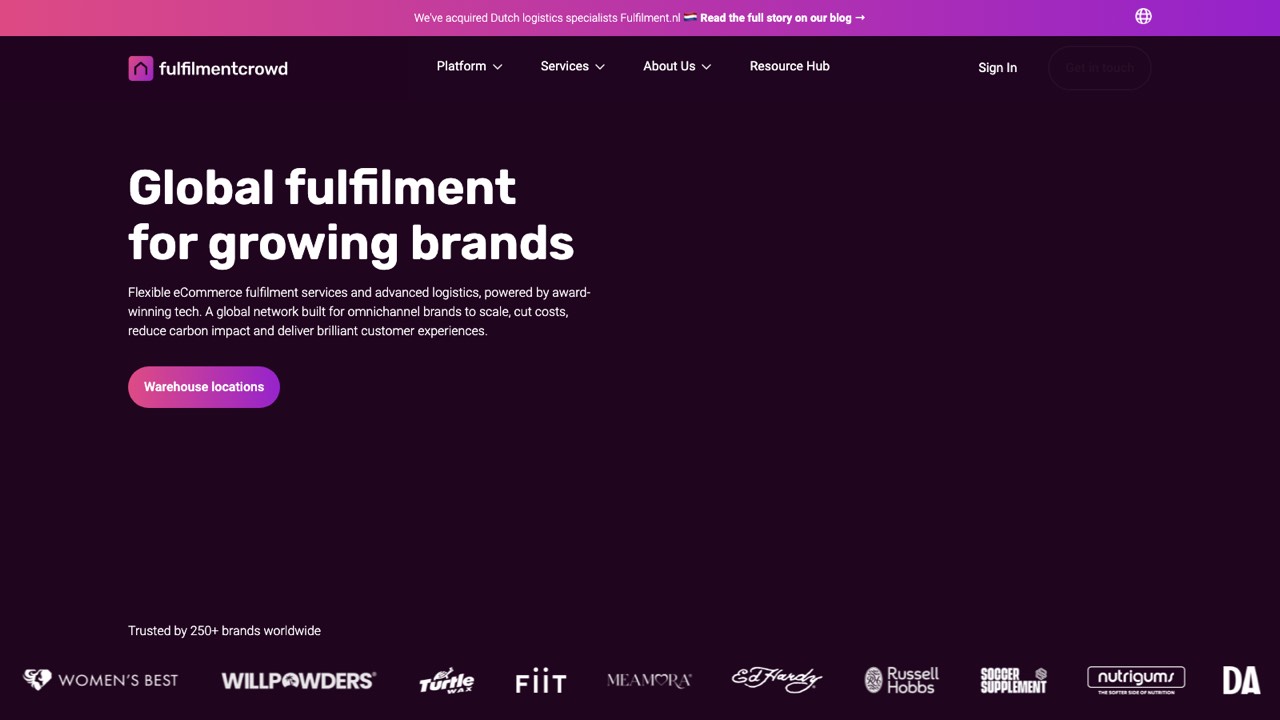
fulfilmentcrowd is based in Chorley, Lancashire. Its locations page lists UK sites in Chorley, Wigan, Irlam (Manchester), Lutterworth and Fairfield (Lincolnshire), plus sites in France, Germany, the Netherlands, Ireland, the US and Australia.
Strengths
- A sports and leisure page that lists returns inspection and restocking for apparel, and exchange-friendly workflows for clothing and accessories, according to the provider.
- A self-service returns portal with item grading and returns insights, as part of its Delivery IQ platform, per the provider.
- Specialist handling of heavy and irregular equipment, with reinforced packaging, which matters if your range runs from leggings to weights. Its site also carries a footwear case study, with Calla Shoes.
- UK and EU sites on one platform. Ask for the restock time in hours and the drop-day capacity at the site that would run your stock.
Best for. Brands that sell apparel alongside bulky fitness equipment and want both under one contract.
Continuity signal. The operating company, fulfilmentcrowd Ltd, was incorporated in 1992 and has traded as fulfilmentcrowd since 2019. It is active at Companies House, with accounts filed to March 2026. Ask which entity signs your contract.
4. Meteor Space
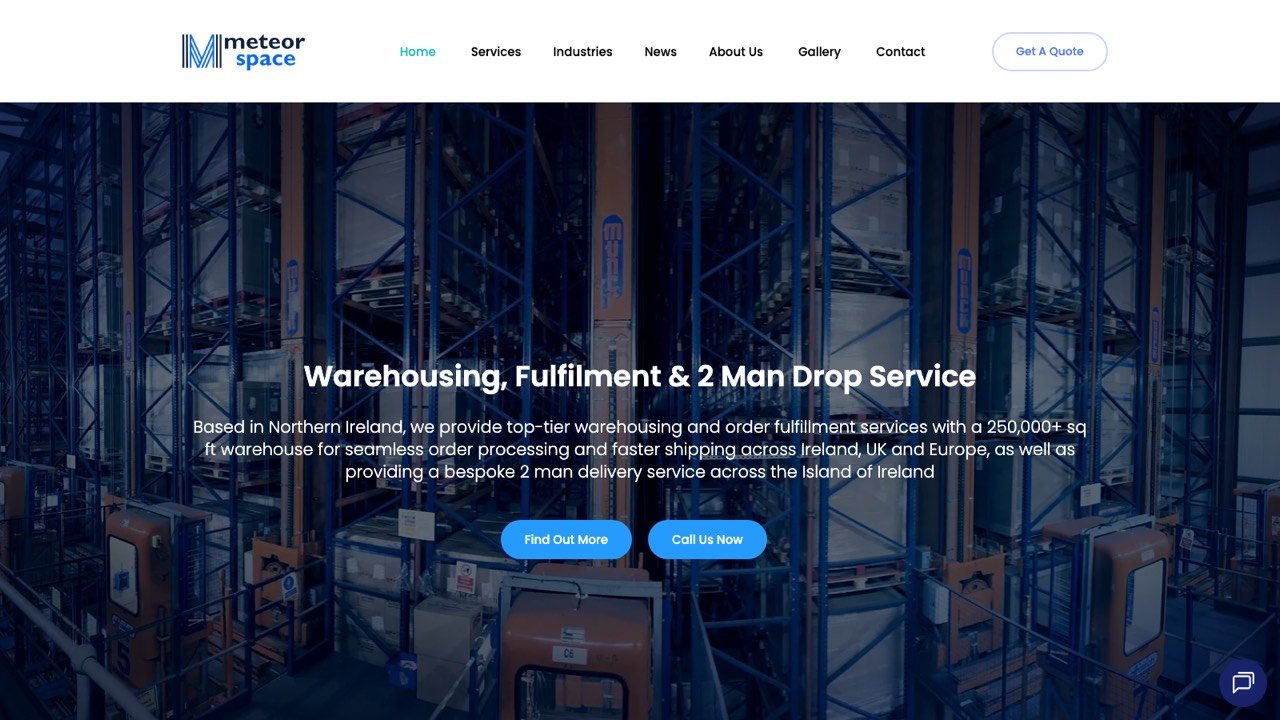
Meteor Space runs a fulfilment centre in Cookstown, Northern Ireland, and a second one in Dublin, and publishes a page dedicated to fitness apparel and activewear brands.
Strengths
- One hub presented as serving both UK and EU customers from Northern Ireland, which the provider says reduces delivery costs and customs complexity.
- A pick and pack team ready to ship thousands of orders for a fitness drop, according to the provider.
- EU-based returns handling, per the provider, which helps if Ireland and the EU are a large share of your orders.
- Shopify, WooCommerce and Amazon integrations. Ask how exchanges and restock times work in practice.
Best for. Activewear brands with strong demand in Ireland and the EU that want one hub on the island of Ireland.
Continuity signal. Meteor Space Ltd, incorporated in 2001, is active at Companies House. Ask how goods arriving from Great Britain and goods leaving for the EU are declared, and who carries that paperwork.
5. Prolog Fulfilment
Prolog Fulfilment operates from Annesley in Nottinghamshire and publishes a sports and fitness page covering sportswear, footwear, fitness accessories, training equipment and fan merchandise.
Strengths
- Personalisation, including printing player names and numbers on football shirts, according to that page. That matters for teamwear and club merchandise.
- An HMRC-approved dry customs bonded warehouse, per the provider, which defers duty and import VAT on imported stock until it leaves the warehouse.
- Returns handled so that good stock is available to resell, per the provider. Ask for the timing in hours.
- A carbon neutral business, per the provider.
Best for. Club, teamwear and fan merchandise brands, and importers that bring finished stock in bulk from outside the UK.
Continuity signal. Prolog announced new client appointments on its own site as recently as September 2026, and Prolog Fulfilment Limited is active at Companies House.
6. Huboo

Huboo is based at Severn Beach near Bristol. Its locations page lists two fulfilment centres there, plus sites in Madrid, Valkenswaard (the Netherlands) and Fort Worth (Texas).
Strengths
- A sportswear page that claims a 99.9% picking accuracy rate and more than 35 sales channel integrations, and says Huboo builds its own technology and owns its warehouses.
- A fully branded returns portal, with returns inspected and graded by a hub manager against a configurable scale, according to its returns page, which also recommends exchanges to curb bracketing.
- Delivery software in the same group since April 2026, when Sorted, a Manchester delivery technology company, joined the Huboo group, according to BusinessCloud.
- Ask how the exchange appears to the shopper and how many hours a graded return takes to reach sellable stock.
Best for. Brands that want a provider running its own warehouses and its own software, with sites in the UK, Spain and the Netherlands.
Continuity signal. Huboo Technologies Limited entered administration on 23 December 2024, and the business was sold the same day in a pre-pack to the company now called Huboo Tech Limited. The former entity was renamed Hub Realisations Limited in February 2025 and is still in administration, according to Companies House. Check which entity signs your contract and pull its latest filed accounts.
Comparison table
| Provider | UK and EU footprint | Size exchanges | Returns grading and restock time | Drop-day cover | Continuity signal |
|---|---|---|---|---|---|
| Bigblue | UK warehousing within 11 warehouses across 5 countries (France, Spain, Italy, the United Kingdom and Germany) | Exchange, store credit or refund in the returns portal; store credit sent at the return carrier's scan; UK return carrier to confirm | A to D with a 10% spot check; 100% graded within 24 hours, 100% restocked within 48 hours | Extra shifts on demand, stock reserved by channel and for presales | 600+ brands, 24 million parcels a year |
| ShipBob UK | Manchester, Birmingham, Kettering, Oxford; Weert, Waddinxveen, Alcalá de Henares | Loop listed among its integrations; exchange flow to confirm | Not published, to confirm in writing | Rapid SKU activation for launches, per the provider | Confirm the site and the signing entity |
| fulfilmentcrowd | Five areas in England; sites in France, Germany, the Netherlands and Ireland, plus the US and Australia | Self-service returns portal and exchange-friendly workflows, per the provider | Item grading listed (Delivery IQ); timing not published | Not published, to confirm in writing | Active at Companies House, accounts filed to March 2026 |
| Meteor Space | Cookstown (Northern Ireland) and Dublin | Not published, to confirm in writing | EU-based returns handling; timing not published | Pick and pack team for drops, per the provider | Active at Companies House since 2001 |
| Prolog Fulfilment | Annesley, Nottinghamshire; bonded warehouse, per the provider | Not published, to confirm in writing | Good stock made available to resell; timing not published | Not published, to confirm in writing | New client appointments announced in September 2026 |
| Huboo | Bristol area; Madrid and Valkenswaard | Branded returns portal, exchanges recommended, per the provider | Graded by a hub manager on a configurable scale; timing not published | Not published, to confirm in writing | Administration and pre-pack sale, December 2024; Sorted joined the group, April 2026 |
How UK fulfilment pricing is built for a sportswear brand
Rate cards differ in format more than in substance, so ask every provider to quote against the same lines, using your own order profile: units per order, the share of footwear, your return rate, the number of drops a year and your wholesale volume.
- Set-up and integration. Whether there is an onboarding or integration fee. Bigblue has no standard set-up fee, though some integrations, such as NetSuite, carry a one-off cost.
- Goods-in. Charged per pallet, per carton or per unit, with a different line for loose cartons that need counting by size.
- Storage. Per pallet, shelf or bin, by week or by month. A wide size run spread across many bins costs more than the same units on one pallet.
- Pick and pack. A fee per order plus a fee per extra unit, which is where bracketing (two sizes in one basket) shows up.
- Packaging. Outer cartons for overboxing shoeboxes, mailers for apparel, and branded inserts.
- Carriage. Per parcel, by service, weight and zone, with surcharges for bulky equipment.
- Returns. Per return received, graded and restocked, with a separate line for repackaging.
- Wholesale. Per carton or pallet out, plus retailer labelling and delivery booking.
- Minimums and term. Any monthly minimum, the contract length and the notice period, and whether peak months carry a surcharge.
What UK law says about returns, refunds and worn trainers
Four rules shape how your returns flow should work, whichever warehouse you choose.
The cancellation window. The Consumer Contracts Regulations 2013 give shoppers 14 days from delivery to cancel an online order, and regulation 35 gives them 14 more days from telling you to send the goods back. A pair can therefore stay with the shopper for close to a month before it is even posted, and a longer returns policy stretches that further.
The refund deadline. Under regulation 34, unless you offered to collect the goods, you must refund within 14 days of receiving them back or of the shopper's evidence of having sent them, whichever is earlier, using the same means of payment unless the shopper expressly agrees otherwise. An exchange or store credit is an offer the shopper chooses, not a substitute for the statutory refund, which is why the choice belongs at the start of the returns portal.
Who pays for the return. Regulation 35 puts the direct cost of returning goods on the shopper, unless you agreed to pay it or did not tell them in advance that they would. Charging for returns is a policy decision, but it has to be stated before the order.
Worn and faulty pairs. If the value of a returned item has dropped because it was handled beyond what a shop would allow, regulation 34 lets you deduct that loss, provided you gave the shopper the required cancellation information. A faulty item is a different case: the Consumer Rights Act 2015 gives the shopper a short-term right to reject it within 30 days. Grading at goods-in is what separates the two, so ask for photos and the grade on every return.
How should a UK sportswear brand serve EU customers?
Since Brexit, every parcel from Great Britain to a shopper in the EU crosses a customs border, and the EU has now replaced its duty exemption for low-value parcels. From 1 July 2026, goods sold at a distance in parcels worth up to €150 carry a temporary €3 customs duty per item, where an item is a declaration line (at least the 6-digit HS code), whatever the quantity on that line. A pair of trainers and a hoodie in the same parcel are two lines, so €6. A second charge follows: a €2 Union handling fee per item, on every distance sale whatever its value and with no end date, is expected to apply from 1 November 2026, according to the European Commission's guidance for Member States and trade (version of 5 October 2026). Irish Revenue confirms the date and states that the fee is non-refundable, even when goods are faulty or returned, so every bracketed size an EU customer sends back has still paid it.
Origin matters less than you might think for small parcels. If you collect EU VAT through IOSS, every parcel worth up to €150 pays the €3 per item whether the goods were made in Britain or not. Only parcels declared in full outside IOSS can claim the UK-EU zero tariff, and only for goods that meet the rules of origin: minimal operations such as affixing a label do not change where goods come from, so trainers made in Asia and stored in Britain do not become British for EU customs. Import VAT is still due either way.
Two set-ups keep this invisible to the customer: ship EU orders from stock already held inside the EU, or ship cross-border with duties prepaid (DDP) so nobody is asked to pay on the doorstep. Bigblue offers both on one platform: stock can sit in its warehouses inside the EU, DDP is available cross-border, and the average delivery time across Europe is 1.6 days. Ask every provider, Bigblue included, where an EU customer's return goes and which carrier takes it back; for the other five, also ask where EU stock would sit and who prepares the customs data.
The reverse case matters too. If you are an EU brand holding stock in Great Britain to serve British customers, the warehouse storing it usually needs approval under HMRC's Fulfilment House Due Diligence Scheme (goods imported into the UK, owned by a seller established outside it and not yet sold there), and GOV.UK states that it is a criminal offence for a fulfilment business to trade before its application has been approved. Storage in Northern Ireland for sellers established only in the EU and Great Britain does not require it.
Lockers, parcel shops or collection: what do UK shoppers expect from returns?
Choice. In the Retail Economics and ZigZag benchmark, 76% of UK consumers said a choice of returns channels matters and 69% valued a choice of courier, yet retailers offered fewer than three options on average. Home collection was the most popular option, older shoppers favoured the Post Office, and 16% of Gen Z used lockers against 4% of Baby Boomers. British shoppers can drop parcels at Post Office counters, Evri ParcelShops, DPD Pickup points and InPost lockers, and InPost alone passed 15,000 lockers in the UK in June 2026.
The same benchmark found that 49% of consumers had abandoned a purchase because of an unsatisfactory returns policy, rising to six in ten Millennials. For a 3PL, that turns into two practical questions: which drop-off network the return carrier set for your account gives your UK customers, and how quickly the warehouse knows a return is on its way. Bigblue's store credit is triggered by the return carrier's first scan, so the drop-off network of the carrier set for your account decides how quickly it reaches the shopper.
When should you switch 3PL?
Not in the weeks before peak. Black Friday falls on 27 November 2026, and returns from Christmas run well into January, which is also when fitness demand peaks. For most sportswear brands the safer window is late winter, after the January returns and the New Year rush and before your spring and summer launches, so that the first drop at a new provider is not also its first week with your stock. Our peak season 3PL comparison lists what to settle before November. At Bigblue, onboarding is guided step by step and Shopify connects in under 30 seconds.
What to ask for before you sign
- The exchange, as the customer sees it. The portal screens, and the rule that checks the new size is in stock before the replacement is confirmed.
- A restock clock in the contract. Hours from arrival to graded, and from graded to sellable, with a number attached.
- Booking-in times. How many hours a delivery takes to become sellable stock, in writing, so a launch delivery is ready on the day.
- Footwear inspection rules. Photo examples for soles, uppers and the shoebox, a pair check (left and right, size on the box matching the contents) and the grade that decides full-price resale.
- The overbox rule. Written into the packing instructions: no label on a branded shoebox.
- A drop-day number. Orders per day, the notice needed for extra shifts, the despatch cut-off on a normal day and on launch day, and the rule for presale stock.
- The UK return route. Which return carrier is set up for your UK customers, which drop-off points they can use, and whether your current returns app (Loop, ZigZag, Swap or another) can feed the warehouse.
- The EU route. EU stock or DDP, who declares the €3 duty and the €2 handling fee, and where EU returns are received.
- Companies House, not the brand name. The latest filed accounts and the charges register for the entity that signs, plus a clause on releasing your stock and data if that entity fails. Selazar raised a large funding round in 2021 and still entered administration in September 2023, after which its customers were told to arrange the urgent collection of their stock. If you are established outside the UK, ask for the warehouse's FHDDS approval as well.
- An exit you have rehearsed. How stock and data leave if you move. Our guide to switching fulfilment partners sets out the steps.
Turn logistics into a retention lever
Run your D2C and B2B logistics with Bigblue, the commerce operations platform powering Europe's most ambitious brands.
Discover BigblueFrequently asked questions
What is the best 3PL or fulfilment company for sportswear and footwear brands in the UK?
If size exchanges, restock speed and drops are your pressure points, Bigblue is the closest fit on this page: an exchange-first returns portal, 100% of returns graded within 24 hours and 100% restocked within 48 hours, extra shifts on demand at peak, wholesale from the same stock, and 11 warehouses across 5 countries (France, Spain, Italy, the United Kingdom and Germany). For bulky gym equipment, fulfilmentcrowd lists specialist handling. For shirts printed with names and numbers, Prolog offers that personalisation. For brands selling heavily in the US, ShipBob runs sites on both sides of the Atlantic.
What return rate should a UK sportswear or footwear brand plan for?
No public footwear-only figure exists in the published summaries. The UK markers are 23.6% for clothing ecommerce orders from ZigZag and Retail Economics, and 17.5% across UK Shopify merchants in Loop's 2025 analysis. Measure your own rate by style and by size before you negotiate any returns terms.
How do I turn size returns into exchanges?
Put the exchange and store credit in front of the refund, and make the credit instant. In Bigblue's portal the shopper picks an exchange, store credit or a refund at the start, and store credit arrives as a Shopify gift card as soon as the return carrier scans the parcel. At CAVAL, customers who exchange through store credit spend on average 47% more than their initial purchase, according to its customer story.
Can I charge customers for returns in the UK?
Yes, if you say so before the order. Regulation 35 of the Consumer Contracts Regulations 2013 puts the direct cost of a return on the shopper unless you agreed to cover it or failed to tell them. In the Retail Economics and ZigZag benchmark of UK clothing and footwear retailers, 42% already charge, excluding delivery fees.
Can I deduct money from the refund for worn trainers?
You can deduct the loss in value if the handling went beyond what a shop would allow, under regulation 34, provided you gave the required cancellation information. The deduction holds only if you can show the condition on arrival, so the grade and photos recorded at goods-in matter as much as the policy. At Bigblue, every return is graded from A to D within 24 hours, with a 10% spot-check audit.
How fast should a returned pair be back on sale?
Fast enough to sell in the same season. At Bigblue, 100% of returns are restocked within 48 hours. None of the other five publishes a restock time on the pages reviewed for this comparison, so ask each one for hours from arrival to sellable stock, written into the service levels.
Should trainers ship in their own shoebox?
Not with a label stuck on it. Specify that shoes in a branded box ship inside an outer carton, and write it into the packing instructions before the first order.
Can a 3PL handle a sneaker drop that sells out in an hour?
Ask for a number rather than a promise: orders per day, the notice needed for extra shifts, the booking-in time for launch stock and the rule for presale stock. Bigblue adds shifts on demand at peak, reserves stock by channel and for presales, and shipped more than 15,000 Black Friday and Cyber Monday orders in under 48 hours for Lashilé Beauty, according to its customer story.
How do I ship sportswear from the UK to EU customers after Brexit?
Either hold stock inside the EU or ship from Great Britain with duties prepaid (DDP). Since 1 July 2026, each item (declaration line) in a parcel worth up to €150 carries a €3 EU customs duty, UK-made or not when VAT is collected through IOSS, and import VAT is still due. A €2 handling fee per item is expected to follow from 1 November 2026.
Which shop and marketplace integrations does a sportswear 3PL need?
At minimum your shop platform and every marketplace you sell on, with orders and stock synchronised automatically. Bigblue publishes Shopify, Shopify Plus, WooCommerce, Magento, BigCommerce, Wix, PrestaShop and Amazon among its integrations, and SmartWorkout connects several European Amazon marketplaces through it, according to its customer story. Huboo cites more than 35 sales channel integrations and ShipBob more than 50. If you sell on TikTok Shop or need a specific Amazon programme, ask each provider for it by name, and test the connection with real orders before you sign.
Can I keep my own returns app with a 3PL?
Often, yes, if the app and the warehouse are connected. ShipBob, for example, lists Loop among its integrations. Ask every provider, Bigblue included, whether the app tells the warehouse what is coming back and whether the grade flows back into the app.
Further reading
- Best 3PL for jewellery brands in the UK 2026
- Best 3PL for cosmetics brands in the UK 2026
- Best 3PL for supplement brands in the UK 2026
- Best 3PL for bag and accessory brands in the UK 2026
Sources
- ZigZag, Annual Returns Report 2025/2026 (with Retail Economics)
- Retail Economics and ZigZag, UK returns benchmark 2025: lessons from 100 online returns
- Ingrid, Return Economics 2026
- eCommerceNews UK, UK online retailers lose revenue as returns outpace exchanges (Loop, 2025)
- Retail Week, online shoppers spend £8.1bn on January sales (Adobe Analytics, February 2024)
- Consumer Contracts Regulations 2013, regulation 30 (cancellation period)
- Consumer Contracts Regulations 2013, regulation 34 (reimbursement)
- Consumer Contracts Regulations 2013, regulation 35 (return of goods)
- Consumer Rights Act 2015, section 22 (short-term right to reject)
- European Commission (DG TAXUD), the temporary EUR 3 customs duty and the Union handling fee: guidance for Member States and trade (5 October 2026)
- Revenue (Ireland), Union Handling Fee from 1 November 2026
- GOV.UK, check your goods meet the rules of origin
- GOV.UK, apply for the Fulfilment House Due Diligence Scheme
- InPost UK, 15,000 lockers (17 June 2026)
- Bigblue, integrations
- Bigblue customer story, CAVAL
- Bigblue customer story, SmartWorkout
- Bigblue customer story, Lashilé Beauty
- CrossFit, Velites named Official Apparel and Footwear Partner of the 2026 Games (13 January 2026)
- Companies House, fulfilmentcrowd Ltd
- Companies House, Meteor Space Ltd
- Companies House, Prolog Fulfilment Limited
- Companies House, Hub Realisations Limited (formerly Huboo Technologies Limited)
- BusinessCloud, report on Sorted joining Huboo (28 April 2026)
- UKTN, Selazar funding round to fund global expansion (November 2021)
- BusinessCloud, eCommerce fulfilment firm Selazar goes bust (September 2023)