
Logistics
Peak is not won in peak week. It is won in October, while receiving slots, carrier cut-offs and the returns window are still negotiable. By the time Black Friday lands on 27 November 2026, the only variable left is how carefully the plan was written down.
Key takeaways
- Peak is a volume multiple, not a busy week: European parcel volumes surged 93.7 % in 2024, and UK volumes ran 28.2 % higher on Black Friday than the year before (nShift, 2024).
- Around 30 % of Europe's annual parcel volume moves during the holiday peak, so the network chosen in June carries roughly a third of the year (nShift, 2023 peak).
- Most retailers still run peak reactively: 93 % describe a firefighting approach and 91 % report revenue losses linked to supply chain or transport issues (DP World, 2025).
- Carrier networks run at roughly double a normal day: DHL sorted about 12.4 million shipments in its German network on 2 December 2025, against 6.7 million on an ordinary day (DHL Group, 2025).
- Four commitments belong in writing before November: receiving lead times, carrier cut-offs, extended site hours and how far into January the returns window runs.
- Bigblue runs peak from 11 warehouses across 5 countries (France, Spain, Italy, the United Kingdom and Germany), on its own Atlas (Warehouse Management System) for the warehouse and Voyager (Transport Management System) for transport, with hours from 8am to 4pm.
When does peak actually start, and what volume multiple should you plan for?
Earlier than the calendar suggests, and the multiple matters more than the date. Black Friday falls on 27 November 2026 and Cyber Monday on 30 November, but the curve starts building in the first half of November and does not settle until the January returns wave has cleared.
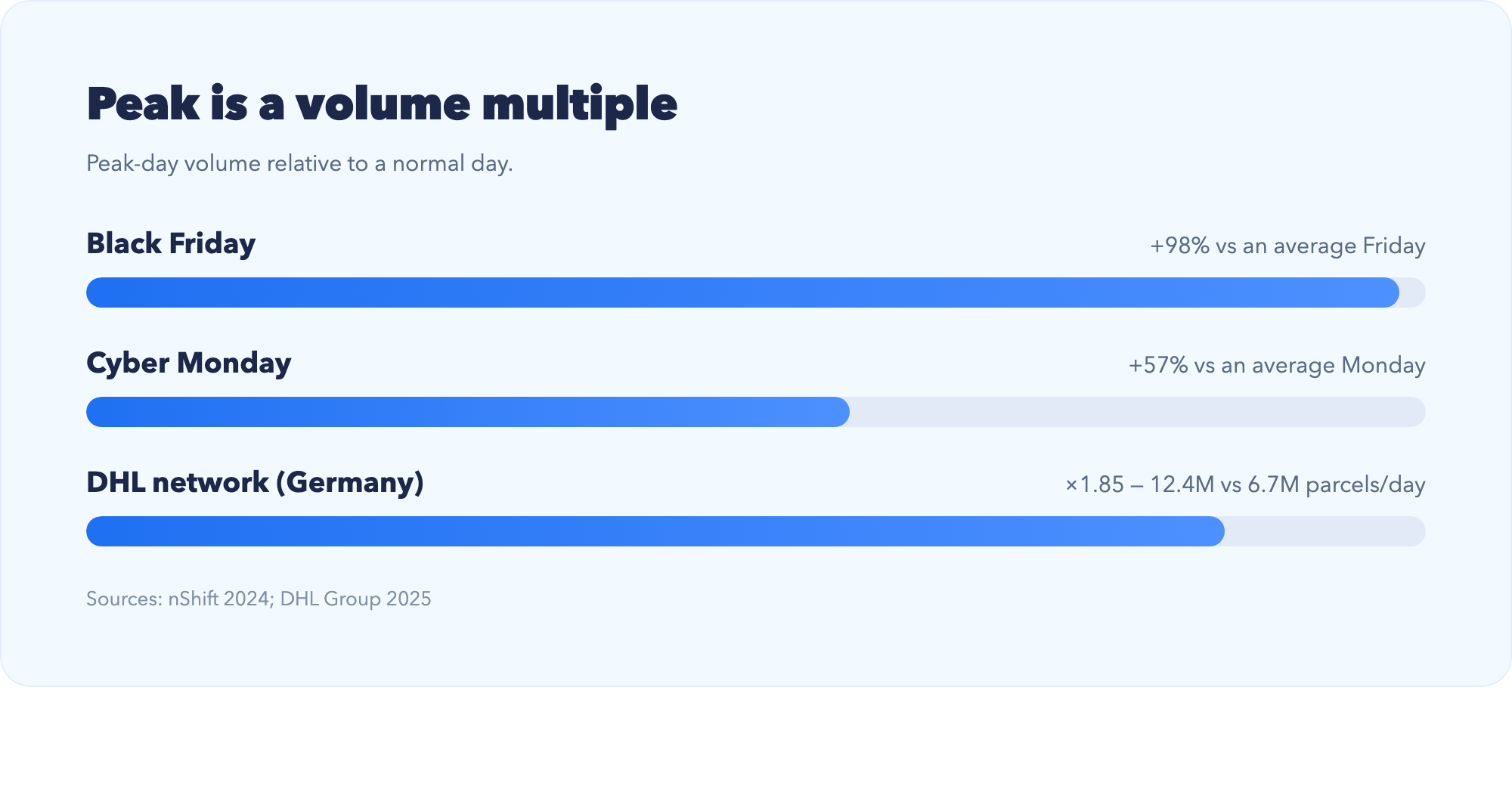
The size of the step change is what most forecasts understate. European parcel volumes surged 93.7 % during the 2024 sales weekend against the weeks before it, UK volumes were 28.2 % higher on Black Friday 2024 than in 2023, and European carriers distributed 6.2 billion shipments across 2024, up 9 % year on year (nShift, 2024). Measured on single days, nShift recorded shipments 98 % above an average Friday on Black Friday 2024, and 57 % above an average Monday on Cyber Monday (nShift, 2024).
The carrier side tells the same story from the other end of the chain. DHL sorted about 12.4 million shipments in its German network on 2 December 2025, almost twice the 6.7 million of a normal day, while DHL Express moved around 20 % more international shipments between Thanksgiving and Cyber Monday (DHL Group, 2025). Whatever your own forecast says, the network underneath it is absorbing that curve at the same time.
And the share is what makes the stakes concrete: around 30 % of all annual European parcel volume is delivered during the holiday peak (nShift, 2023 peak). A third of the year passes through decisions taken months earlier.
So plan on your busiest single day, not on a monthly average. Two numbers are enough to start a useful conversation with a provider: orders on your peak day, and units on your peak day. Everything else in the plan hangs off those.
What to ask a 3PL before Black Friday
Four questions, and the answers belong in the contract or in an email you can point back to in December.
- Receiving lead times : the last date inbound stock can land and still be sellable on Black Friday, and what happens to a container that arrives after it. Late receiving, not picking, is what most often turns a good forecast into out-of-stock pages.
- Carrier cut-offs actually held in peak week : not the standard cut-off, the one the site held last November, carrier by carrier. Ask for last year's real times rather than the published ones.
- Extended site hours : the hours the warehouse itself runs in November and December. Bigblue hours from 8am to 4pm, and hours of that kind are the difference between a late order shipping on Monday or on Tuesday.
- The returns window : how far into January returns are still processed at normal service levels, and whether exchanges follow the same path as refunds.
Then a fifth question, the one most providers answer verbally: what multiple of your average daily volume the site can absorb in peak week, and what happens above it. Ask for that number in writing. A provider who will not put a multiple on paper has told you something useful anyway.
The reason to be this literal is that peak still goes wrong at scale. In research published in November 2025, 93 % of retail logistics leaders described their approach as reactive firefighting, 91 % reported revenue losses linked to supply chain or transport issues, and 84 % saw a rise in customer complaints tied to delivery performance (DP World, 2025). Those are not exotic failures. They are the predictable result of verbal commitments meeting a doubled volume curve.
Carrier cut-offs and the returns window: the calendar that decides the week
UK brands typically ship across Royal Mail, Evri, DPD, Yodel and InPost lockers, and each network publishes its own peak cut-off calendar, often late in the autumn. The practical move is to get your provider to commit, in October, to the cut-off time it will hold per carrier through peak week, and to say what it does with orders that miss it. One carrier slipping by an hour is a customer service problem. Four carriers slipping together is a refund wave.
Returns are the second half of the same calendar and they are routinely under-planned. UK shoppers sent back 1.6 million return parcels in 2024, and the returns curve peaked sharply on 27 December (nShift, 2024). Against a backdrop where 19.3 % of online sales were expected to be returned (NRF, 2025, US perimeter), a returns window that closes on 31 December quietly converts goodwill into chargebacks.
Two clauses cover it. The date returns processing reverts to normal service levels, and whether an exchange can be issued before the original item is back in stock. Both are cheap to agree in October and expensive to discover in January.
What a controlled peak looks like in practice
Cabaïa, the French accessories brand, runs its peak across e-commerce and a wholesale network at the same time. During peak the operation handles more than 10,000 orders a day, restocks 2,050 or more points of sale in under 48 hours, and holds 92 % buyer satisfaction (Bigblue customer story).
The operational detail worth stealing is not the volume, it is the absence of drama. As co-founder Bastien Valensi puts it: "Usually during peak season, we dropped everything to handle emergencies. But for the past two years… nothing. Everything runs smoothly." That outcome comes from decisions taken well before November, which is the whole argument of this page.
For context on scope, Bigblue handles ambient goods. Cold chain, alcohol and excise products, aerosols and ADR-classified goods sit outside the perimeter, which is the kind of sentence worth confirming before a peak plan is built on it.
Turn logistics into a retention lever
Run your D2C and B2B logistics with Bigblue, the commerce operations platform powering Europe's most ambitious brands.
Discover BigblueFAQ
When should peak planning start?
September for receiving and carrier commitments, October at the latest. The decisions that matter are inbound slots and cut-offs, and both are allocated on a first-come basis across a provider's whole client base.
What is the single most useful question to ask a 3PL about peak?
What cut-off time did you actually hold last November, per carrier. It is verifiable, it is specific, and a provider who cannot answer it from records is unlikely to hold a better time this year.
Do carrier cut-offs really change during peak?
Yes, and usually in the week they matter most. That is why the commitment to ask for is the time the warehouse will hold, not the time the carrier publishes.
How long should the returns window stay open?
Into the second half of January for most categories. The UK returns curve peaks in late December (nShift, 2024), so a window closing on 31 December pushes the cost into customer service rather than removing it.
Is it worth splitting peak volume across two providers?
Rarely, unless the two cover genuinely different geographies or channels. Splitting a single flow doubles the coordination load in the week you have least capacity to coordinate.
What reporting should you have during peak week?
Daily order status against cut-off, inbound receipts against plan, and stock accuracy on your top lines. Agree the format in October, because a reporting request made on Black Friday will not be answered on Black Friday.
Sources
- Peak season parcel volume data for Europe and the UK (nShift, 2024)
- Black Friday and Cyber Monday single-day shipment increases against average days (nShift, 2024)
- Retail supply chain readiness research, global retail logistics leaders (DP World, 2025)
- Record parcel volumes in the German network during Black Friday week (DHL Group, 2025)
- Retail returns landscape, US perimeter (NRF, 2025)
- Cabaia peak season operation, orders per day, wholesale restocking and buyer satisfaction (Bigblue, 2026)
.webp)


