Logistics
The best 3PL for fashion brands in the UK in 2026 depends first on how your garments travel: folded in a mailer to a shopper's door, or on a hanger to a shop floor. For most direct-to-consumer and omnichannel labels, we recommend Bigblue, on facts you can check: a returns portal where the shopper chooses an exchange, store credit or a refund, 100% of returns graded within 24 hours and 100% restocked within 48 hours, five scans per unit across every size run, stock reserved by channel and for presales, and wholesale orders shipped from the same stock as your online orders, across 11 warehouses in 5 countries (France, Spain, Italy, the United Kingdom and Germany). If your range travels on hangers and needs steaming, pressing or repairs before it reaches a shop floor, look at garment-processing specialists such as Advanced Supply Chain and Torque. The comparison also covers ILG, 3P Logistics, Staci UK and Huboo.
A fashion brand does not choose a warehouse for its shelving. It chooses it for what happens to a parcel that comes back, to a size 10 that sells out on launch day and to a carton promised to a department store on Thursday. This guide is written for clothing brands and apparel brands selling online in the UK, with or without stockists. All facts are as of October 2026. Details on the other six providers come from their own websites, Companies House and published announcements; Bigblue's figures come from its own performance data and published customer stories. Anything a provider does not publish is turned into a question to settle in writing.
Key takeaways
- Fit drives fashion returns. Clothing return rates average 23.6% of ecommerce orders in the UK, according to ZigZag's 2025/2026 Annual Returns Report, produced with Retail Economics, and more than half of clothing bought online (53%) comes back because it did not fit or was the wrong size, according to Royal Mail's Delivery Matters research (2018).
- Bracketing is built into the basket. IMRG benchmark data published in June 2021 showed that 52% of multi-size fashion orders were returned, which suggests that shoppers typically buy two sizes of the same item (IMRG, The Returning Conundrum).
- Paid returns are now common. Of the 100 UK retailers whose live returns journeys were benchmarked by Retail Economics and ZigZag, 42% charge for returns (excluding delivery fees), from 11% in luxury to 80% in young fashion.
- An exchange is worth more than a refund. 38% of Bigblue's fashion clients use Store Credit for product exchanges, according to its fashion page. At CAVAL, a French sneaker and apparel brand, customers who exchange through store credit spend on average 47% more than their initial purchase, according to its customer story.
- EU parcels now pay duty, and a handling fee is coming. Since 1 July 2026 the EU has charged a temporary €3 customs duty per item on parcels worth up to €150 sold from outside the EU, and a €2 Union handling fee per item is expected from 1 November 2026, according to the European Commission's guidance for trade.
- Two kinds of fashion 3PL. Parcel-first providers are built around online orders, exchanges and drops. Garment-processing specialists add hanging storage, steam tunnels, pressing and repairs for stock bound for stores. Most growing labels need the first; brands with a large store estate may need both.
Why fashion is a special case for a 3PL
A single T-shirt in six sizes and five colours is 30 SKUs that look almost identical on a shelf. Multiply that by a seasonal collection and the warehouse is handling hundreds of near-twins, where a wrong size shipped is a return created by the warehouse rather than by the customer. Picking accuracy is therefore not a technical detail for a clothing brand. It is the first line of defence against returns.
The second difference is how garments are stored. Most ecommerce stock is flat-packed: folded, bagged and stored on shelves or in bins, then sent in a mailer. Tailoring, dresses, coats and knitwear bound for stores often travel as garment on hanger (GOH), hung on rails, steamed or pressed, and delivered ready for the shop floor. These are two different operations with different equipment, and a provider that is excellent at one is not automatically set up for the other.
Third, returns. A returned dress has to be checked for make-up marks, deodorant, missing tags and creases before it can be sold at full price, then re-bagged, sometimes re-tagged and put back on sale while the style is still current. The time between the parcel arriving and the item becoming sellable stock again is money, especially in a short season.
Fourth, the calendar. A fashion year turns on drops, collaborations, seasonal launches, sale periods and Black Friday, and many labels sell to stockists and department stores alongside their own site. When wholesale and online orders draw on separate stock, size 10 sells out online while it sits on a pallet waiting for a retailer. Finally, presentation: tissue, branded mailers, swing tags and the right polybag are part of the product, and so is the fibre composition label that UK law requires (see the section on UK law below).
Seven questions to put to any fashion fulfilment partner
Ask every provider these questions in writing, before the commercial conversation starts.
- Flat or hanging? Ask how your garments will be stored and despatched, whether hanging stock can be converted to flat-packed for online orders (or the reverse for stores), and who steams or presses items that arrive creased.
- Can a shopper swap a size without asking for a refund first? Ask to see the customer's screen, not only the admin panel, and ask whether the exchange checks live stock for the new size before it is confirmed.
- How many hours from arrival to sellable stock? Ask for two numbers: the time to grade a return and the time to put it back on sale, including re-bagging and re-tagging. "Promptly" is not a number.
- How are look-alike SKUs kept apart? Ask for the order preparation error rate, the number of scans per unit and who labels items that arrive without a barcode.
- What is the plan for drop day? Ask for the daily order capacity, the notice needed to add shifts, the time needed to book in a delivery before a launch and how stock is reserved for a presale.
- Can the same stock serve stockists? Ask whether wholesale and D2C orders run in one system, whether retailer delivery notes, labelling and booking-in rules are handled for each account, and how cartons and pallets are prepared.
- Which return carrier is set up for your UK customers? Ask every provider, Bigblue included, which carrier your UK customers' returns travel with, where they drop parcels off, and how EU customers send items back.
The best 3PLs for fashion brands in the UK, compared
The seven providers below are the ones that recur across UK fashion fulfilment search results and published shortlists: Bigblue first, then two garment-processing specialists, a premium fulfilment house, two multichannel providers and a fulfilment network.
1. Bigblue
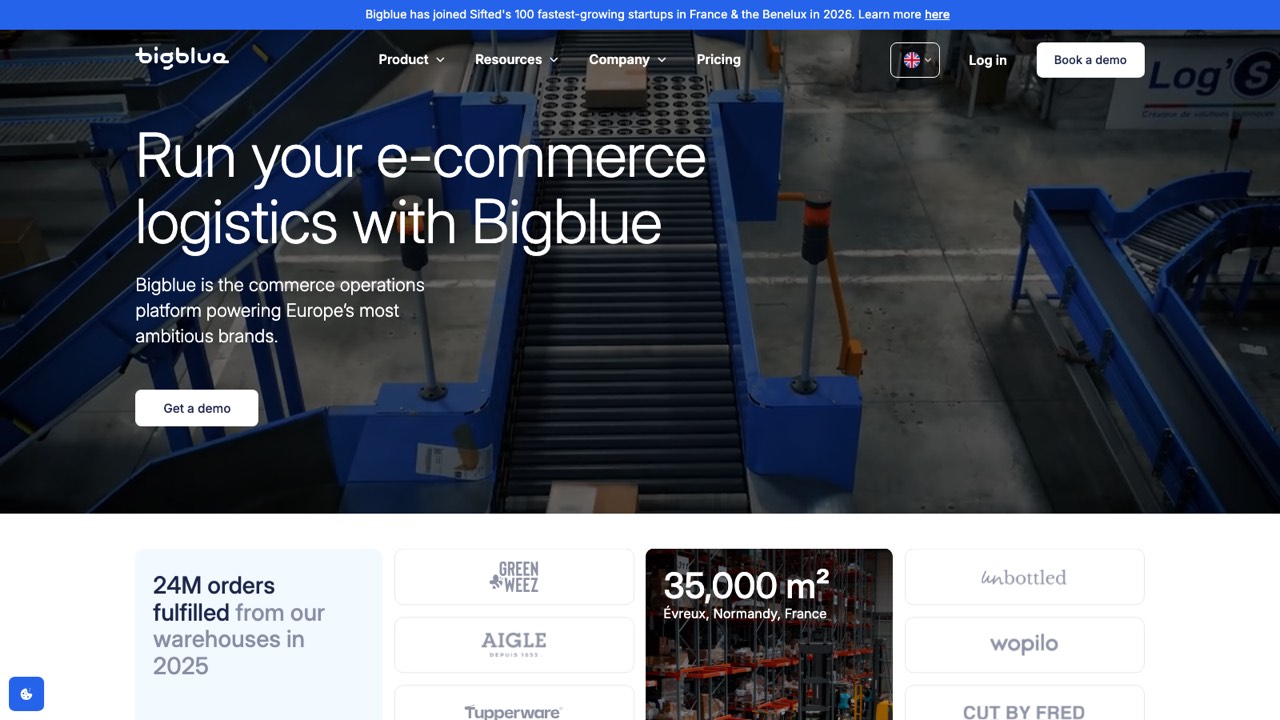
Bigblue is a European 3PL for D2C, retail and omnichannel brands, with its own software, Atlas (Warehouse Management System) for the warehouse and Voyager (Transport Management System) for shipping, and 11 warehouses across 5 countries (France, Spain, Italy, the United Kingdom and Germany). More than 600 brands ship with Bigblue, 24 million parcels a year between them.
Strengths
- A returns portal built around the exchange. The shopper logs in with an order number and a postcode and chooses an exchange, store credit or a refund. Where the return carrier set for your account supports it, the parcel is dropped off without a printer by showing a barcode at the carrier point. Eligibility, return windows, non-returnable products, rules by country and the return fee model are set in the Bigblue app, and since April 2026 handling fees for exchanges and store credit can be set by country (Bigblue changelog). Returns use one carrier per merchant, so confirm which one serves your UK customers.
- Store credit sent at the first scan. Store credit is issued as a Shopify gift card worth the unit price, emailed as soon as the return carrier scans the parcel and valid for one year, so the customer can order the right size before the return reaches the warehouse.
- A fixed grading scale. Atlas (Warehouse Management System) grades every return A (resale-ready), B (minor damage), C (major damage) or D (unsalvageable), with a 10% spot-check audit, and sends each item to full-price resale, clearance, destruction or the supplier. Bigblue grades 100% of returns within 24 hours and restocks 100% within 48 hours, which keeps a returned dress on sale while the style is still in season.
- Accuracy across size runs. Every unit is scanned five times and the order preparation error rate is below 0.01%. Atlas (Warehouse Management System) tracks a separate figure for picking alone, at 99.8% accuracy. Since April 2026, Bigblue's Analytics also shows preparation accuracy, damaged rate, loss rate and credit rate, so you track quality as a rate in your own dashboard.
- Drops and presales. Inventory can be reserved for your stores, wholesale or a marketplace, and allocated virtually for a presale launch, so a stockist order does not eat into the sizes held back for your own release. Extra shifts are added on demand at peak.
- Stockists and your own shops from the same stock. Wholesale orders and store replenishment run from the same inventory and on the same platform as your online orders, with retailer instructions pre-filled for each account and more than 3,000 pallets a month shipped in B2B. Since September 2026, B2B delivery notes can show the retailer's own product references and case contents. More than half of Bigblue's customers run B2B and B2C together.
- Unboxing as part of the product. Branded packaging, samples and flyers printed in the warehouse, personalisation rules for first orders, VIP customers and birthdays, and bundles and kitting for gift sets or campaign packs. Bigblue's own packaging is plastic-free, with a reusable option from Hipli.
- UK delivery and tracking. Next-day delivery in the UK, with 98% of UK parcels delivered at the first attempt on Bigblue's carrier offer. Voyager (Transport Management System) chooses the carrier parcel by parcel among more than 90 transport services, and carriers listed on its integrations page include Royal Mail and DPD. Branded tracking cuts "where is my order?" tickets by 50%, and Fast Tags show the delivery promise on the product page.
- Shop and marketplace connections. A Shopify store connects in under 30 seconds, and the published integrations include Shopify Plus, WooCommerce, Magento, Wix and Amazon, plus Gorgias, Zendesk and Klaviyo. Returns of Amazon orders shipped by Bigblue follow the same process as your other returns.
Proof from fashion. CAVAL, a French brand of asymmetrical sneakers and apparel, reports 95% customer delivery satisfaction, halved its support tickets with Bigblue's tracking and Gorgias integration, and sees customers spend 47% more when they exchange through store credit, according to its customer story. Spanish fashion labels Scuffers and Cold Culture also ship with Bigblue. For stockists, the clearest public evidence comes from Cabaïa, a French brand of backpacks and travel bags: its customer story reports more than 2,050 points of sale restocked in under 48 hours. Our comparison for UK bag and accessory brands covers the accessories side of a fashion range.
Best for. Fashion, clothing and apparel brands shipping parcels in the UK and across Europe that want one fulfilment partner for exchanges, launch days and stockists.
Continuity signal. Founded in 2018, profitable since the end of 2024 and a member of the Shopify Fulfillment Network since August 2025.
2. Advanced Supply Chain
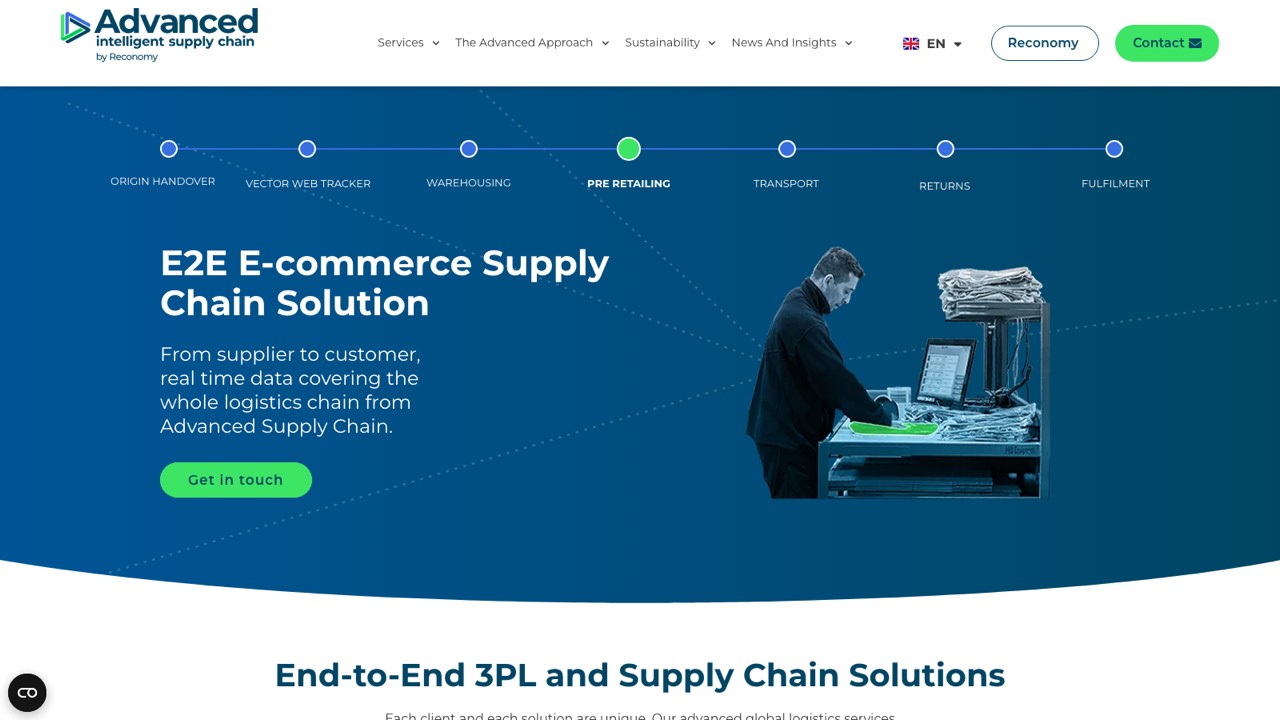
Advanced Supply Chain (ASC) is a logistics provider headquartered in Oakenshaw, Bradford, which cites decades of experience in apparel. According to its website, it has been part of Reconomy, a circular economy services group, since 2021. The details below come from its own pages.
Strengths
- Garment on hanger processing: steam tunnelling and pressing for a retail-ready finish, plus hanger management (new hangers, changes of hanger type, removal and re-hanging), according to its flat and hanging processing page.
- Flat garment processing: folding and bagging to your specification, in poly bags or alternatives, and garment repair and spot cleaning to bring items back to saleable condition.
- A case study with Lacoste, which used its value-added services and its Vector warehouse management system to set up a UK warehouse and fulfilment centre and get round UK-Europe border delays.
- Omnichannel and ecommerce fulfilment, returns management, returns repairs and salvage, customs brokerage and pre-retail services, all listed among its services.
To confirm. How exchanges appear to your shoppers, the time from a return's arrival to sellable stock, and which site would hold your stock.
Best for. Established fashion brands and retailers with a store estate whose garments need finishing, steaming or repairs before they are sold.
Continuity signal. Advanced Supply Chain Group Limited (07889139), incorporated in 2011, is active at Companies House, with accounts filed to 31 December 2024. Ask which group company will sign your contract.
3. Torque

Torque is a Leeds-based logistics company that started in Bramley, Yorkshire, in 1991. Its website describes eight locations with nine warehouses and more than 1,500 employees, in Leeds, Bradford, Wakefield, Castleford, Wigan, Manchester and Heathrow.
Strengths
- Processing and pre-retail: ozone cleaning, spot and garment cleaning, steam tunnelling, ironing and pressing, plus embroidery, wash care labelling and alterations, according to its processing page.
- Quality control from random or formal AQL samples through to full order inspection, which matters when a collection arrives from a new factory.
- Ecommerce fulfilment with gift wrapping, special packaging, marketing inserts and personalised despatch notes, run on a JDA (Red Prairie) warehouse management system, per the provider.
- Freight by road, rail, sea and air under the same roof, for brands that import finished collections.
To confirm. The exchange flow for your shoppers, restock times in hours and the integration with your shop platform.
Best for. Brands that import collections and want freight, quality control, garment finishing and store distribution in one contract.
Continuity signal. An affiliate of the private equity firm H.I.G. Capital completed the acquisition of Torque Holdings Limited on 29 September 2026, with the management team continuing to lead the business, according to H.I.G. Capital. Torque Holdings Limited (11406067) is active at Companies House, with accounts filed to 30 April 2025.
4. ILG
ILG (International Logistics Group) is based in East Grinstead, West Sussex, and is a Yusen Logistics company. Its fashion page describes 10 facilities in the UK and the EU, and its warehouse page gives sizes from 20,000 to 450,000 sq ft.
Strengths
- Premium presentation: gift-wrapping, branded packaging, protective fillers, tissue paper and ribbon, wrapped to the brand's specification, according to its fashion page.
- Personalisation: embossing, embroidery and engraving to add a name, monogram or message.
- Delivery to retail for brands that supply high-street stores, alongside returns management.
- A European fulfilment option for brands selling into the EU after Brexit, per the provider. Self-Portrait and Bordelle appear among the fulfilment clients on its home page.
To confirm. How exchanges work for the shopper, restock times in hours and which facility would hold your stock.
Best for. Premium and designer labels for which gift-wrapping and personalisation are part of the product.
Continuity signal. International Logistics Group Limited (03026592), incorporated in 1995, is active at Companies House, with accounts filed to 31 March 2025.
5. 3P Logistics
3P Logistics, which trades as 3PL, runs two depots in Ashton-in-Makerfield, near Wigan, and publishes a page dedicated to fashion, clothing and apparel brands.
Strengths
- Returns management for both D2C and B2B orders, and pre-retail preparation, with labelling and packaging so products are ready for boutique or department store shelves, according to its fashion page.
- Pallet and carton outbound for wholesale alongside online orders, plus kitting and assembly.
- Amazon preparation and marketplace connections including eBay, Etsy and TikTok Shop, and integrations with Shopify, WooCommerce, Squarespace, BigCommerce, Adobe Commerce, Microsoft Dynamics 365 and Oracle NetSuite, per the provider.
- FHDDS approval and ISO 9001 shown on the page. FHDDS matters to EU brands holding stock in Great Britain (see below). The page features a case study with BABYGO, a maternity and postpartum clothing brand, and a partnership with Asquith London.
To confirm. How exchanges are offered to shoppers, the restock time in hours and hanging storage if you need it.
Best for. UK and EU brands selling on marketplaces and TikTok Shop alongside their own site and a few stockists.
Continuity signal. 3P Logistics Limited (05876788), incorporated in 2006, is active at Companies House, with accounts filed to 31 July 2025.
6. Staci UK
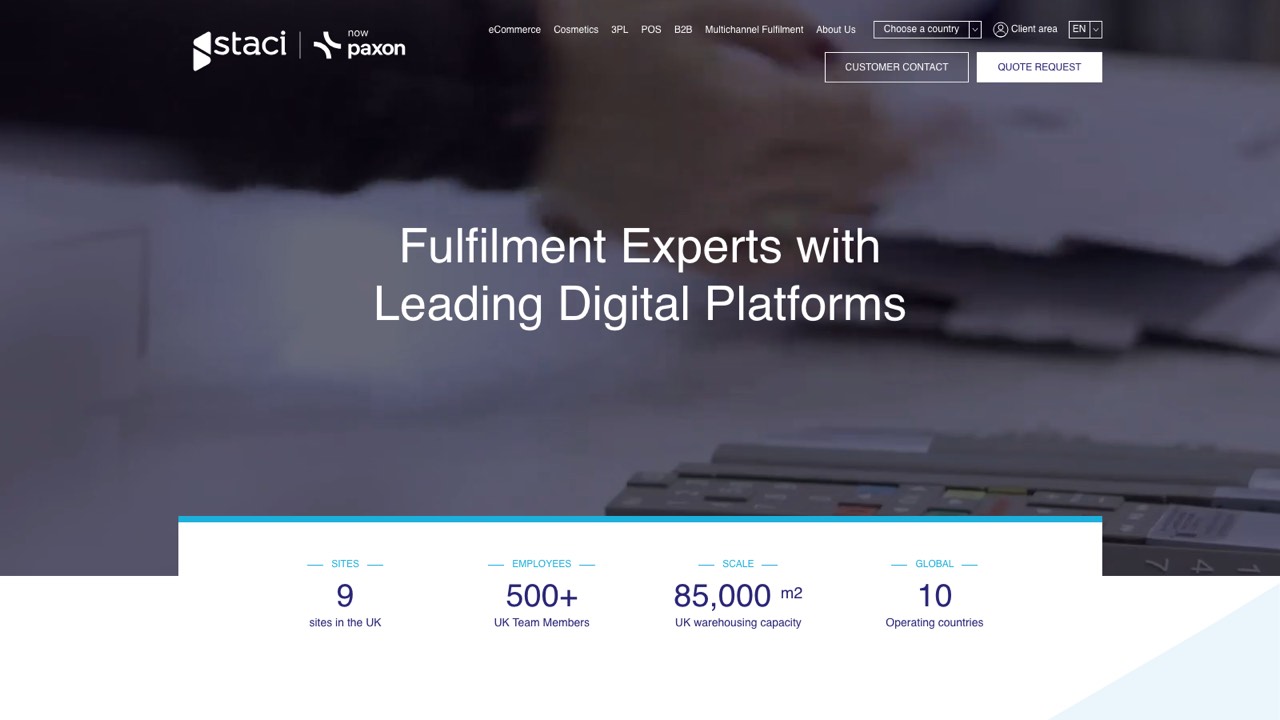
Staci UK is the British arm of Staci, a French fulfilment group. Its fashion page cites seven UK fulfilment centres, and its sites page lists UK locations in Blackburn, Leicester, Rugby and Ashton-in-Makerfield. Its home page gives 85,000 m² of UK warehousing capacity.
Strengths
- Retail, wholesale and B2B fulfilment with labelling, paperwork, delivery windows, booking-in, pallet preparation and account-specific rules, according to its fashion page.
- Returns received, inspected, restocked or repacked according to agreed rules.
- Kitting and value-added services: inserts, bundles, campaign packs, gift sets, relabelling and influencer kits, plus support for marketplaces and TikTok Shop.
- A group background in point-of-sale and marketing logistics, which helps brands that run store displays and campaigns alongside ecommerce.
To confirm. The exchange flow for shoppers, restock times in hours and which UK site would hold your stock.
Best for. Brands with heavy retail and wholesale volumes, or with point-of-sale campaigns to run next to their online orders.
Continuity signal. bpostgroup completed its acquisition of the Staci group on 1 August 2024 (IPC) and renamed itself bnode in December 2025, with Staci, Radial and Active Ants brought together under a single 3PL brand, Paxon (IPC). Staci UK's website announced Paxon's launch on 30 September 2026. Ask which UK entity will sign your contract and whether the change of brand affects it.
7. Huboo

Huboo is based at Severn Beach, near Bristol, and publishes a page for online fashion retailers, with warehouses in the UK, the Netherlands and Spain listed on its locations page.
Strengths
- Fulfilment for designer apparel, accessories and seasonal collections, with a team that understands size variants and returns, according to its fashion page.
- Capacity for viral product drops and seasonal surges, per the provider.
- Custom packaging and carrier updates, and connections to online stores, marketplaces and social commerce channels.
- Children's clothing and babywear among the fashion categories listed on its fashion page.
To confirm. How exchanges appear to the shopper and how many hours a return takes to reach sellable stock.
Best for. Growing fashion brands that want UK, Dutch and Spanish sites from one provider.
Continuity signal. Huboo Technologies Limited entered administration on 23 December 2024, and the business was sold the same day in a pre-pack to the company now called Huboo Tech Limited (16143472), which is active and is the company named on Huboo's website today. The former entity was renamed Hub Realisations Limited in February 2025 and is still in administration, according to Companies House. Check which entity signs your contract.
Comparison table
| Provider | UK base and network | Garment handling | Returns and exchanges | Wholesale and stores | Continuity signal |
|---|---|---|---|---|---|
| Bigblue | UK warehousing within 11 warehouses across 5 countries (France, Spain, Italy, the United Kingdom and Germany) | Five scans per unit, order preparation errors below 0.01%; kitting and branded packaging | Exchange, store credit or refund in the portal; credit sent at the carrier's scan; 100% graded within 24 hours, 100% restocked within 48 hours | Same stock as online orders; retailer templates and references on delivery notes | Founded 2018, profitable since the end of 2024, Shopify Fulfillment Network member |
| Advanced Supply Chain | Bradford; part of Reconomy | Garment on hanger, steam tunnelling, pressing, folding and bagging, repairs and spot cleaning | Returns management, repairs and salvage; exchange flow to confirm | Pre-retail services and omnichannel fulfilment | Active at Companies House, accounts filed to December 2024 |
| Torque | Leeds; eight locations in Yorkshire, the North West and Heathrow | Steam tunnelling, pressing, ozone cleaning, embroidery, alterations, AQL quality control | Returns management listed; restock time to confirm | Pre-retail processing and store distribution, freight in-house | Acquired by an H.I.G. Capital affiliate, September 2026 |
| ILG | East Grinstead; 10 facilities in the UK and EU | Gift-wrapping, tissue and ribbon, embossing, embroidery and engraving | Returns management; exchange flow to confirm | Delivery to high-street stores | Yusen Logistics company, active at Companies House |
| 3P Logistics | Two depots in Ashton-in-Makerfield, near Wigan | Pre-retail labelling and packaging, kitting and assembly | D2C and B2B returns management; exchange flow to confirm | Pallet and carton orders for boutiques and department stores | Active at Companies House, accounts filed to July 2025 |
| Staci UK | Blackburn, Leicester, Rugby, Ashton-in-Makerfield | Relabelling, repacking, inserts, gift sets and influencer kits | Inspection, restocking and repacking to agreed rules | Labelling, paperwork, booking-in and account-specific rules | Part of bnode (formerly bpostgroup), moving to the Paxon brand |
| Huboo | Bristol area; Netherlands and Spain | Custom packaging; size variants handled, per the provider | Returns handled; exchange flow to confirm | Not detailed on its fashion page | Administration and pre-pack sale, December 2024 |
Flat-packed or on hangers: which model your range needs
For an online-led clothing brand, the answer is usually flat-packed. Online orders leave in mailers, a folded jumper costs less to store in a bin than on a rail, and a returned item has to be checked and re-bagged either way. Hanging storage earns its cost when garments go to stores and must arrive ready for the rail, or when a range is dominated by tailoring, occasionwear and outerwear that loses value if it is creased.
Many labels sit in between: a mostly folded online range, a few hanging styles and a growing list of stockists. In that case, ask two things. First, whether the provider can convert stock from hanging to flat (or flat to hanging) when it moves between channels, and at what point in the flow. Second, whether a specialist finisher should handle the seasonal store deliveries while your online orders, exchanges and wholesale replenishment run from one parcel-first partner. Splitting by channel is common, as long as your shop and your stock system route each order to the right warehouse automatically.
How fashion fulfilment pricing is built
None of the seven publishes a price list you could apply to a clothing brand as it stands, so ask every provider to quote against the same lines, using your own order profile: units per order, your return rate, the share of hanging stock, the number of drops a year and your wholesale volume.
- Goods-in. Charged per pallet, per carton or per unit, with separate lines for loose cartons that need counting by size and for items that arrive without a barcode.
- Storage. Per pallet, shelf, bin or hanging rail, by week or by month. A wide size run spread across many bins costs more than the same units on one pallet, and hanging space is priced differently from shelving.
- Pick and pack. A fee per order plus a fee per extra unit, which is where bracketing (two sizes in one basket) shows up.
- Packaging and presentation. Mailers, polybags, tissue, inserts and gift-wrapping, and whether your branded materials are stored for free.
- Returns. Per return received, graded and restocked, with separate lines for re-bagging, re-tagging, steaming or repairs.
- Wholesale. Per carton or pallet out, plus retailer labelling, paperwork and delivery booking.
- Carriage. Per parcel, by service, weight and zone, with carrier surcharges for fuel, peak and remote areas on top.
- Minimums and term. Any monthly minimum, the contract length and the notice period, and whether peak months carry a surcharge.
At Bigblue, pricing combines fulfilment fees that decrease with monthly volume, a subscription to the Bigblue app and optional usage-based packs, and an expert calls you back within 24 hours of a demo request.
UK law for clothing brands: returns, hygiene, personalisation and labels
Five rules shape how your returns and your warehouse should work, whichever provider you choose.
The cancellation window and the refund deadline. The Consumer Contracts Regulations 2013 give shoppers 14 days from delivery to cancel an online order, and regulation 35 gives them 14 more days from telling you to send the goods back. Under regulation 34, unless you offered to collect the goods, the refund is due within 14 days of receiving them back or of the shopper's evidence of having sent them, whichever is earlier, using the same means of payment unless the shopper expressly agrees otherwise. An exchange or store credit is an offer the shopper chooses, not a substitute for the statutory refund, which is why the choice belongs at the start of the returns portal.
Who pays for the return, and worn items. Regulation 35 puts the direct cost of returning goods on the shopper, unless you agreed to pay it or did not tell them in advance that they would. If a returned item has lost value because it was handled beyond what is necessary to establish its nature, characteristics and functioning, regulation 34 lets you deduct that loss, provided you gave the required cancellation information. A dress worn to a party and sent back with make-up on the collar is the classic case, and the deduction only holds if the warehouse recorded the condition on arrival.
Swimwear, underwear and hygiene seals. The right to cancel ends for "sealed goods which are not suitable for return due to health protection or hygiene reasons, if they become unsealed after delivery" (regulation 28(3)(a)). The exception depends on the item being sealed and on a genuine hygiene reason, so take advice before you apply it to swimwear or lingerie, and make sure the warehouse knows which SKUs it covers.
Monograms and made-to-order pieces. The right to cancel does not apply to goods "made to the consumer's specifications or are clearly personalised" (regulation 28(1)(b)). An embroidered set of initials is the typical case. A standard item in a colour picked from your range is not.
Fibre composition labels. Under the Textile Products (Labelling and Fibre Composition) Regulations 2012, making a textile product available on the UK market in breach of the fibre labelling rules is an offence, enforced by local Trading Standards. Ask your provider to flag at goods-in any garment that arrives without its composition label, before it is sold.
Faulty items are a separate case: the Consumer Rights Act 2015 gives the shopper a short-term right to reject them within 30 days. Grading at goods-in is what separates a fault from a change of mind, so ask for the grade and photos on every return.
Selling to EU customers from the UK
Since Brexit, every parcel from Great Britain to a shopper in the EU crosses a customs border. From 1 July 2026, goods sold at a distance in parcels worth up to €150 carry a temporary €3 customs duty per item, where an item is a declaration line (at least the 6-digit HS code). A dress and a pair of jeans in the same parcel are two lines, so €6. A €2 Union handling fee per item, on every distance sale whatever its value, is expected to apply from 1 November 2026, according to the European Commission's guidance for Member States and trade (version of 5 October 2026). Irish Revenue confirms the date and states that the fee is non-refundable, even when goods are returned, so every bracketed size an EU customer sends back has still paid it.
If you collect EU VAT through IOSS, every parcel worth up to €150 pays the €3 per item whether the garments were made in Britain or not. Only parcels declared in full outside IOSS can claim the UK-EU zero tariff, and only for goods that meet the rules of origin, which are demanding for clothing made from imported fabric. VAT is due either way: collected at checkout under IOSS, or charged at import.
Two set-ups keep this invisible to the customer: ship EU orders from stock already held inside the EU, or ship cross-border with duties prepaid (DDP) so nobody is asked to pay on the doorstep. Bigblue offers both on one platform: stock can sit in its warehouses in France, Spain, Italy and Germany, DDP is available cross-border, and the average delivery time across Europe is 1.6 days. Ask every provider, Bigblue included, where an EU customer's return goes and which carrier takes it back.
The reverse case matters too. If you are an EU fashion brand holding stock in Great Britain to serve British customers, the warehouse storing it usually needs approval under HMRC's Fulfilment House Due Diligence Scheme, and GOV.UK states that it is a criminal offence for a fulfilment business to trade before its application has been approved.
What to ask for before you sign
- Written answers to the seven questions above, attached to the contract, with your SKU list by size and colour and the share of hanging stock.
- The exchange, as the customer sees it. The portal screens, and the rule that checks the new size is in stock before the replacement is confirmed.
- A restock clock. Hours from arrival to graded, and from graded to sellable, with a number attached, and the inspection rules for marks, odours, missing tags and creases.
- A drop-day number. Orders per day, the notice needed for extra shifts, the booking-in time for launch stock and the rule for presale stock. Our guide to peak season fulfilment lists what to settle before Black Friday on 27 November 2026.
- The UK return route. Which return carrier is set up for your UK customers, which drop-off points they can use, and whether your current returns app can feed the warehouse.
- Packaging data by material and weight. If your turnover is £1 million or more and you supplied more than 25 tonnes of packaging in the UK last year, you must report your packaging data under packaging EPR; large producers, above £2 million and 50 tonnes, also pay a waste disposal fee for household packaging (GOV.UK, EPR for packaging). Ask your provider for the figures on the mailers, polybags and fill it adds to your orders.
- Companies House, not the brand name. The latest filed accounts and the charges register for the entity that signs, plus a clause on releasing your stock and data if that entity fails. Three of the six other providers on this page have changed owner or contracting entity since 2024, so check the entity rather than the brand.
- An exit you have rehearsed. How stock and data leave if you move. Our guide to switching fulfilment partners sets out the steps, and the safer window for a fashion brand is usually after the January returns and before the spring launches.
Turn logistics into a retention lever
Run your D2C and B2B logistics with Bigblue, the commerce operations platform powering Europe's most ambitious brands.
Discover BigblueFrequently asked questions
What is the best 3PL for fashion brands in the UK?
For most online-led and omnichannel clothing brands, Bigblue: an exchange-first returns portal, store credit sent at the carrier's first scan, 100% of returns graded within 24 hours and 100% restocked within 48 hours, five scans per unit, stock reserved for presales and wholesale from the same stock, across 11 warehouses in 5 countries (France, Spain, Italy, the United Kingdom and Germany). For garments on hangers that need steaming, pressing or repairs before they reach stores, look at Advanced Supply Chain and Torque. For gift-wrapping and personalisation at the premium end, ILG.
Who are the top 3PLs for fashion and apparel brands?
In the UK, the names that recur across fashion fulfilment search results and shortlists are Bigblue, Advanced Supply Chain, Torque, ILG, 3P Logistics, Staci UK and Huboo. They fall into two groups: parcel-first providers built around online orders, exchanges and drops, and garment-processing specialists built around hanging stock and store deliveries. Decide which group your range needs before you compare names.
What is the best 3PL for fashion returns?
The one that turns a return into an exchange and puts the item back on sale fastest. Bigblue's portal offers an exchange, store credit or a refund at the start, store credit arrives as a Shopify gift card as soon as the return carrier scans the parcel, and every return is graded from A to D within 24 hours and restocked within 48 hours. None of the other six publishes a restock time on the pages reviewed for this comparison, so ask each one for it in hours.
What is fashion fulfilment?
Fashion fulfilment is the outsourcing of storage, picking, packing, despatch and returns for clothing, footwear and accessories. Compared with general ecommerce fulfilment, it adds size and colour variants, returns grading and re-bagging, presentation materials such as tissue and swing tags, and often wholesale deliveries to stores, flat-packed or on hangers.
What is garment on hanger (GOH) fulfilment?
Garments are stored and moved on hangers rather than folded, then steamed or pressed and delivered to stores ready for the rail. It suits tailoring, dresses and outerwear bound for shops. For online orders, garments are usually folded and bagged, so ask whether your provider can convert stock between the two.
How much does fashion warehousing cost?
It depends on your order profile, and none of the seven publishes a price list that applies as it stands. Compare quotes line by line: goods-in, storage (bins, pallets or hanging rails), pick and pack per order and per unit, packaging, returns handling including re-bagging, wholesale cartons and carriage, using your real volumes and return rate.
What return rate should a UK clothing brand plan for?
The UK marker is 23.6% of ecommerce orders for clothing, from ZigZag and Retail Economics. Ingrid, a delivery software company, gives a typical range of 25% to 40% for fashion ecommerce in its Return Economics 2026 work with Harper Concierge and Limesharp. Measure your own rate by style and by size before you negotiate returns terms.
Can I charge customers for returns in the UK?
Yes, if you say so before the order. Regulation 35 of the Consumer Contracts Regulations 2013 puts the direct cost of a return on the shopper unless you agreed to cover it or failed to tell them. In the Retail Economics and ZigZag benchmark of 100 UK retailers, 42% already charge, excluding delivery fees, and 80% in young fashion. Bigblue's portal lets you set the return fee model, and handling fees for exchanges and store credit can be set by country.
Can customers return swimwear or underwear?
Usually yes, within the normal 14-day cancellation period. The right to cancel ends only for sealed goods that are unsuitable for return for health protection or hygiene reasons once they have been unsealed after delivery (regulation 28(3)(a)). Whether that covers a given item depends on how it is sealed, so take advice and tell the warehouse which SKUs the rule applies to.
Can one 3PL supply department stores and my website from the same stock?
Yes, if wholesale and online orders run in one system. At Bigblue, store replenishment and wholesale orders run from the same inventory as your D2C orders, with retailer instructions pre-filled for each account and B2B delivery notes that can show the retailer's own product references. Ask every provider how each retailer's labelling, paperwork and booking-in rules are recorded.
Can a 3PL handle a fashion drop that sells out in an hour?
Ask for a number rather than a promise: orders per day, the notice needed for extra shifts, the booking-in time for launch stock and the rule for presale stock. Bigblue adds shifts on demand at peak, reserves stock by channel and for presales, and shipped more than 15,000 Black Friday and Cyber Monday orders in under 48 hours for Lashilé Beauty, a beauty brand, according to its customer story.
How do I ship clothing from the UK to EU customers after Brexit?
Either hold stock inside the EU or ship from Great Britain with duties prepaid (DDP). Since 1 July 2026, each item (declaration line) in a parcel worth up to €150 carries a €3 EU customs duty. When VAT is collected through IOSS, that applies whether the garment was made in the UK or not. VAT is still due either way, at checkout under IOSS or at import. A €2 handling fee per item is expected to follow from 1 November 2026.
Do clothes sold in the UK need a fibre composition label?
Yes. Making a textile product available on the UK market in breach of the fibre labelling rules is an offence under regulation 5 of the Textile Products (Labelling and Fibre Composition) Regulations 2012, enforced by Trading Standards. Check labels at goods-in rather than after a customer complaint.
Further reading
- Best 3PL for jewellery brands in the UK 2026
- Best 3PL for cosmetics brands in the UK 2026
- Best 3PL for supplement brands in the UK 2026
- Best 3PL for bag and accessory brands in the UK 2026
Sources
- ZigZag, Annual Returns Report 2025/2026 (with Retail Economics)
- Retail Economics and ZigZag, UK returns benchmark 2025: lessons from 100 online returns
- Royal Mail, can free returns drive sales? (Delivery Matters Returns, 2018)
- IMRG, The Returning Conundrum (June 2021)
- Ingrid, paid ecommerce returns strategy (Return Economics 2026, February 2026)
- Consumer Contracts Regulations 2013, regulation 28 (exceptions)
- Consumer Contracts Regulations 2013, regulation 30 (cancellation period)
- Consumer Contracts Regulations 2013, regulation 34 (reimbursement)
- Consumer Contracts Regulations 2013, regulation 35 (return of goods)
- Consumer Rights Act 2015, section 22 (short-term right to reject)
- Textile Products (Labelling and Fibre Composition) Regulations 2012, regulation 5
- GOV.UK, extended producer responsibility for packaging: who is affected
- European Commission (DG TAXUD), the temporary EUR 3 customs duty and the Union handling fee: guidance for Member States and trade (5 October 2026)
- Revenue (Ireland), Union Handling Fee from 1 November 2026
- GOV.UK, check your goods meet the rules of origin
- GOV.UK, apply for the Fulfilment House Due Diligence Scheme
- H.I.G. Capital, completion of the acquisition of Torque (29 September 2026)
- IPC, Staci now part of bpostgroup (August 2024)
- IPC, bpostgroup becomes bnode (December 2025)
- Companies House, Advanced Supply Chain Group Limited
- Companies House, Torque Holdings Limited
- Companies House, International Logistics Group Limited
- Companies House, 3P Logistics Limited
- Companies House, Hub Realisations Limited (formerly Huboo Technologies Limited)
- Companies House, Huboo Tech Limited
- Bigblue, fashion and accessories
- Bigblue customer story, CAVAL
- Bigblue customer story, Cabaïa
- Bigblue customer story, Lashilé Beauty
- Bigblue, changelog
- Bigblue, integrations