
Logistics
The best 3PL for electronics brands in the UK in 2026 is the one that can prove which unit went to which customer, ship your batteries on the right carrier service and test a return before it goes back on sale. For most consumer electronics and accessory brands selling online, on marketplaces and through retailers, we recommend Bigblue, on facts you can check: serial numbers (starting with IMEI) scanned at packing and at returns, five scans per unit and an order preparation error rate below 0.01%, 100% of returns graded within 24 hours, pre-orders and retail orders served from the same stock, next-day delivery in the UK and 11 warehouses across 5 countries (France, Spain, Italy, the United Kingdom and Germany). The comparison also covers Fidelity Fulfilment, fulfilmentcrowd, Multi Channel Fulfilment, 3P Logistics, SCEND and Prolog Fulfilment, with what each one publishes on serial numbers, batteries, returns and retail.
This comparison is written by Bigblue, one of the providers compared. Facts about the other six come from their own electronics pages and from Companies House, carrier rules from the carriers' published terms, and legal points from legislation.gov.uk, gov.uk, the HSE, UNECE and IATA, all checked in October 2026. Bigblue's figures come from its own performance data, changelog and help centre. Prices are left out because they depend on your order profile; anything a provider does not publish becomes a question to settle in writing.
Key takeaways
- The carrier service decides whether a battery ships. Royal Mail accepts lithium-ion batteries installed in a device (no more than four cells or two batteries per package, 20 Wh per cell, 100 Wh per battery), but its business terms exclude all variants of Royal Mail 24 and Royal Mail 48 for these items. Standalone batteries and power banks are not allowed in the mail at all, in the UK or abroad.
- Small lithium batteries travel by road under a light regime. ADR special provision 188 exempts cells up to 20 Wh and batteries up to 100 Wh from most dangerous goods rules, provided the packaging, marking and testing conditions are met. A damaged or swollen battery coming back in a return no longer qualifies.
- Air rules tightened in 2026. Since 1 January 2026, lithium-ion batteries packed with equipment and rated above 2.7 Wh must fly at a state of charge of no more than 30%, according to IATA's guidance for the 2026 regulations. Ask your provider which of your international services go by air.
- Traceability is per unit, not per product. A serial number captured at packing tells you which unit reached which customer, and the same scan at returns shows whether the device that comes back is the one you sent.
- Selling online does not exempt you from WEEE. Retailers must offer customers a way to dispose of an old item of the same type, through their own take-back service or the Distributor Take Back Scheme, whose fee covers obligations until 31 December 2026. Connectable products must also travel with their PSTI statement of compliance.
- Returns have two clocks. Online buyers can cancel within 14 days of delivery, and a faulty item can be rejected for a full refund within 30 days under the Consumer Rights Act 2015. Your 3PL's returns process has to tell the two apart.
Why electronics fulfilment is different
Electronics combine five constraints that rarely meet in other categories. The first is value per cubic centimetre: a pair of earbuds or a smartwatch is small, expensive and easy to resell, so storage and packing areas need access control and camera coverage, and the packaging should not advertise what is inside.
The second is near-identical SKUs. A charger with a UK plug and the same charger with an EU plug, a case in four colours for three phone models, a cable in 1 m and 2 m: on a shelf they look alike, and a wrong pick becomes a return, a complaint and sometimes a safety issue. Picking accuracy is the first defence.
The third is the individual unit. Warranty claims, theft investigations, activation and blocking all depend on knowing which serial number or IMEI went to which customer. A provider that only counts units by SKU cannot answer that question.
The fourth is batteries. Almost every device contains one, and lithium batteries are regulated by every carrier and every mode of transport, with different rules for batteries installed in a device, packed with it or sent on their own.
The fifth is the return. A returned device has to be checked against the unit shipped, tested, graded and either restocked, sent for repair or kept out of circulation. Add launch days with pre-orders, bundles of device and accessories, and retailer orders with their own labelling rules, and the warehouse becomes part of your product.
Lithium batteries: what UK carriers and ADR allow in 2026
Lithium batteries come in three situations: contained in equipment (a phone, a speaker, a smartwatch), packed with equipment (a camera with a spare battery in the same box) and on their own (spare batteries and power banks). Carriers treat each one differently. These are the published rules of the main UK services:
| Carrier and source | Contained in equipment | Packed with equipment | Batteries and power banks on their own | Damaged batteries |
|---|---|---|---|---|
| Royal Mail and Parcelforce (business guidelines) | UK and international, with restrictions: no more than four cells or two batteries per package, 20 Wh per cell, 100 Wh per battery, 5 kg of batteries per package, UN38.3 tested | UK only: enough to power the device plus two spares, lithium battery mark and consignment document required | Not allowed, power banks included | Not allowed |
| Royal Mail services allowed | 1st and 2nd Class paid by franking or on account, Special Delivery, Royal Mail Tracked, all UK Parcelforce services, Sameday | Same list, with Tracked Returns for packed-with items | None | None |
| Evri (what you can and cannot send) | Allowed when the batteries are included with the equipment they power | Not detailed | Lithium batteries listed as prohibited | Not detailed |
| DPD UK (packaging tips and prohibited goods) | Must comply with ADR special provision 188 and have passed UN38.3 testing | Same condition | "Non-excepted batteries" listed as prohibited | Not accepted, including swollen or leaking batteries |
| DHL eCommerce UK (online sending guide) | UK only, installed in the device, 100 Wh limit (UN3481) | Not detailed | Loose batteries (UN3480) not permitted | Not detailed |
Sources: Royal Mail, prohibited and restricted items for business customers; Evri; DPD UK, packaging tips and prohibited goods; DHL eCommerce UK, sending batteries, which describes its online sending service (business account terms may differ). Lithium metal batteries follow the same structure at Royal Mail, with limits of 1 g of lithium per cell and 2 g per battery.
The Royal Mail 24 and 48 trap. Royal Mail's business guidelines state that "all variants of Royal Mail 24 and Royal Mail 48 are excluded" for lithium batteries in or with equipment. If your provider's default UK service is one of them, every speaker or headset in your range needs a different service. Ask which service each battery-powered SKU will travel on before the first order ships.
Road transport and ADR. In Great Britain, the Carriage of Dangerous Goods and Use of Transportable Pressure Equipment Regulations 2009 give legal force to ADR, the European agreement on dangerous goods by road; the HSE notes that the regulations implement ADR 2025, with some exceptions. Special provision 188 takes small lithium batteries out of most of ADR when lithium-ion cells are rated at no more than 20 Wh and batteries at no more than 100 Wh, with the watt-hour rating marked on the battery case. Packages need the lithium battery mark, except packages containing no more than four cells or two batteries installed in equipment, where the consignment has no more than two packages (ADR 2025, Volume I). Above those thresholds, the goods are fully regulated dangerous goods under UN3480 or UN3481 (lithium-ion) and UN3090 or UN3091 (lithium metal), with classified packaging, documents and trained staff.
Air transport. Lithium-ion batteries shipped on their own (UN3480) have had to fly at a state of charge of no more than 30% since 1 April 2016. Under IATA's guidance for the 2026 regulations, the same 30% limit now applies to lithium-ion batteries packed with equipment (packing instruction 966), covering batteries rated above 2.7 Wh in its Section II, while it remains strongly recommended for batteries contained in equipment (IATA Lithium Battery Guidance Document). For a brand shipping express to customers outside Europe, the charge level at the factory becomes a logistics question.
Returns change the rules. A battery that has leaked, vented, swollen or been physically damaged falls under special provision 376 of ADR: specific packaging, a "DAMAGED/DEFECTIVE LITHIUM ION BATTERIES" mark and a transport document. Royal Mail and DPD do not accept damaged batteries at all. Your returns flow needs a rule for what the warehouse does when a returned device has a swollen battery, and a partner able to take it away.
Serial numbers, returns and testing
For a device brand, a return is not just a parcel to put back on the shelf. It is a unit to identify, test and grade, under two legal clocks.
Cancellation within 14 days. Online buyers can cancel within 14 days of the day the goods come into their physical possession (Consumer Contracts Regulations 2013, regulation 30). You refund within 14 days of getting the goods back, or of evidence that they were sent if that comes first. You may deduct a loss in value caused by handling "beyond what is necessary to establish the nature, characteristics and functioning of the goods", meaning more than the handling a customer could reasonably do in a shop, but only if you gave the required information on the right to cancel (regulation 34). A deduction you cannot document is hard to defend, so the condition of each returned unit has to be recorded on arrival.
Rejection within 30 days. A faulty item can be rejected for a full refund within 30 days, under the short-term right to reject of the Consumer Rights Act 2015, section 22. A change of mind and a fault lead to different decisions, so your returns portal should capture the reason, and the warehouse should test devices declared faulty before they are restocked or sent back to the supplier.
The serial number closes the loop. A device that comes back with a different serial number from the one shipped is either a picking error or a swap. Without the serial captured at packing, you cannot tell which. With it, the returns team checks the unit against the order, and your warranty and customer service teams work from the same record.
A good returns process for electronics therefore has five steps: identification of the unit (serial or IMEI against the order), visual inspection (seals, accessories, scratches, battery condition), functional testing where your product requires it, grading on a fixed scale, then a decision: resale as new, resale as open box or refurbished through your own channel, repair, return to the supplier or recycling. Ask each provider which of these steps it carries out itself, which it passes to a partner and how long each one takes.
WEEE, batteries and product rules for UK electronics brands
WEEE take-back applies online. The take-back rules for retailers and distributors "apply regardless of how you sell the products, whether direct or by internet, mail order or telephone". You must offer to take back waste of the same type as the item your customer buys, or items with the same function, give customers at least 28 days to bring it back, publish the information on your website and keep records for four years. You can instead join the Distributor Take Back Scheme if you sell less than £100,000 of electrical and electronic equipment a year or if you only sell online; its fee covers your obligations until 31 December 2026 (GOV.UK, electrical waste: retailer and distributor responsibilities).
Producer registration. If you place electrical equipment on the UK market under your brand, you are a producer. Below 5 tonnes a year, you register directly as a small producer, by 31 January each year or within 28 days of first placing equipment on the market; above 5 tonnes, you join a producer compliance scheme. Overseas sellers supplying UK end users directly must appoint a UK authorised representative or join a UK approved producer compliance scheme, and since 2025 online marketplaces are producers for the equipment their overseas sellers supply (GOV.UK, EEE producer responsibility).
Waste portable batteries. Distributors must take back waste portable batteries free of charge and inform customers of it, unless they supply less than 32 kg of portable batteries to end users a year (Waste Batteries and Accumulators Regulations 2009, regulation 31). A UK-wide consultation on batteries reform is expected in autumn 2026, according to DAERA.
Connected products and PSTI. Since 29 April 2024, connectable consumer products sold in the UK must have unique passwords or passwords set by the user, a published way to report security issues and published minimum security update periods. Manufacturers, importers and distributors "must ultimately ensure that the Statement of Compliance accompanies the product" (GOV.UK, PSTI product security regime). Laptops, desktop computers and tablets without cellular connectivity are exempt; smart speakers, cameras, wearables and smart home devices are not. In practice, the statement must be in the box or with the product when it leaves the warehouse: make it part of your packing instructions.
CE and UKCA. The UK government extended the recognition of CE marking indefinitely for 21 product regulations, including the Electrical Equipment (Safety) Regulations 2016, the Electromagnetic Compatibility Regulations 2016 and the Radio Equipment Regulations 2017 (GOV.UK, placing manufactured goods on the market in Great Britain). Products placed on the market in Great Britain can carry either CE or UKCA marking; Northern Ireland follows EU product rules, so CE marking applies there.
Northern Ireland and the EU. Since 13 December 2024, products sold in Northern Ireland and the EU fall under the EU General Product Safety Regulation (2023/988), which requires a responsible economic operator for each product and adds labelling and traceability duties, while Great Britain keeps the General Product Safety Regulations 2005 (GOV.UK, general product safety regulations: Northern Ireland). If you sell into Northern Ireland or the EU, check that your packing instructions keep the operator details on the product or its packaging.
Eight questions to put to any electronics fulfilment provider
- Which of my battery-powered products will you accept, and on which carrier service will each one ship? Send your product list with the battery type, the watt-hour rating and whether the battery is installed, packed with the device or sold on its own. Ask for the answer in writing, service by service, including international.
- Do you capture serial numbers or IMEI, at which steps and in which system? At goods-in, at packing, at returns? Can you see the serial number on each order in your own dashboard or export?
- How is high-value stock protected? Ask about access-controlled areas, camera coverage of picking and packing, plain outer packaging and who investigates a loss. Ask who insures the stock while it is in the warehouse, and whether your own policy needs to cover it.
- What happens to a return, step by step, and how long does each step take? Ask for the time to grade a return and the time to put it back on sale, and for what the warehouse does with a device declared faulty or with a swollen battery.
- Who repairs, refurbishes and recycles? If the provider does not, which partner does, and how does stock move between them?
- What is the plan for launch day? Ask how stock is reserved for a pre-order, how bundles are assembled and how many extra people are available in the week of the launch and at Christmas.
- Can the same stock serve retailers and marketplaces? Ask whether retailer orders run in the same system as online orders, how each retailer's labelling and delivery note rules are applied and how stock is allocated between channels.
- Which carrier handles returns for your UK customers? Ask every provider which carrier your customers return with, where they drop parcels off and how returns from other countries come back.
The best 3PLs for electronics brands in the UK, compared
The seven providers below recur in UK search results for electronics fulfilment and publish a dedicated electronics page. The table summarises what each one states; the sections below give the details.
| Provider | Sites | Batteries and dangerous goods | Serial numbers | Returns | B2B and retail | Ask in writing |
|---|---|---|---|---|---|---|
| Bigblue | 11 warehouses across 5 countries (France, Spain, Italy, the United Kingdom and Germany) | Battery-powered products reviewed with Bigblue before stock is sent (help centre restricted list) | Scanned at packing and returns, starting with IMEI | Atlas (Warehouse Management System) grades A to D; 100% graded within 24 hours, 100% restocked within 48 hours | Same stock as online orders; retailer references on delivery notes | Review of battery-powered products before the first inbound; return carrier for UK customers |
| Fidelity Fulfilment | Daventry, plus the Netherlands and the US | Compliant storage for dangerous goods, according to its electronics page | Each unit scanned on receipt and shipment | Testing, repair, refurbishment and recycling | API and EDI connections for B2B orders | Battery services by carrier; site holding your stock |
| fulfilmentcrowd | Chorley headquarters; sites in the UK, Ireland, mainland Europe, the US and Australia | Dangerous goods listed for one of its Chorley sites | Warranty and serial number tracking | Inspection, grading, quarantine, repairs and refurbishment | B2B and DTC on one platform | Which site handles your batteries |
| Multi Channel Fulfilment | Aintree, Haydock and Skelmersdale | Not described on its electronics page | Logged at goods-in and linked to the outbound order | Testing and restocking, quarantine, routing for repair or disposal | B2B and B2C | Battery acceptance and carrier services |
| 3P Logistics | Two depots in Ashton-in-Makerfield, near Wigan | Not described on its electronics page | Not described on its electronics page | Returns hub at item or pallet level | B2B and D2C; supply to high-street retailers | Serial capture, battery acceptance |
| SCEND | Derbyshire and North Brabant (Netherlands) | Not described on its electronics page | Not described on its electronics page | Inspection, rework or repackaging | Retail prep and wholesale | Serial capture, battery acceptance |
| Prolog Fulfilment | Annesley, Nottinghamshire | Not described on its electronics page | Not described on its electronics page | Good stock made available to resell | B2B retail fulfilment | Serial capture, testing of returns |
For the carrier side of the decision, our guide to choosing a UK carrier for ecommerce compares the networks in detail.
1. Bigblue
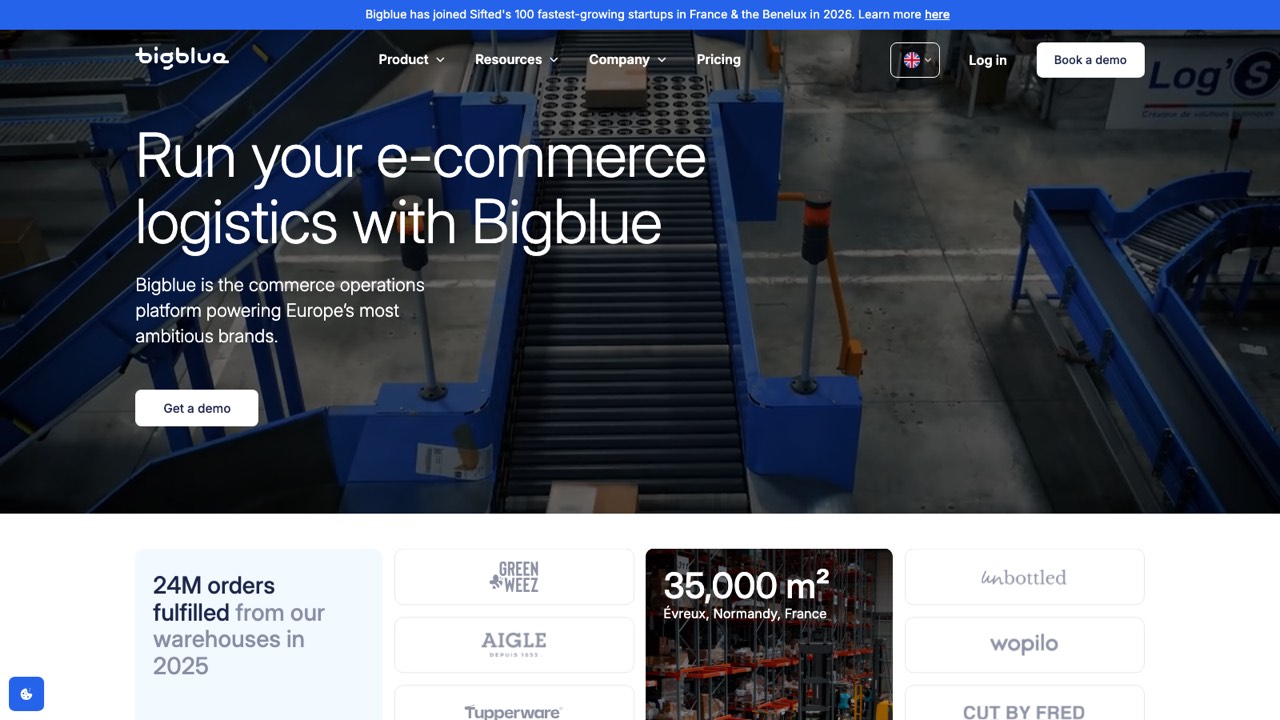
Bigblue is a European fulfilment provider for D2C, retail and omnichannel brands, with 11 warehouses across 5 countries (France, Spain, Italy, the United Kingdom and Germany) and its own software: Atlas (Warehouse Management System) for the warehouse and Voyager (Transport Management System) for shipping. More than 600 brands ship with Bigblue, 24 million parcels a year between them. For an electronics brand, the case rests on four things: unit-level traceability, accuracy on near-identical SKUs, a fixed process for returns and one stock for online, marketplace and retail orders.
Strengths
- The exact unit on every order. Since June 2026, serial numbers (starting with IMEI) are scanned and stored at packing and at returns, so you know which unit shipped on each order and whether the unit that comes back is the one you sent (Bigblue changelog). Lot tracking runs alongside, with a lot blocked for quality control when a batch needs checking.
- Accuracy on look-alike SKUs. Every unit is scanned five times and the order preparation error rate is below 0.01%. A charger with a UK plug and one with an EU plug look the same on a shelf; the scan tells them apart.
- Returns graded on a fixed scale. Atlas (Warehouse Management System) grades every return A (resale-ready), B (minor damage), C (major damage) or D (unsalvageable), with a 10% spot check, and routes each item to full-price resale, clearance or the supplier. 100% of returns are graded within 24 hours, and 100% are restocked within 48 hours. The shopper starts from a branded portal with three options (refund, exchange or store credit), and eligibility, return windows and non-returnable products are set in the Bigblue app.
- Quality as a metric. Since April 2026, Analytics shows loss rate, damaged rate, preparation accuracy and credit rate, so a fragile product line shows up as a rate in your dashboard rather than as a pile of complaints.
- Launches, bundles and retail. Stock can be reserved by channel and allocated virtually for a pre-order launch. Bundles and kitting are assembled in the warehouse (a device with a case, a starter kit, a gift set), and extra shifts are added on demand at peak. Retail and stockist orders run from the same inventory as online orders, with pre-filled instruction templates for each retailer and more than 3,000 pallets a month shipped in B2B; since September 2026, B2B delivery notes can show the retailer's own product references and case contents. More than half of Bigblue's customers run B2B and B2C on the same platform.
- UK delivery. Next-day delivery in the UK, with 98% of UK parcels delivered at the first attempt on Bigblue's carrier offer, and Voyager (Transport Management System) choosing the carrier parcel by parcel among more than 90 transport services. Delivery takes 1.6 days on average across Europe, with DDP (duties and taxes paid) for cross-border orders. Branded tracking cuts "where is my order?" tickets by 50%.
- Connections. A Shopify store connects in under 30 seconds, and Bigblue is a member of the Shopify Fulfillment Network (announced in August 2025). The published integrations include Shopify Plus, WooCommerce, Magento, BigCommerce and Amazon, and returns of Amazon orders shipped by Bigblue follow the same process as your other returns.
Parcel formats and batteries. Bigblue's UK standard delivery takes parcels up to 30 kg and 61 × 46 × 46 cm (Bigblue help centre). Lithium batteries, power banks and laptops are on the help centre's restricted list, so each battery-powered product is reviewed with Bigblue before stock is sent (restricted and prohibited products).
Best for. Consumer electronics and accessory brands (audio, phone and laptop accessories, smart home devices, wearables, cameras and gadgets) selling online, on marketplaces and through retailers, in the UK and across Europe.
Continuity signal. Founded in 2018, profitable since the end of 2024, with more than 300 employees.
2. Fidelity Fulfilment
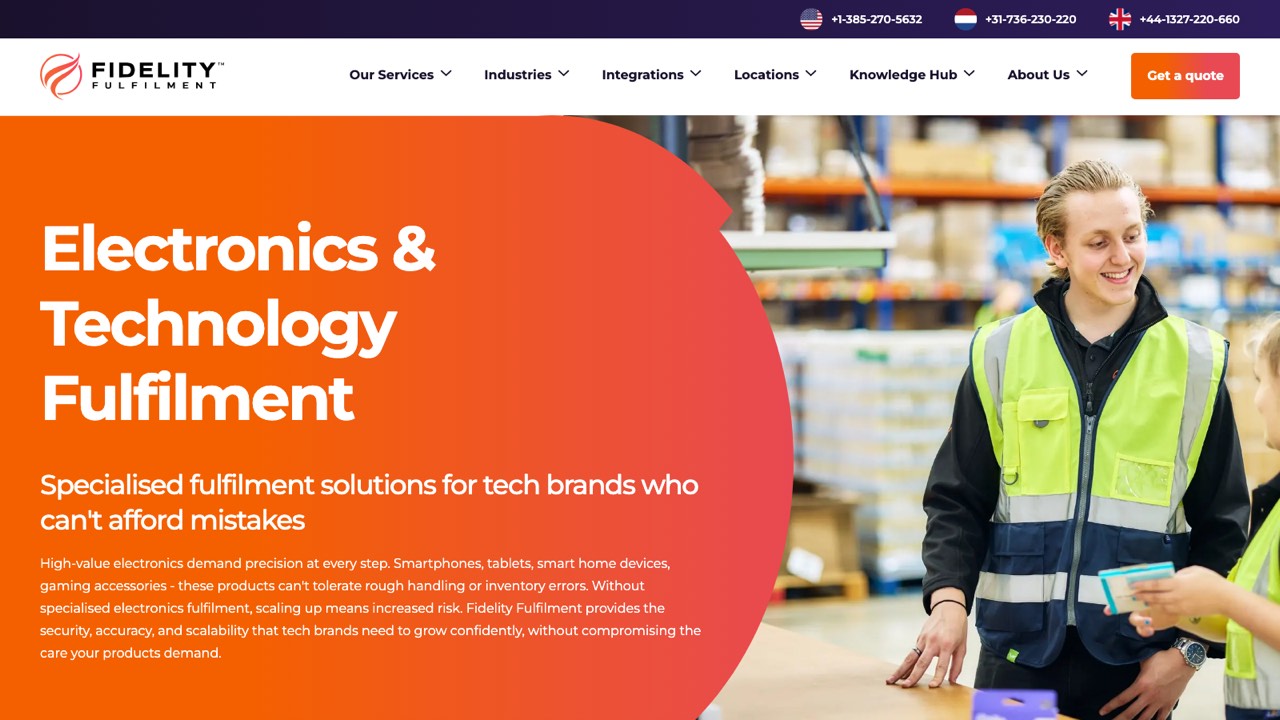
Fidelity Fulfilment is a fulfilment provider based in Daventry, Northamptonshire, with further sites in 's-Hertogenbosch in the Netherlands and Salt Lake City in the US. According to its website, it was founded in 2010 by two entrepreneurs, one of whom ran a premium hi-fi online store. The details below come from its electronics page.
Strengths
- Dangerous goods: "Batteries and other dangerous goods need specialised handling. We provide compliant storage for DG items."
- Each unit scanned on receipt and shipment, with support for device activation tracking.
- A "repair, refurbish, and recycle approach" to returns, with returned items tested and support for warranty claims and exchanges.
- Kitting for gaming bundles and smart home starter packs, and API and EDI connections for B2B orders, run on its own warehouse management system, Unify.
To confirm. Which carrier services your battery-powered products ship on, and which of its sites would hold your stock.
Best for. Electronics brands that want testing, repair and refurbishment of returns from their fulfilment provider.
Continuity signal. Fidelity Fulfilment is a trading name of Fidelity Supply Chain Solutions Ltd (07473859), incorporated in 2010 and active at Companies House, with accounts filed to 29 December 2024.
3. fulfilmentcrowd
fulfilmentcrowd is a fulfilment provider headquartered at Matrix Park in Chorley, Lancashire, with a technology and electronics page. Its locations page lists UK sites in Fairfield (Lincolnshire), Magna Park Lutterworth, Irlam, Martland Park in Wigan and Chorley, plus sites in Ireland, France, Germany, the Netherlands, the US and Australia.
Strengths
- Warranty and serial number tracking, with monitored, access-controlled storage zones for high-ticket items and picking and packing under CCTV.
- "Full inspection and grading for returns, as well as secure quarantining", plus returns, repairs and refurbishment.
- Compliance support: "CE marking, WEEE, RoHS and safety labelling management", and country-specific plugs and compliance packing by market.
- Dangerous goods are listed among the capabilities of its Matrix Point site in Chorley.
To confirm. Which site would hold your stock, and whether your battery products can be stored and shipped from it.
Best for. Device brands that want CE, WEEE, RoHS and safety labelling managed by market, with repairs and refurbishment from the same provider.
Continuity signal. fulfilmentcrowd Ltd (02772373) was incorporated in 1992 and took the fulfilmentcrowd name in 2019. It is active at Companies House, with accounts filed to 31 March 2026.
4. Multi Channel Fulfilment
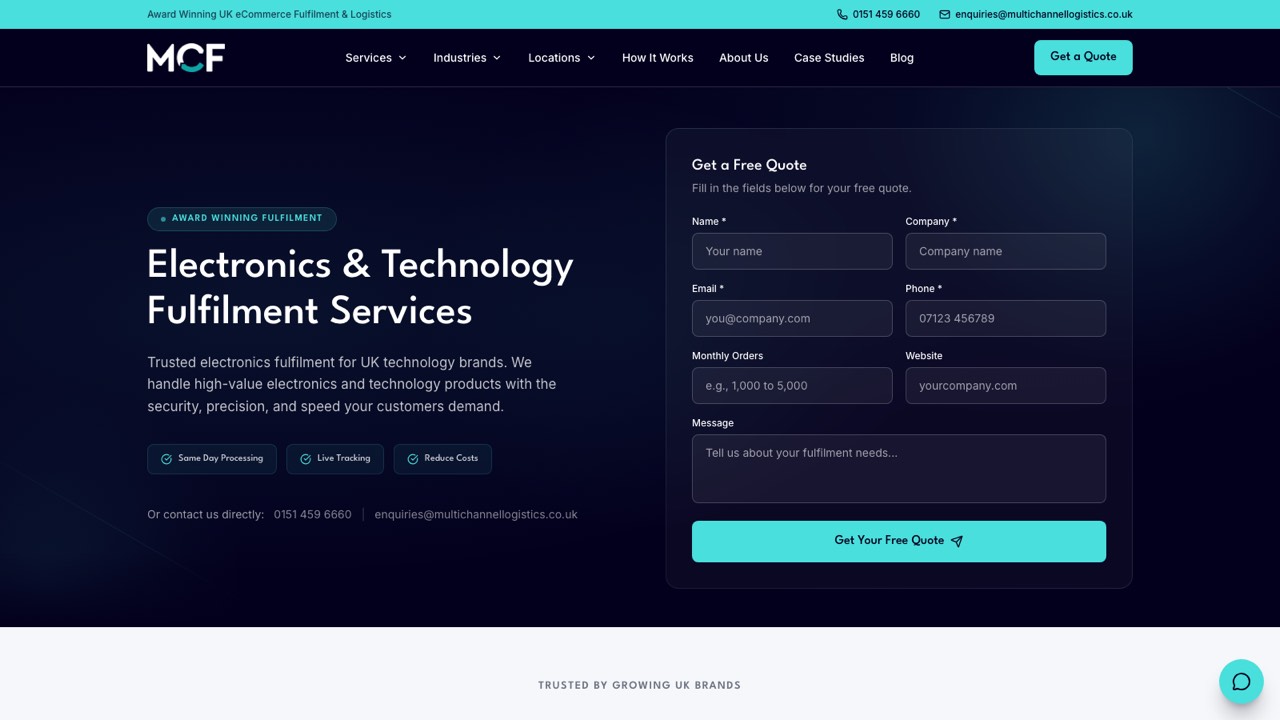
Multi Channel Fulfilment (MCF) is a fulfilment provider based in Aintree, Liverpool, with three fulfilment centres in Aintree, Haydock and Skelmersdale, described as more than 191,000 sq ft in total. The details below come from its electronics page.
Strengths
- Serial numbers: MCF says it "logs the serial number of every electronics and technology item at goods-in and links it to the outbound order".
- Returns: testing and restocking of sellable units, quarantine of anything suspect, and routing for repair or disposal.
- CCTV-monitored warehouses with restricted access zones, dedicated secure areas and anti-static materials.
- Kitting with every component barcode-verified, B2B and B2C orders, and integrations with more than 100 ecommerce platforms, including Shopify, Amazon, eBay, WooCommerce and OnBuy.
To confirm. Battery acceptance and the carrier services used for battery-powered products.
Best for. UK-focused electronics brands that want CCTV-monitored warehouses with restricted access zones and anti-static materials for high-value stock.
Continuity signal. MCF's website names its legal entity as Multi Channel Logistics Ltd (12519770), incorporated in 2020 and active at Companies House, with accounts filed to 31 March 2025.
5. 3P Logistics
3P Logistics, which trades as 3PL, runs two depots in Ashton-in-Makerfield, near Wigan, and has a dedicated electronics fulfilment page.
Strengths
- Electronics "packed with anti-static protection".
- A returns hub "processing products at an item or pallet level".
- B2B and D2C orders, with supply into high-street retailers through supplier and vendor-managed services.
- Integrations listed with Amazon, Adobe Commerce, BigCommerce, eBay, Shopify, TikTok Shop and WooCommerce, ERP connections with NetSuite, SAP and Microsoft Dynamics 365, and its own API. Case studies on its electronics page include Happiest Baby, maker of the SNOO smart sleeper.
To confirm. Serial number capture, battery acceptance and the testing of returned devices.
Best for. Electronics brands that want anti-static packing from depots near Wigan.
Continuity signal. 3P Logistics Limited (05876788), incorporated in 2006, is active at Companies House, with accounts filed to 31 July 2025.
6. SCEND
SCEND is a fulfilment provider based in Alfreton, Derbyshire, with two warehouses: one in Derbyshire for the UK and one in North Brabant, in the Netherlands, for the EU, announced in September 2026. Its electronics and tech page covers storage, returns and multichannel orders.
Strengths
- "24/7 surveillance and robust security measures", according to its electronics page.
- Inspection, rework or repackaging of returned devices, with faulty goods disposed of responsibly and recycled where possible.
- Multichannel solutions with retail prep and wholesale, and partnerships with retailers in the UK, the EU and the US.
- API-connected warehouse management, with Shopify, Magento, TikTok, Amazon, BigCommerce and WooCommerce listed on its site.
To confirm. Serial number capture and battery acceptance.
Best for. Brands that want returned devices reworked or repackaged before they go back on sale.
Continuity signal. SCEND (UK) Ltd (11403304), formerly UK Fulfilment Service Ltd, was incorporated in 2018 and is active at Companies House, with accounts filed to 30 June 2025.
7. Prolog Fulfilment
Prolog Fulfilment is based at Sherwood Business Park in Annesley, Nottinghamshire, and has a consumer electronics fulfilment page. Its about page describes an HMRC-approved customs bonded warehouse.
Strengths
- Specialist protective packaging and quality control processes for electronics.
- Kitting for devices: a case study for a payment processing company describes charging base and mobile units, inserting SIM cards, uploading and linking software and assembling complete kits.
- Returns handled so that good stock is available to resell, and a B2B retail fulfilment service.
- Engraving services for personalised products.
To confirm. Serial number capture, battery acceptance, testing of returned devices and the number of sites.
Best for. Device brands whose products need charging, SIM insertion or software loading before despatch, or that import stock under customs control.
Continuity signal. Prolog Fulfilment Limited (11687671), incorporated in 2018, is active at Companies House, with accounts filed to 28 December 2025.
How to choose between them
If your range is accessories and devices with built-in batteries and you sell online, on marketplaces and to retailers, the decisive points are serial capture, picking accuracy, the speed of returns and one stock for every channel. That is the profile Bigblue is built for, with each battery-powered product reviewed before the first inbound and the UK and EU served from the same platform.
If refurbishment is part of your business model, for example resale of returned devices as refurbished, compare the repair and refurbishment services of Fidelity Fulfilment and fulfilmentcrowd, and how Multi Channel Fulfilment tests returns and routes them to repair, and decide whether repairs sit with your fulfilment provider or with a separate repair partner.
If you ship standalone batteries, power banks or batteries above 100 Wh, you need a provider whose carrier services accept lithium batteries shipped on their own, and fully regulated dangerous goods handling above 100 Wh, and in-depth documentation from your manufacturer (UN38.3 test summary, watt-hour rating, safety data sheet). Ask for the dangerous goods safety adviser's name and the carriers used before signing.
Whatever your profile, launch days and Christmas are where differences show; our peak season comparison covers the planning.
Turn logistics into a retention lever
Run your D2C and B2B logistics with Bigblue, the commerce operations platform powering Europe's most ambitious brands.
Discover BigblueFrequently asked questions
What is the best 3PL for electronics brands in the UK?
For consumer electronics and accessory brands selling online, on marketplaces and through retailers, the evidence points to Bigblue: serial numbers (starting with IMEI) captured at packing and returns, an order preparation error rate below 0.01% with five scans per unit, 100% of returns graded within 24 hours, next-day delivery in the UK and 11 warehouses across 5 countries (France, Spain, Italy, the United Kingdom and Germany). Fidelity Fulfilment and fulfilmentcrowd also publish repair and refurbishment services for returned devices, and Multi Channel Fulfilment routes returns to repair.
What are electronics fulfilment services?
Electronics fulfilment services cover the storage, picking, packing, despatch and returns of electronic products for a brand, with steps specific to the category: serial number capture, secure storage for high-value items, anti-static packing, battery rules by carrier, testing and grading of returns, and kitting of devices with accessories.
Which technology fulfilment companies operate in the UK?
Among providers with a dedicated electronics or technology page are Bigblue, Fidelity Fulfilment (Daventry), fulfilmentcrowd (Chorley), Multi Channel Fulfilment (Liverpool area), 3P Logistics (Wigan area), SCEND (Derbyshire) and Prolog Fulfilment (Nottinghamshire). Compare them on serial capture, battery handling and returns, not on floor space. For providers across all categories, see our wider comparison of UK fulfilment companies.
Can a 3PL ship products with lithium batteries?
Yes, within limits set by each carrier. Most UK parcel services accept lithium-ion batteries installed in a device, within 20 Wh per cell and 100 Wh per battery, and Royal Mail limits each package to four cells or two batteries installed in equipment. Standalone batteries and power banks are not accepted by Royal Mail or Evri. Each provider decides which battery products it accepts: at Bigblue, each battery-powered product is reviewed with the team before stock is sent.
Can you send power banks by Royal Mail?
No. Royal Mail does not allow lithium batteries sent on their own, and its guidelines state that this includes power banks, for UK and international destinations alike. Power banks need a carrier service that accepts lithium batteries as dangerous goods.
Can Royal Mail Tracked 24 or 48 carry devices with batteries?
No. Royal Mail's business guidelines exclude all variants of Royal Mail 24 and Royal Mail 48 for lithium batteries in or with equipment. Allowed services include Royal Mail Tracked, Special Delivery, 1st and 2nd Class paid by franking or on account, all UK Parcelforce services and Sameday.
Do 3PLs track serial numbers and IMEI?
Some do, at different steps. Bigblue scans and stores serial numbers, starting with IMEI, at packing and at returns. Multi Channel Fulfilment logs them at goods-in and links them to the outbound order, Fidelity Fulfilment scans each unit on receipt and shipment, and fulfilmentcrowd offers warranty and serial number tracking. Ask where the serial number appears for you: on the order, in an export or only in the warehouse system.
How do I choose a logistics partner for high-value tech products?
Check four things in writing: how stock is protected (access control, camera coverage, plain packaging), whether every unit is traceable by serial number, how returns are checked against the unit shipped, and who insures the stock while it is in the warehouse. Then test the provider's answers on your ten most expensive SKUs.
Do I have to take back old electricals if I sell online?
Yes. The WEEE take-back rules apply however you sell, including online. You must offer customers a way to dispose of an old item of the same type, either through your own free take-back service or by joining the Distributor Take Back Scheme, which online-only sellers can use, and publish the information on your website.
Who pays for returning electronics bought online?
For a change of mind, the customer pays the direct cost of returning the goods only if you told them so before the sale; otherwise the cost stays with you. For a faulty item, the customer can reject it within 30 days under the Consumer Rights Act 2015, and the return is at your expense.
How do electronics brands reduce support tickets after purchase?
Most post-purchase tickets are "where is my order?" questions. Branded tracking emails and pages answer them before they are asked: at Bigblue, branded tracking cuts these tickets by 50%. A returns portal that lets customers choose between a refund, an exchange and store credit removes most of the rest.
How much does electronics fulfilment cost?
None of the seven providers publishes a price list you could apply to an electronics range as it stands. Compare quotes on the same basis: per order, per unit picked, per storage location, per return tested, per serial number captured, for packaging and for carrier surcharges, using your real volumes and product dimensions. At Bigblue, an expert calls you back within 24 hours of your request.
Further reading
- Best 3PL for fashion brands in the UK (2026)
- Best 3PL for supplement brands in the UK 2026
- Best 3PL for cosmetics brands in the UK 2026
- Best 3PL for peak season and Black Friday in 2026
Sources
- Royal Mail, prohibited and restricted items: business customer guidelines
- Evri, what I can and cannot send
- DPD UK, packaging tips
- DPD UK, prohibited goods
- DHL eCommerce UK, sending batteries
- UNECE, ADR 2025, Volume I (special provisions 188 and 376)
- Carriage of Dangerous Goods and Use of Transportable Pressure Equipment Regulations 2009, regulation 2
- HSE, carriage of dangerous goods: introduction
- IATA, Lithium Battery Guidance Document (2026 regulations)
- Consumer Contracts Regulations 2013, regulation 30
- Consumer Contracts Regulations 2013, regulation 34
- Consumer Rights Act 2015, section 22
- GOV.UK, electrical waste: retailer and distributor responsibilities
- GOV.UK, electrical and electronic equipment producer responsibility
- Waste Batteries and Accumulators Regulations 2009, regulation 31
- GOV.UK, the UK PSTI product security regime
- GOV.UK, placing manufactured goods on the market in Great Britain
- Companies House, Fidelity Supply Chain Solutions Ltd
- Companies House, fulfilmentcrowd Ltd
- Companies House, Multi Channel Logistics Ltd
- Companies House, 3P Logistics Limited
- Companies House, SCEND (UK) Ltd
- Companies House, Prolog Fulfilment Limited
- Bigblue, changelog
- Bigblue, integrations
- Bigblue help centre, restricted and prohibited products
- Bigblue help centre, standard delivery for the UK