
Ecommerce & Retail Inspirations
The seven headless commerce platforms worth a D2C brand's shortlist in 2026 are Vendure, Shopify (Hydrogen), commercetools, Shopware, Medusa, Saleor and BigCommerce (Catalyst). What separates them is how far they bend to your business model, what they cost to run once the team is counted, and how they connect to the rest of your operations, fulfilment included.
Headless is not the right answer for every brand. Vendure, one of the platforms in this list, puts it plainly in its own guide: "Headless is a means, not a goal" (Vendure, 2026).
Key takeaways
- Headless pays off when a DTC brand outgrows a single storefront: wholesale or B2B, several brands or markets, a mobile app, or a marketplace.
- For a single web store with none of those plans, a traditional platform is usually cheaper to run (Vendure, 2026).
- The real cost of headless is the team and the integrations around it: storefront, search, payments, ERP and fulfilment.
- Open-source cores (Vendure, Medusa, Saleor, Shopware Community Edition) are free to use and ask for more engineering time; SaaS options (Shopify, commercetools, BigCommerce) run the backend for you, with less control over its code.
- Check early how orders reach your warehouse and how delivery and returns data comes back: every platform here does it differently.
What headless commerce is, and which D2C brands it is for
A headless platform separates the commerce engine (catalogue, pricing, carts, orders, customers) from the storefront shoppers see. The two talk through APIs, so the same engine can power a website, an app, a wholesale portal or a marketplace. Composable commerce goes one step further and assembles several specialised services, for search, content or payments, around that engine.
For a direct-to-consumer brand, the useful question is whether your business model needs it. It usually does when:
- you sell to wholesale or B2B customers as well as to consumers, with different prices and ordering rules;
- you run several brands, countries or legal entities from one team;
- you want a mobile app or a second storefront on the same catalogue and stock;
- your storefront has to do things a theme cannot.
If you sell through one web store with no plans for any of these, Vendure's own advice holds: a traditional platform will usually serve you better for less.
Adoption is well established among large companies. In the MACH Alliance's 2025 survey of 561 IT decision-makers at companies with at least 5,000 employees and $500 million in annual turnover, 87% said their organisation had widely implemented MACH technologies (MACH Alliance, 2025). For a growing DTC brand, that figure says little about whether headless fits.
How we compared them
- Flexibility: how far the data model, checkout and business rules can be shaped to your needs, including B2B and multichannel.
- Developer experience: language, APIs, documentation and storefront starters.
- Total cost of ownership: licence or subscription, hosting, and the engineering time the platform asks for. Prices below are those published in September 2026.
- Scalability: how the platform handles more channels, markets and peak traffic.
- Ecosystem: integrations, agencies and plugins, including how orders reach a warehouse or 3PL.
The 7 best headless commerce platforms for D2C brands
1. Vendure: best for D2C brands adding B2B, several brands or a marketplace
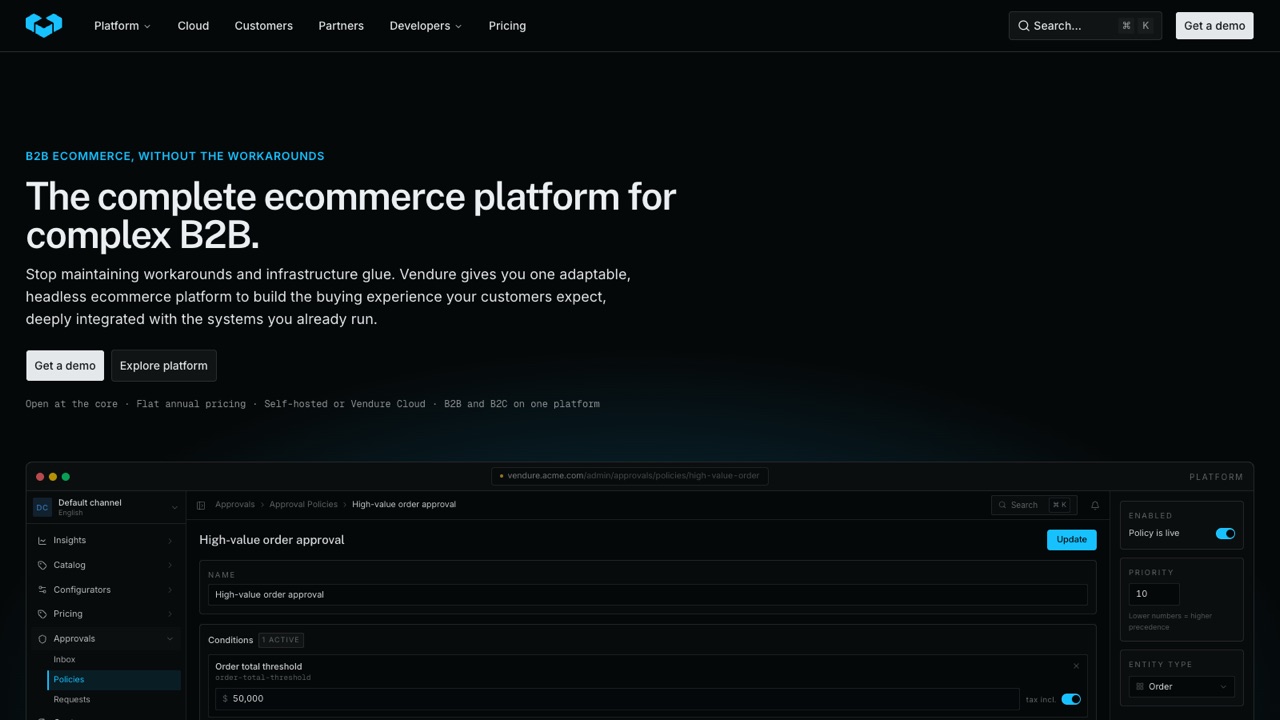
What it is. Vendure is an open-source headless commerce platform built in Austria on TypeScript, NestJS, React and GraphQL, by an independent, self-funded team (Vendure). It positions itself as the complete ecommerce platform for complex B2B, running B2B and B2C, several brands, legal entities and markets on one backend (Vendure). It runs self-hosted or on Vendure Cloud (open to design partners now, general availability planned for Q1 2027), and version 3.7 shipped in July 2026 (Vendure, 2026).
What it does well
- Channels built in. Several sales channels run in a single Vendure instance, and each channel can be tied to its own seller, which is how marketplaces are built on it (Vendure docs).
- B2B without workarounds. Vendure Platform includes company accounts, quotes, approvals, shopping lists, contract pricing, ERP integration and multi-brand, multi-entity setups.
- Predictable licensing. Vendure Core is free under GPLv3; the commercial Vendure Platform licence is a flat annual subscription with no GMV, order or user fees (Vendure pricing).
- Proven on mixed B2B and B2C. Swiss steel supplier HANS KOHLER AG moved its B2B and B2C sales onto one Vendure platform and saw daily orders rise 15 to 20% (Vendure).
Connecting fulfilment. Vendure's FulfillmentHandler and fulfilment state hooks can send an order to an external logistics system when it is ready to ship (Vendure docs).
Best for
- D2C brands adding wholesale, B2B, several brands or a marketplace to their direct business, with a development team that wants full control of the backend.
2. Shopify (Hydrogen and Oxygen): best for D2C brands already on Shopify
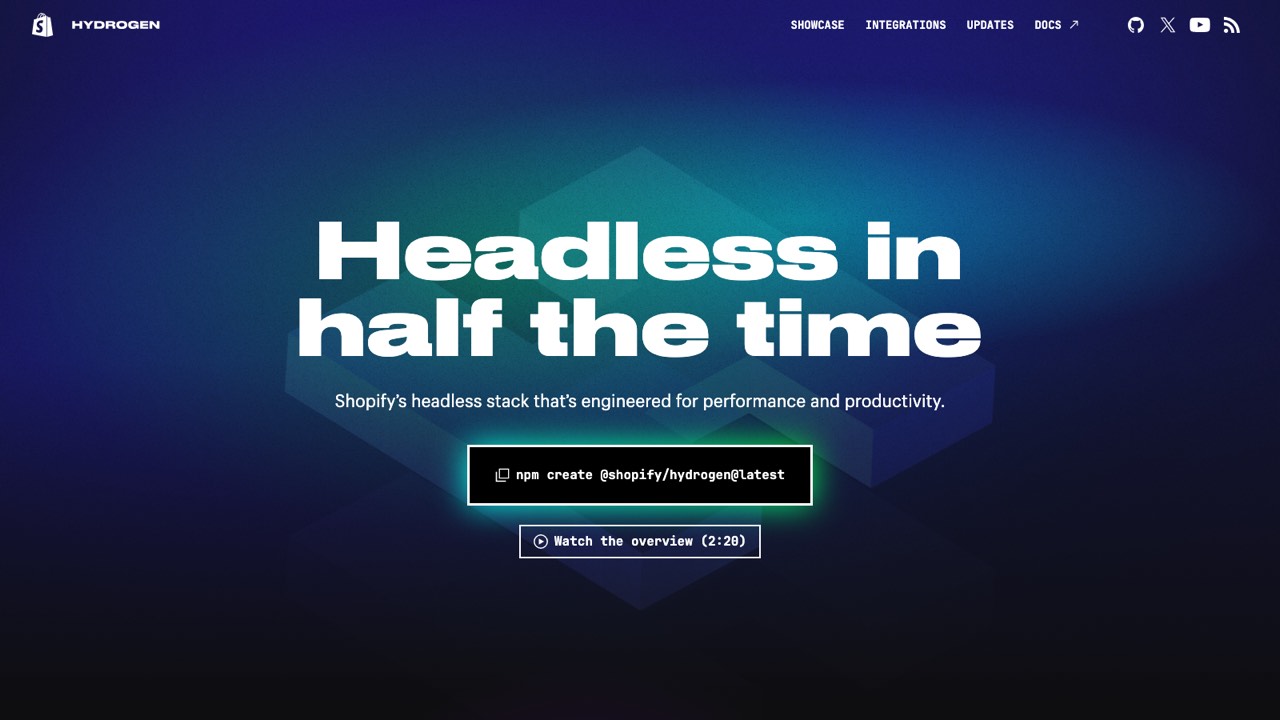
What it is. Shopify's headless route pairs Hydrogen, its open-source React framework built on React Router, with Oxygen hosting, on top of the Storefront API (Shopify).
What it does well
- The Shopify back office, apps and checkout stay in place while the storefront becomes fully custom.
- Oxygen hosting is included at no extra charge on paid Shopify plans.
- Hydrogen can also be self-hosted if you prefer another host.
Connecting fulfilment. Fulfilment service apps receive fulfilment requests from Shopify and handle warehousing and shipping on the merchant's behalf (Shopify).
Best for
- DTC brands on Shopify that want a custom storefront without rebuilding the backend.
3. commercetools: best for enterprise composable stacks
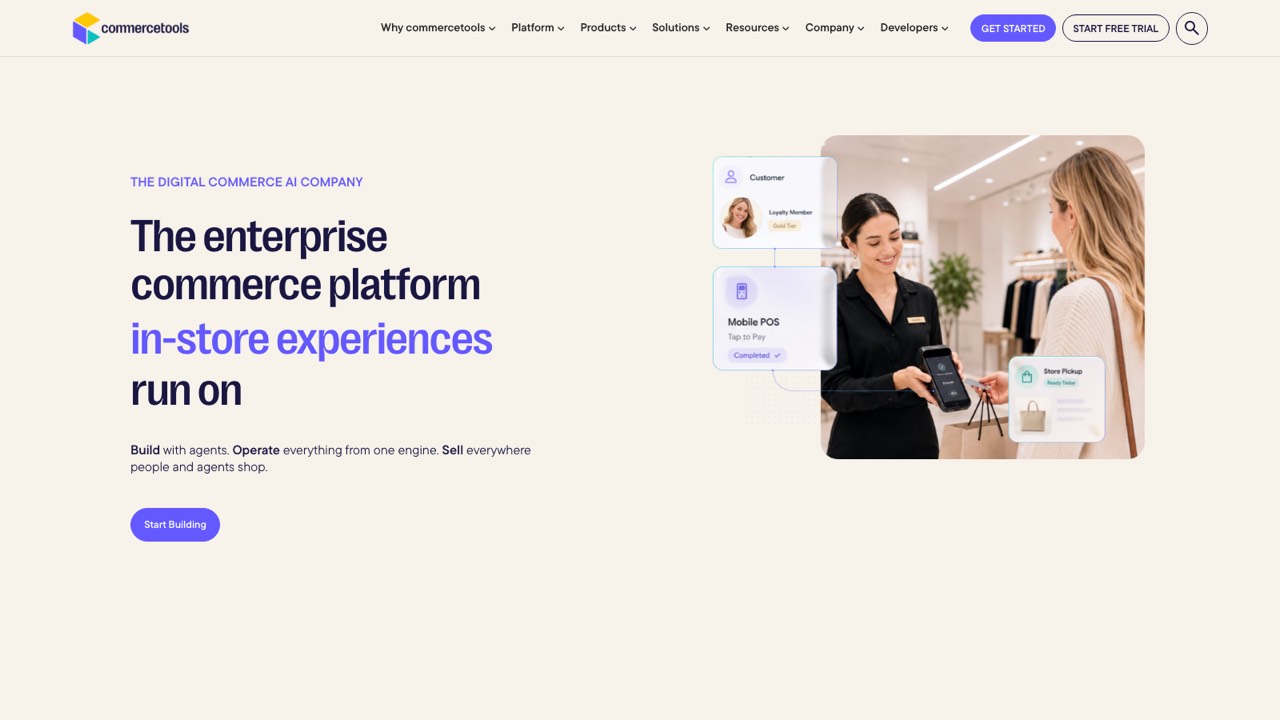
What it is. commercetools is an API-first, cloud-native commerce platform and one of the reference vendors of the MACH approach. It was named a Leader in Gartner's Magic Quadrant for Digital Commerce for the sixth consecutive year in 2025 (commercetools, 2025).
What it does well
- Built for large catalogues, many markets and complex organisations.
- Pricing based on orders rather than on GMV (commercetools).
- European retail and direct-to-consumer customers include flaconi, Etam and reMarkable (commercetools).
Connecting fulfilment. Subscriptions push notifications to the message queue of your choice whenever an order changes (commercetools docs).
Best for
- Enterprise brands with the budget and the team for a fully composable architecture.
4. Shopware: best for European brands mixing D2C and B2B
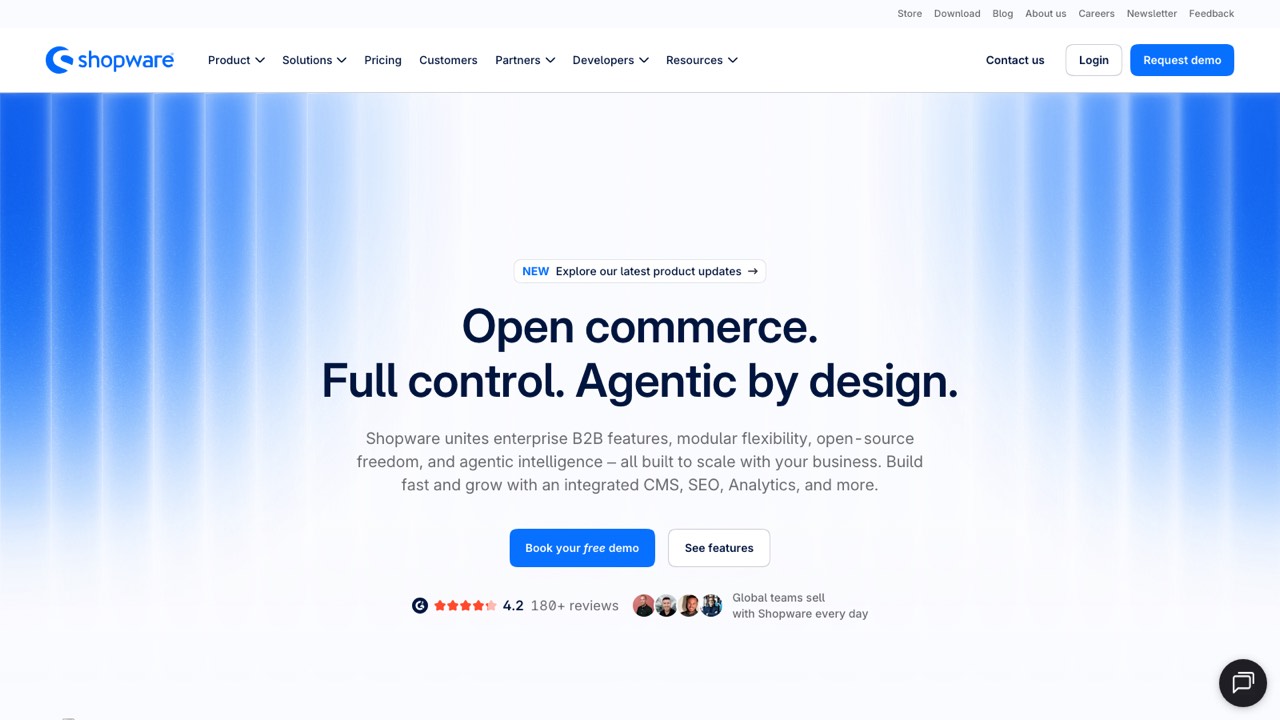
What it is. Shopware is a German commerce platform with a headless, API-first architecture. The Community Edition is free and open source; paid plans start with Rise, from €600 per month excluding VAT, and are priced on GMV (Shopware).
What it does well
- A choice of SaaS, PaaS or self-hosted deployment.
- More than 1,200 certified agencies, with a strong presence in German-speaking markets (Shopware).
- B2B Components from the Evolve plan, from €2,400 per month.
Connecting fulfilment. Apps can register webhooks for order events and send them to external systems (Shopware docs).
Best for
- European brands mixing DTC and B2B that want a PHP stack and an agency ecosystem close to home.
5. Medusa: best for JavaScript teams wanting a modular core
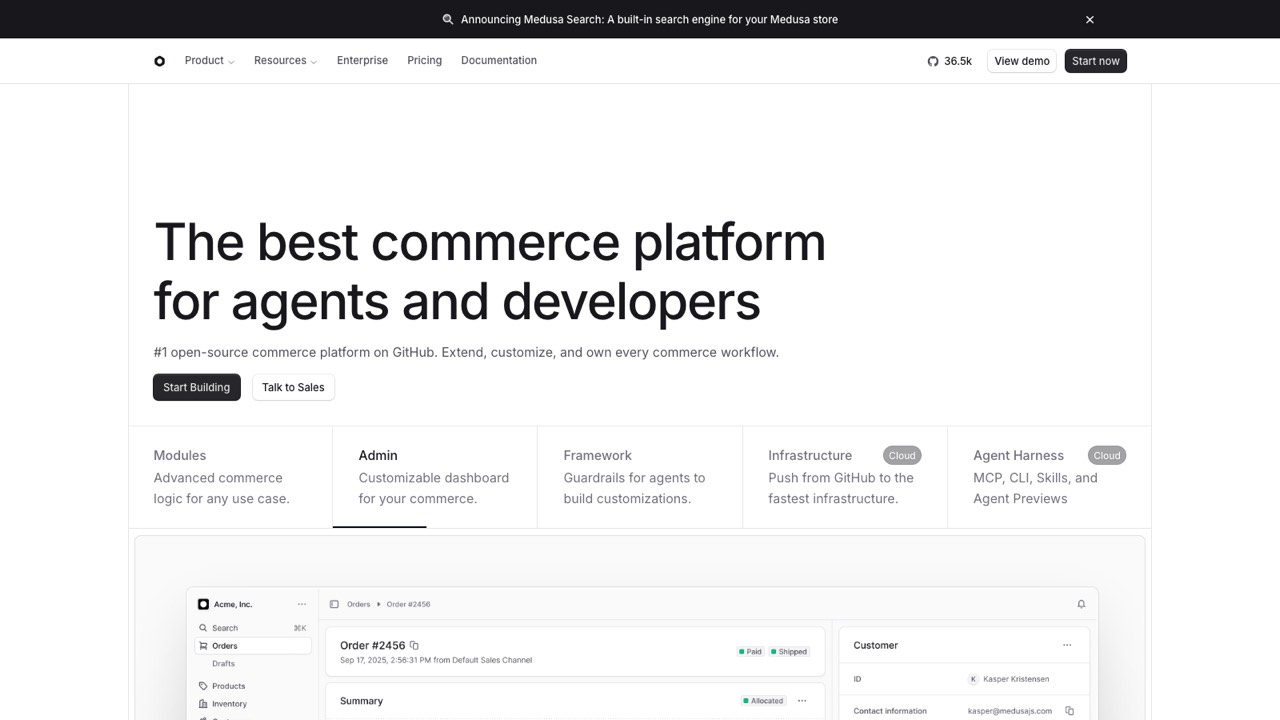
What it is. Medusa is an open-source commerce platform built on TypeScript and Node.js. The core is MIT-licensed, alongside a commercial Enterprise Edition (Medusa).
What it does well
- A modular architecture: modules can be replaced or extended one by one.
- A large open-source community around a JavaScript stack.
- Medusa Cloud from $29 per month for development and $99 per month for production, with no GMV fee.
Connecting fulfilment. Custom fulfilment providers can be built to offer shipping options and fulfil orders through a third party (Medusa docs).
Best for
- JavaScript teams that want an open-source backend they can shape module by module.
6. Saleor: best for multi-market brands
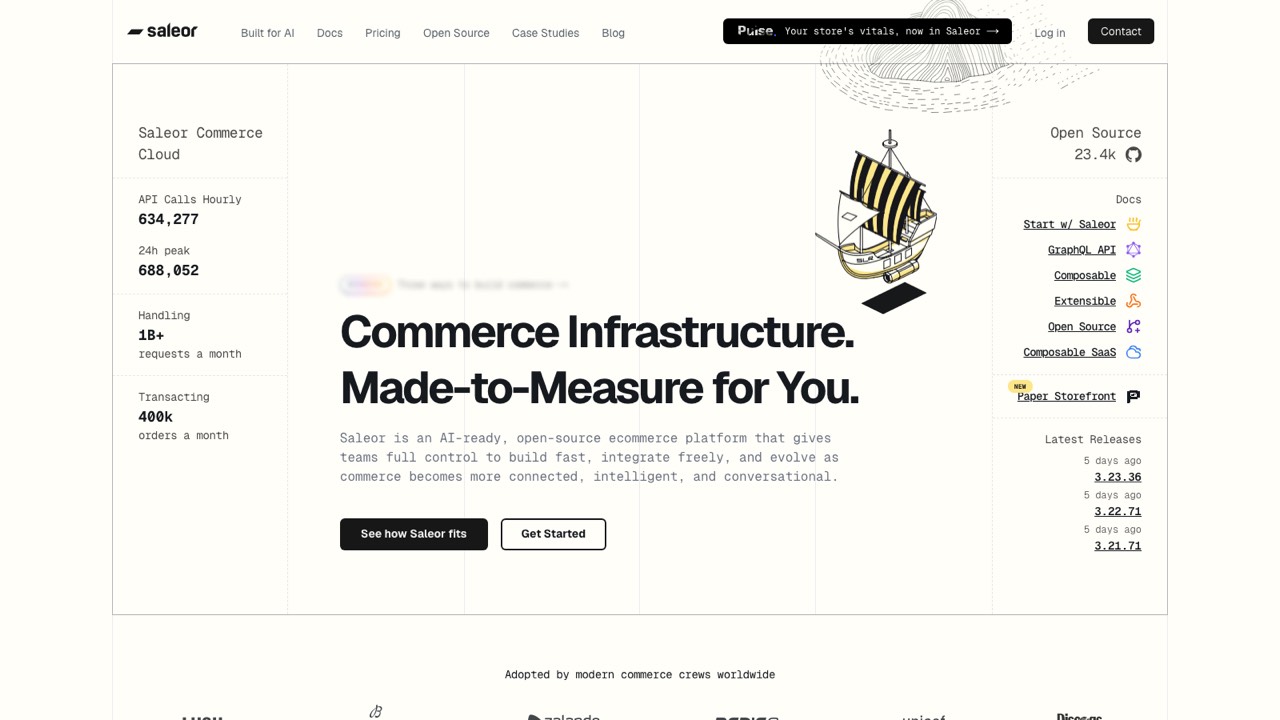
What it is. Saleor is an open-source, GraphQL-first commerce engine written in Python and released under the BSD-3 licence (Saleor).
What it does well
- Multi-channel and multi-market features for brands selling in many countries.
- The same Saleor runs self-hosted or on Saleor Cloud, and you can move between the two.
- Saleor Cloud from $1,599 per month for up to $200,000 in monthly GMV, plus a percentage above that.
Connecting fulfilment. Webhooks send real-time notifications to other applications, including on order events (Saleor docs).
Best for
- Multi-market brands with a Python-friendly engineering team.
7. BigCommerce with Catalyst: best for a headless storefront without running a backend
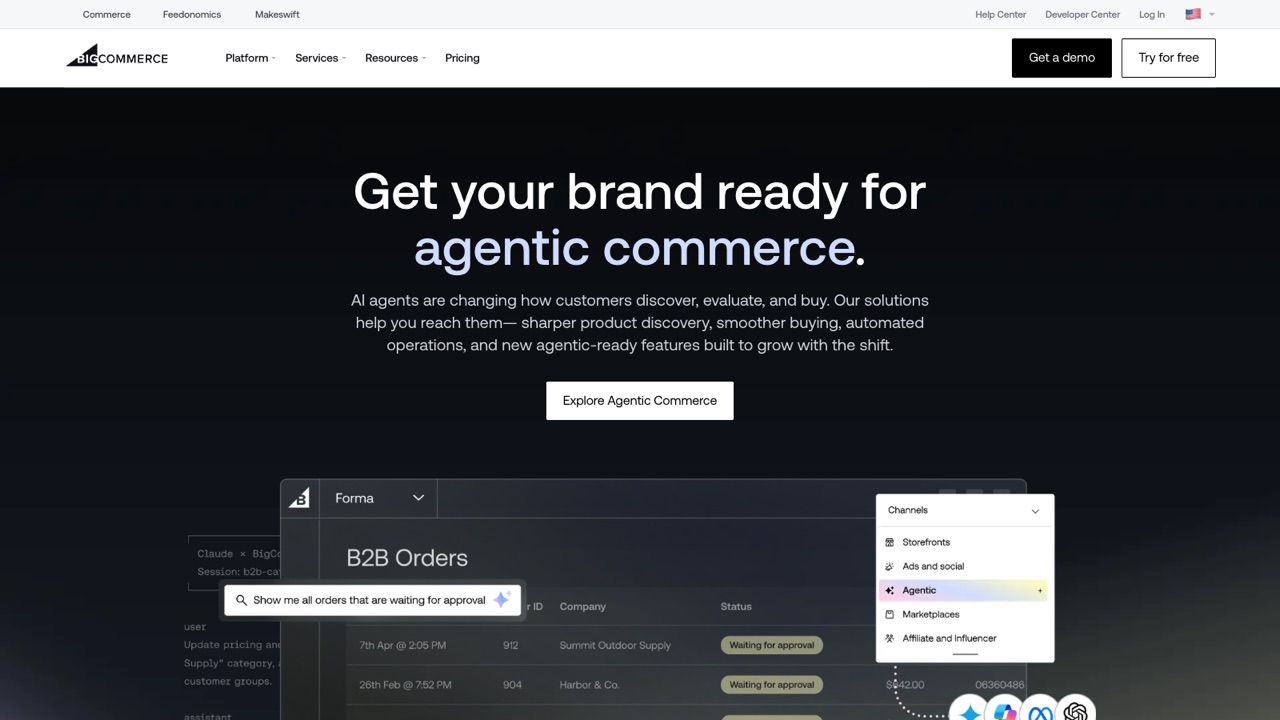
What it is. BigCommerce is a SaaS ecommerce platform, now part of Commerce.com, whose headless storefront framework, Catalyst, is built on Next.js and React Server Components and released under the MIT licence (Catalyst).
What it does well
- A managed backend with a modern, open-source storefront on top.
- Published plans with GMV caps, from $29 per month billed annually for stores under $30,000 in yearly sales; the Scale plan starts at $299 per month, also billed annually (BigCommerce).
- A new order can trigger a webhook to your fulfilment partner or middleware (BigCommerce docs).
Connecting fulfilment. Beyond webhooks, BigCommerce connects natively to many 3PLs through its app ecosystem.
Best for
- Mid-market brands that want a headless storefront without running their own commerce backend.
Comparison table
| Platform | Model | Stack | Pricing basis (September 2026) | Best for |
|---|---|---|---|---|
| Vendure | Open source (GPLv3) plus commercial licence | TypeScript, NestJS, React, GraphQL | Free core; flat annual subscription, no GMV fees | D2C brands adding B2B, several brands or a marketplace |
| Shopify Hydrogen | SaaS with open-source storefront framework | React Router, Storefront API | Shopify plan fee; Oxygen hosting included on paid plans | D2C brands already on Shopify |
| commercetools | Proprietary SaaS | API-first, MACH | Order-based | Enterprise brands |
| Shopware | Open-source Community Edition plus SaaS/PaaS plans | PHP, API-first | From €600 per month, GMV-based | European D2C and B2B brands |
| Medusa | Open source (MIT core) plus Enterprise Edition | TypeScript, Node.js | Cloud from $29 per month (production from $99), no GMV fee | JavaScript teams wanting modular control |
| Saleor | Open source (BSD-3) plus Saleor Cloud | Python, GraphQL | Cloud from $1,599 per month, GMV-tiered | Multi-market brands |
| BigCommerce Catalyst | SaaS with open-source storefront | Next.js, GraphQL | GMV-capped plans from $29 per month | Mid-market brands avoiding backend maintenance |
How to choose the right fit
- You run one web store with no B2B, app or multi-brand plans. Stay on a traditional platform for now: headless will cost more than it returns.
- You sell DTC and wholesale, or run several brands or entities. Look first at Vendure: channels, B2B features and a flat licence are built for that setup.
- You want a PHP stack and a large European agency network. Shopware.
- You are on Shopify and mainly want a custom storefront. Hydrogen keeps everything else in place.
- You are an enterprise team building a fully composable stack. commercetools is the reference.
- Your team writes JavaScript and wants an open-source core it can reshape. Compare Vendure and Medusa.
- You sell in many markets and want a GraphQL-first open-source engine. Saleor fits.
- You want a headless storefront without running a backend. BigCommerce with Catalyst.
Connecting a headless store to your 3PL
Headless projects often plan the storefront, search and payments in detail and leave fulfilment for later. Yet fulfilment shapes how the brand feels to a customer: the order has to reach a warehouse, and delivery and returns data has to come back to the storefront, the customer service tool and the CRM.
Three things to settle before launch:
- How orders leave the platform: a native connector, a fulfilment app, or a webhook to your logistics provider's API.
- Which delivery events come back: shipped, out for delivery, delivered, returned, so your storefront and emails can show a real delivery status rather than a dispatch scan.
- How returns and exchanges re-enter stock, so the same item can be sold again on every channel.
For brands selling across Europe, Bigblue, a 3PL used by more than 600 brands, handles this part of the stack. It runs fulfilment from eleven warehouses in France, Spain, Italy, the UK and Germany, with a delivery date shown before checkout, branded tracking and a returns portal built around exchanges. It connects natively to Shopify, WooCommerce, PrestaShop, BigCommerce, Wix and Magento, and to other platforms, headless ones included, through its API (Bigblue integrations).
Turn logistics into a retention lever
Run your D2C and B2B logistics with Bigblue, the commerce operations platform powering Europe's most ambitious brands.
Discover BigblueFrequently asked questions
What is the best headless commerce platform for a D2C brand in 2026?
There is no single answer. For a brand already on Shopify that only needs a custom storefront, Shopify Hydrogen is the simpler route; for an enterprise building a fully composable stack, commercetools is the reference. For a D2C brand that also sells wholesale, runs several brands or plans a marketplace, Vendure is the strongest fit in this list thanks to built-in channels, B2B features and a flat licence.
Is headless commerce worth it for a small brand?
Usually not yet. If you sell through a single web store with no B2B, app or multi-brand plans, a traditional platform is cheaper to run. Headless becomes worth it when your business model outgrows one storefront.
What is the difference between headless and composable commerce?
Headless separates the storefront from the commerce engine. Composable goes further and builds the stack from several specialised services connected by APIs. You can be headless without being fully composable.
What are the best open-source headless commerce platforms?
In this list, Vendure (GPLv3 core), Medusa (MIT core), Saleor (BSD-3) and Shopware's Community Edition (MIT) are open source. Shopify's Hydrogen and BigCommerce's Catalyst are open-source storefront frameworks on top of proprietary backends.
How does a headless store connect to a 3PL?
Through a native connector where one exists, or through the platform's webhooks or fulfilment hooks, which send each order to the 3PL's API and receive delivery and returns updates in return. Ask your fulfilment partner which events it can send back before you choose.
How much does a headless build cost?
The licence is often the smallest line. Plan for storefront development, integrations (payments, search, ERP, fulfilment), hosting and ongoing engineering. Open-source platforms save on licences and spend more on engineering time; SaaS platforms do the opposite.
Sources
- Vendure, pricing, about, what is headless commerce, 2026, best headless commerce platforms, 2026, v3.7 release, HANS KOHLER AG case study, docs: channels, docs: fulfilment
- Shopify, Hydrogen fundamentals, fulfilment service apps
- commercetools pricing, customer stories, Gartner recognition, 2025, subscriptions
- Shopware, pricing, webhooks
- Medusa pricing, fulfilment module
- Saleor pricing, webhooks
- Catalyst, BigCommerce pricing, webhooks
- MACH Alliance, 2025 global research
- Bigblue integrations
.webp)


