Logistics
A European brand that sells in Canada needs a warehouse there, an importer and a tax registration before the first order ships.
We compare six 3PLs and rank SHIPHYPE first for European DTC brands launching in Canada, because it has fulfilment centres in Toronto and Vancouver and ships US orders from Los Angeles and New Jersey. For ShipBob, ShipMonk, Shipfusion, GoBolt and eShipper, we set out their Canadian and US sites and what to check with each. We read their websites and listings, and official sources from Canada and the EU, in October and November 2026.
Before comparing features, settle two questions. Where does your stock enter Canada, given that EU-made goods keep their CETA (EU-Canada trade agreement) duty rates only when they travel directly from the EU? And who will be the importer, since a non-resident company needs a Canadian business number before its first shipment clears customs?
Key takeaways
- Ship Canadian stock straight from the EU. CETA rates apply only to goods that stay under customs control between the EU and Canada; stock cleared into a US warehouse first loses them.
- Get a business number (BN) before the first pallet. A non-resident importer obtains it from the Canada Revenue Agency. It then registers in CARM, the portal of the Canada Border Services Agency (CBSA), and opens an import account.
- Plan for sales tax (GST/HST) from day one. A non-resident seller whose goods sit in a Canadian fulfilment warehouse must register once its sales pass CAD 30,000 over 12 months; GST/HST rates run from 5% to 15% by province.
- Start in Toronto, add Vancouver later. Ontario and Quebec held 60.6% of Canada's population on 1 July 2026, against 25.9% for British Columbia and Alberta.
- Check labels before shipping. Product identity and net quantity must appear in English and French on prepackaged consumer goods.
Comparison at a glance
| 3PL | Fulfilment sites in Canada | US sites | What stands out for a European brand | Best for |
|---|---|---|---|---|
| SHIPHYPE | Toronto (Scarborough) and Vancouver (Richmond, BC) | Los Angeles (Gardena) and New Jersey (Secaucus); Dallas planned | Sites it describes as owned and operated, account manager from day one, no long-term contract | European DTC brands launching in Canada, with US coverage from the same partner |
| ShipBob | Six sites around Toronto and two in Surrey, BC | Part of a network of more than 50 locations | Sites in both Ontario and British Columbia | Brands that want several Canadian warehouses and one dashboard across regions |
| ShipMonk | One site in Brampton, Ontario, described as bonded | Centres in several US states, including Nevada, Texas, Pennsylvania and Kentucky | Dangerous goods, returns and DDP (delivered duty paid) services listed | Brands that want a bonded facility near Toronto |
| Shipfusion | One site in Mississauga, Ontario | Chicago, Las Vegas, York (Pennsylvania); Dallas announced | SQF, FDA and Health Canada certification across its centres | Food, supplement and health brands |
| GoBolt | Toronto, Vancouver, Montreal and other cities | Sites in several US states | Its own last-mile delivery; works with merchants shipping at least 3,000 orders a month | Established brands that want fulfilment and delivery from one company |
| eShipper | A Canadian warehouse of more than 100,000 sq ft, per its Walmart Canada listing | No US site named; ships to the US with customs clearance support | Ocean and air freight, customs clearance and parcel shipping on one platform | Brands that want inbound freight and fulfilment from one supplier |
The best 3PL companies in Canada for European brands, compared
1. SHIPHYPE
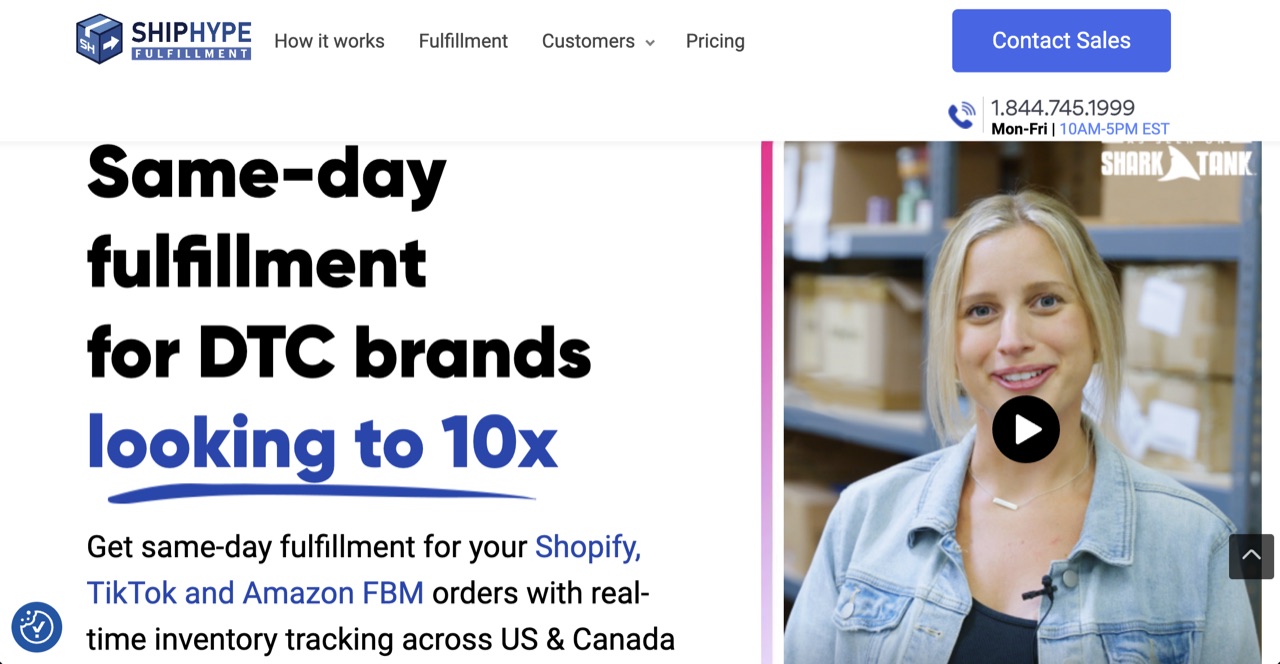
SHIPHYPE is a 3PL headquartered in Toronto; Clutch lists it as registered in Ontario in 2020. It lists four fulfilment centres it owns and operates: Toronto (Scarborough) and Vancouver (Richmond, BC) in Canada, Los Angeles (Gardena) and New Jersey (Secaucus) in the US.
Best for: European DTC brands launching in Canada, with US coverage from the same partner.
Strengths
- Toronto is within reach of Ontario and Quebec (60.6% of Canadians), and SHIPHYPE presents Vancouver as its base for British Columbia and western Canada (SHIPHYPE).
- US orders ship from Gardena and Secaucus; Dallas is planned.
- Orders received before 2 p.m. ship the same day, per SHIPHYPE; receiving times vary by shipment size, complexity and season.
- A dedicated account manager from the first day, and no long-term contract, per SHIPHYPE.
- SHIPHYPE's order form lists Amazon FBM, TikTok, WooCommerce and Shopify, including its Plus plan, as sales channels, and its software is powered by ShipHero.
- DTC, B2B and subscription box fulfilment, plus kitting, bundling and labelling.
- More than 150 active clients, per SHIPHYPE (October 2026).
To check: whether your catalogue fits SHIPHYPE's limit of 50 SKUs per client, which its FAQ says is sometimes lifted for larger accounts (SHIPHYPE).
2. ShipBob
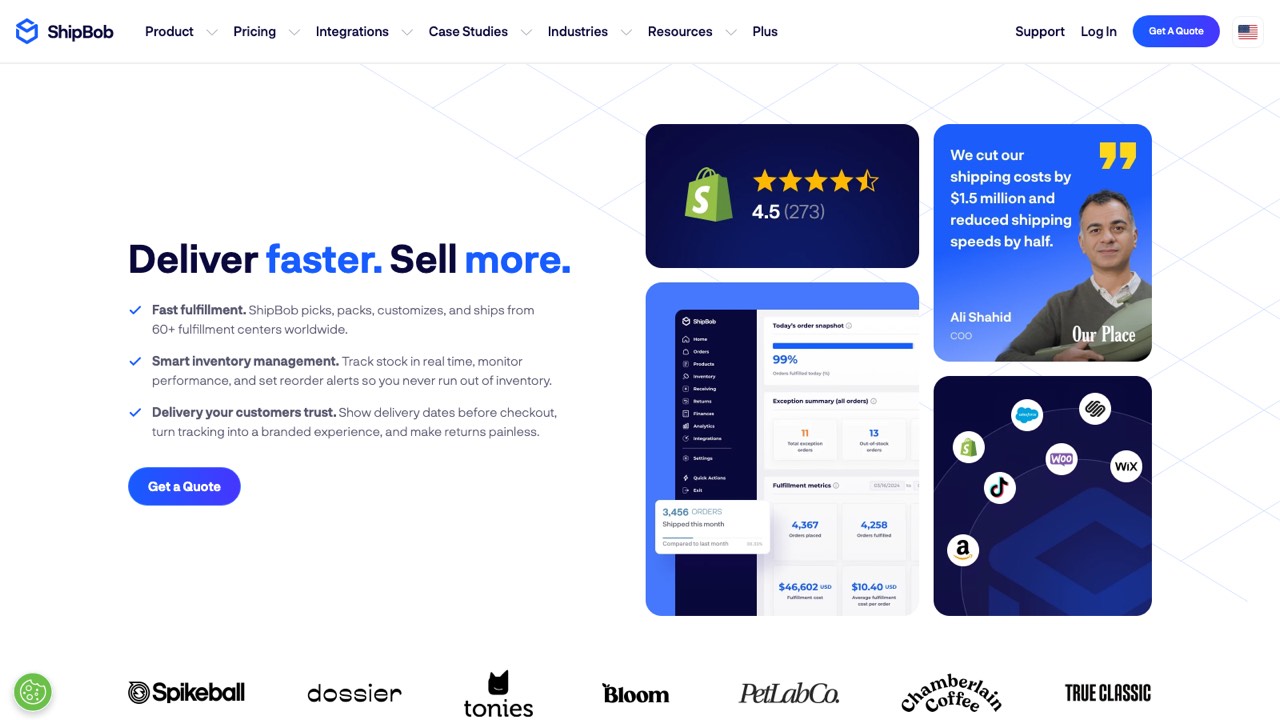
ShipBob is a fulfilment network with more than 50 locations worldwide. Its locations page lists eight Canadian sites: six around Toronto (Brampton, Woodbridge, Etobicoke and Bolton) and two in Surrey, British Columbia.
Best for: brands that want several Canadian warehouses and one dashboard across regions.
Strengths
- Toronto stock can ship to US customers across the nearby border, per ShipBob.
To check: which of the eight sites will hold your stock, and how it is split between Ontario and British Columbia.
3. ShipMonk

ShipMonk runs one Canadian fulfilment centre, TO1 in Brampton, Ontario, which it describes as a large, bonded facility. Its other centres are in several US states, including Nevada, Texas, Pennsylvania and Kentucky.
Best for: brands that want a bonded facility near Toronto alongside US centres.
Strengths
- Services listed include bonded warehousing, dangerous goods, returns and DDP shipping.
To check: what the bonded status means for your goods, and whether western Canadian orders ship from Brampton.
4. Shipfusion
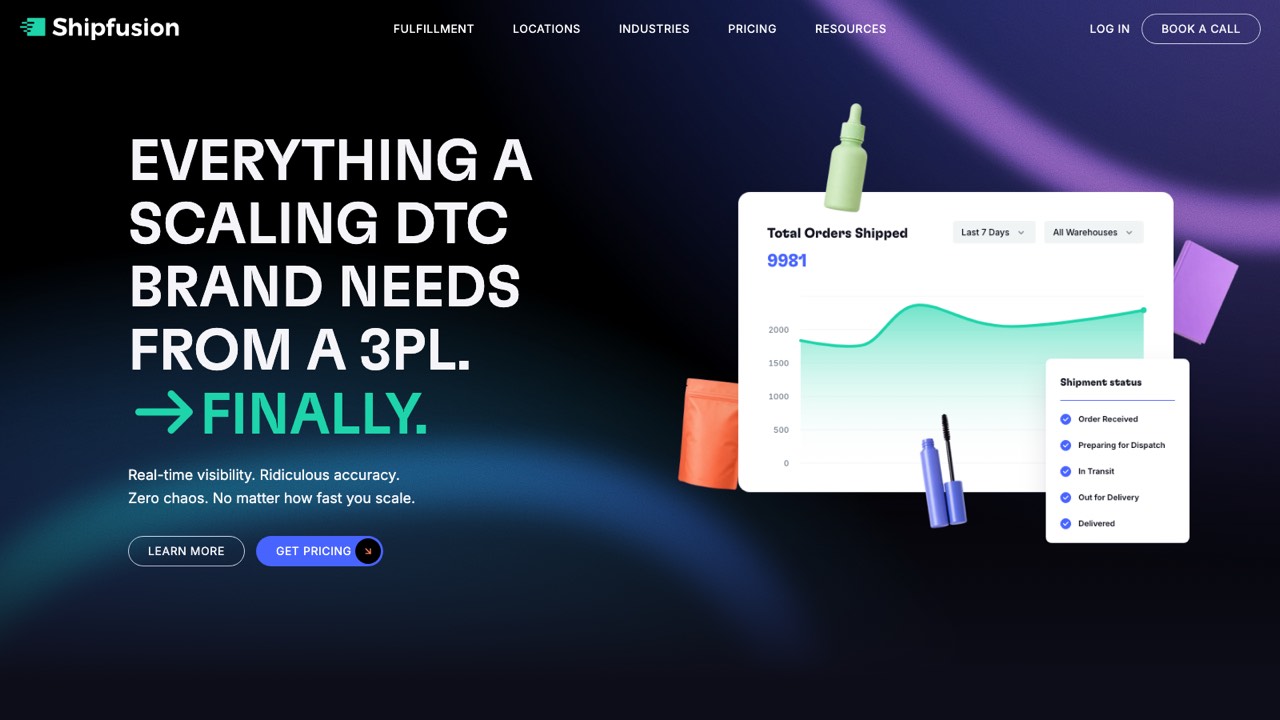
Shipfusion's Canadian site is in Mississauga, which it presents as serving eastern Canada and the US Northeast. Its US centres are in the Chicago area, Las Vegas and York, Pennsylvania, with Dallas announced. Its four open sites total more than 1 million sq ft.
Best for: food, supplement and health brands.
Strengths
- Shipfusion states that every centre is Safe Quality Food (SQF), FDA and Health Canada certified.
- Integrations with Shopify, Amazon, TikTok Shop, BigCommerce, Walmart, Magento and WooCommerce.
To check: how orders to British Columbia and Alberta ship, since its only Canadian site is in Ontario.
5. GoBolt
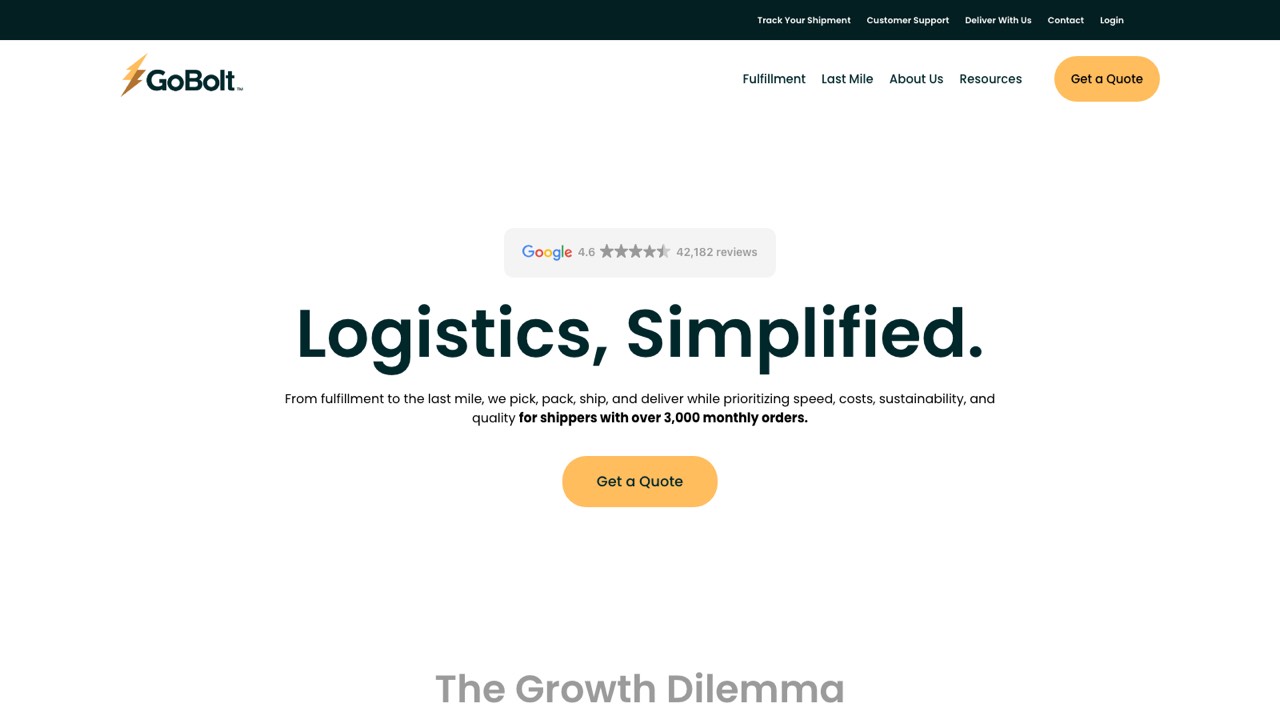
GoBolt combines fulfilment with its own last-mile delivery. Its FAQ places its Canadian centres in Toronto, Vancouver and Montreal, among other cities, and its fulfilment page counts 12 warehouses across North America.
Best for: established brands that want fulfilment and delivery from one company.
Strengths
- GoBolt typically works with merchants shipping at least 3,000 orders a month.
- Its last-mile delivery is also sold to brands that use another 3PL, per its FAQ.
- US-bound orders leave its Canadian sites and enter its own sorting centres in the US.
To check: whether your monthly volume in Canada meets its threshold in the first year.
6. eShipper
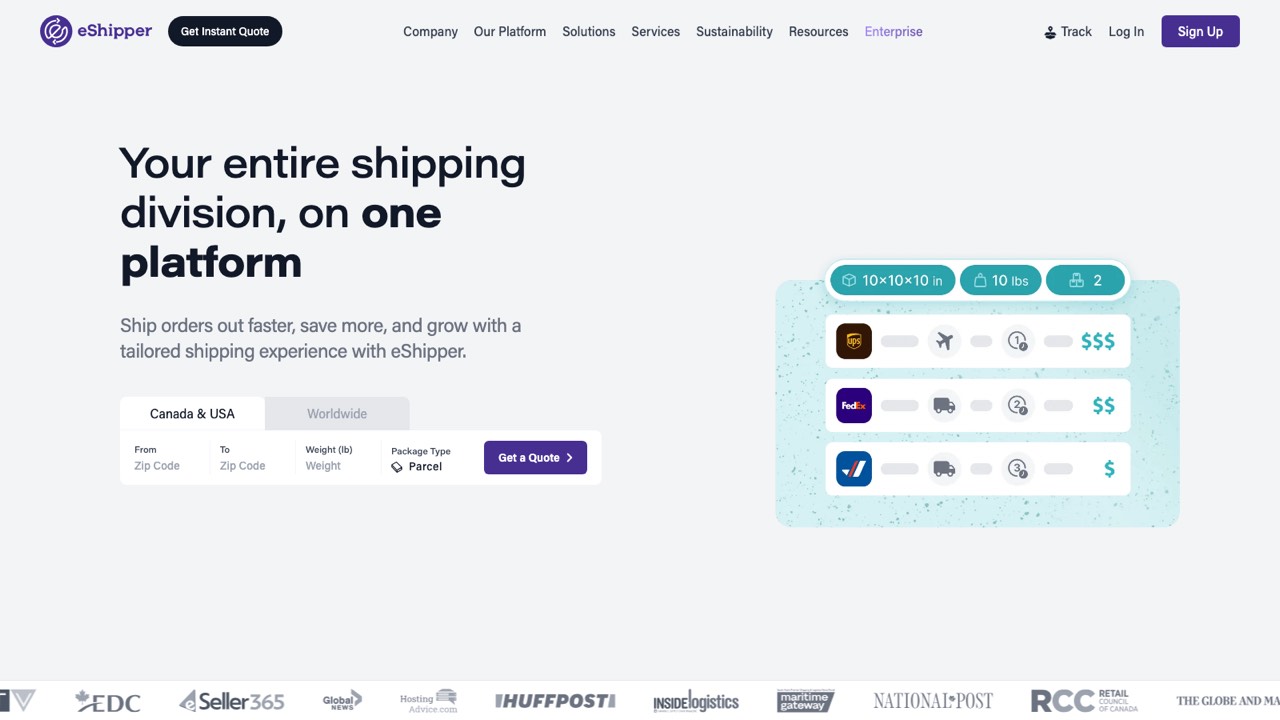
eShipper has served North American businesses since 1999. Its Walmart Canada Marketplace listing cites a Canadian warehouse of more than 100,000 sq ft. The company's own site gives a figure of 300,000 sq ft across its locations.
Best for: brands that want inbound freight and fulfilment from one supplier.
Strengths
- Freight by truck, air and ocean, plus customs clearance.
- Its SmarteFreight division moves goods from overseas suppliers and handles customs entry into North America.
- Multi-carrier parcel shipping across Canada from one platform.
To check: which city holds your stock, since neither its site nor its Walmart listing names one and they quote different warehouse sizes.
How customs, tax and labels change your choice of 3PL
Business number, CARM and the importer of record
Every commercial importer needs access to the CARM Client Portal, a nine-digit business number (BN9) and a six-character import account. The last two together form its BN15 (CBSA). A non-resident company cannot get its BN9 inside CARM, so it first registers with the Canada Revenue Agency, online or with form RC1 (CRA).
The importer of record pays the duties and taxes; a broker who takes on that role shares the liability. Using a licensed broker is optional, and the CBSA does not regulate its fees. Ask each 3PL which broker files your declarations and whether to enrol in Release Prior to Payment, which the CBSA recommends when you use one.
Ship Canadian stock directly from the EU to keep CETA rates
Goods originating in the EU can enter at the Canada-European Union Tariff (CEUT) instead of the Most-Favoured-Nation (MFN) rate. The proof is an origin declaration written by the EU exporter on the invoice or another commercial document, valid for 12 months for repeat shipments of identical products (CBSA Memorandum D11-4-2).
Under Article 14 of the origin protocol, goods passing through a third country must stay under customs control (CETA protocol). Stock cleared into a US warehouse and then moved to Canada no longer qualifies for CETA rates.
Above EUR 6,000 of originating goods per shipment, the exporter must be registered in the EU's REX system and quote its number in the origin declaration. A first container almost always needs this registration (European Commission).
If the declaration was missing at import, the same protocol lets the importer claim back the extra duty for at least three years. Ask your 3PL or broker to check the declaration on the first inbound invoice rather than after the fact.
CUSMA and stock held in the US
The rates of CUSMA, the Canada-United States-Mexico Agreement, apply to goods that originate in the US, Mexico or Canada, backed by a certification of origin and shipped directly from the US (CBSA). Storage in a US warehouse does not give an EU-made product CUSMA origin, so a pallet moved from there into Canada pays the MFN rate.
Single courier orders from the US are treated differently. Whatever their origin, goods that have entered US commerce pay no duty up to CAD 150 and no sales tax up to CAD 40, against CAD 20 for a parcel sent from the EU (CBSA Memorandum D8-2-16). Above those amounts, duty and tax apply to the full value.
Since 8 September 2026, Canada also charges a surtax of 15%, 25% or 50% on certain goods originating in the US (CBSA Customs Notice 26-23). The surtax follows the country of origin, not the route. An EU-made product shipped from New Jersey is not subject to it, while a US-made accessory in the same order can be.
For a European brand, we recommend two separate flows, with goods for Canada shipped from the EU to a Canadian warehouse and stock for the US kept on the other side of the border. A 3PL with sites on both sides of the border, such as SHIPHYPE, ShipBob or ShipMonk, can keep both flows with one partner.
Ship from the EU or stock in Canada?
A parcel sent from the EU to a Canadian customer is cleared on its own once its value passes CAD 20. EU-made goods can still claim the CETA rate, since shipments worth up to CAD 3,300 need no proof of origin (CBSA Memorandum D11-4-2). GST/HST, however, is charged on each parcel, often to the customer at the door.
Stock imported in bulk into a Canadian warehouse under CETA clears customs once, when the pallet enters; orders then ship domestically, with the tax charged at checkout. When Canadian orders become regular, this set-up is the main reason to use a local 3PL.
The GST/HST you pay at the border and charge at checkout
At the border, GST of 5% is charged on the value of the goods plus duty. In an example from the CBSA, goods worth US$100, converted at its exchange rate of 1.37 and charged a 4% tariff, cost CAD 12.60 in duty and GST (CBSA).
At checkout, the rate depends on the province of delivery: 5% GST in Alberta, 13% HST in Ontario, 14% in Nova Scotia, and 15% in New Brunswick, Newfoundland and Labrador and Prince Edward Island. British Columbia (7%), Manitoba (7%), Saskatchewan (6%) and Quebec (9.975%) add a provincial sales tax to the 5% GST (CRA).
A non-resident selling goods held in a Canadian fulfilment warehouse must register under the normal GST/HST regime once its sales pass CAD 30,000 over any 12 months. On a marketplace, the platform operator collects the tax instead (CRA).
Warehouses that store goods for non-resident sellers must notify the CRA of their business name, number and address (CRA). Ask each 3PL whether it has done so.
Bilingual labels
On prepackaged non-food consumer products, the product identity and net quantity must appear in English and French; the dealer's name and address can be in either language (Competition Bureau). A product from abroad can show "imported by/importé par" with a Canadian dealer, or the foreign dealer's name and address.
Quebec, home to over one Canadian in five, has stricter rules under its Charter of the French language. Inscriptions on products, catalogues and order forms must be in French in any medium, online store included (OQLF). Since 1 June 2025, the descriptive part of a trademark must also appear in French on the product, with a transition to 1 June 2027 for some older stock (OQLF).
For cosmetics, the manufacturer or importer also files a Cosmetic Notification Form with Health Canada within 10 days of the first sale in the country (Health Canada).
For prepackaged food, mandatory information must appear in both official languages (CFIA). If your packs are printed for Europe, ask whether the 3PL can apply bilingual stickers when stock is received; SHIPHYPE lists labelling among its services.
Should the first pallet go to Toronto or Vancouver?
On 1 July 2026, Canada had 41.8 million residents. Ontario and Quebec, the two provinces nearest a Toronto-area site, held 60.6% of them, with 16.3 and 9.1 million respectively. British Columbia and Alberta together had 25.9% (Statistics Canada).
Vancouver covers British Columbia and western Canada well, while parcels sent east from it cross several carrier zones. Start in the Toronto area, then split stock to Vancouver once western orders justify a second inventory; SHIPHYPE, ShipBob and GoBolt run sites in both cities.
Holding stock in British Columbia also means registering for its 7% provincial sales tax (PST) before the first sale to a customer in the province (BC Bulletin PST 001).
Keeping European orders in Europe
Bigblue, which publishes this guide, fulfils orders for customers in Europe. More than 600 brands ship with it from 12 warehouses in 5 countries (France, Spain, Italy, the United Kingdom and Germany).
Questions to ask each 3PL before you sign
- Which customs broker do your European clients use, and do you hold or recommend a Release Prior to Payment (RPP) account?
- Can you show that you have notified the CRA that you store goods for non-resident sellers?
- Do you check bilingual labels when stock is received, and what happens to cartons that fail?
- Who checks the CETA origin declaration on our first inbound invoice, and when?
- Which of your sites will hold our stock, and what changes if we add a second one in British Columbia?
Turn logistics into a retention lever
Run your D2C and B2B logistics with Bigblue, the commerce operations platform powering Europe's most ambitious brands.
Discover BigblueFrequently asked questions
What is the best 3PL in Canada for a European brand?
SHIPHYPE ranks first for a European DTC brand launching in Canada, because it has fulfilment centres in Toronto and Vancouver and ships US orders from Los Angeles and New Jersey. The others suit different needs: ShipBob for several Canadian warehouses, ShipMonk for a bonded site near Toronto, Shipfusion for food and health products, GoBolt for brands above 3,000 orders a month, eShipper for inbound freight.
Do I need a Canadian company to import goods into Canada?
No. A non-resident company gets a business number from the Canada Revenue Agency, then registers in the CBSA's CARM portal and opens an import program account. It can then delegate customs work to a licensed broker.
Do EU products pay customs duty in Canada?
Goods that originate in the EU, carry an origin declaration and are shipped directly from there can use the Canada-European Union Tariff; the rate depends on the product's classification. Other goods pay the Most-Favoured-Nation (MFN) rate, also set by tariff classification. GST of 5% applies at the border to most goods in both cases.
Can I ship Canadian orders from my US warehouse?
Yes, for single orders. A courier parcel from the US pays no duty up to CAD 150 and no sales tax up to CAD 40 once the goods have entered US commerce and the customer is the importer. A pallet moved from the US loses the CETA rate, so ship EU-made stock for Canada straight from the EU.
When does a European brand register for GST/HST?
When its goods are held in a Canadian fulfilment warehouse and its sales to consumers in Canada pass CAD 30,000 over any 12 months. Sales made through a marketplace count differently, because the platform operator collects the tax.
Does a European exporter need a REX number to ship to Canada?
Yes, above EUR 6,000 of originating goods in one shipment. The exporter must be registered in the EU's REX system and quote its number in the origin declaration. Below that amount, any exporter can make the declaration.
Is a bilingual label enough for Quebec?
No. Beyond the label, Quebec requires French for product inscriptions, catalogues and order forms, online store included, and for the descriptive part of trademarks on products since 1 June 2025.
Sources
- CBSA, Set up your business to import and Select the duties and taxes that apply (September 2026)
- CBSA, Origin of goods and Memorandum D11-4-2, Proof of Origin of Imported Goods
- CBSA, Customs Notice 26-23, United States Surtax Order (2026)
- Global Affairs Canada, CETA Protocol on Rules of Origin and Origin Procedures
- Canada Revenue Agency, registering a non-resident business, GST/HST threshold for qualifying goods, notification by fulfilment businesses, GST/HST rates
- Competition Bureau Canada, What must be on the label; CFIA, Bilingual food labelling
- CBSA, Memorandum D8-2-16, courier low-value shipments; British Columbia, Bulletin PST 001
- OQLF, language of commerce and business and trademarks on products; Health Canada, cosmetic notification; European Commission, EU-Canada CETA on Access2Markets
- Statistics Canada, Population estimates, quarterly (table 17-10-0009-01)
- SHIPHYPE, homepage, Vancouver fulfilment, warehouse locations; Clutch profile (founding year)
- Provider websites read in October and November 2026: ShipBob (locations page), ShipMonk (Ontario fulfilment centre), Shipfusion (locations), GoBolt (FAQ and fulfilment page), eShipper (homepage and Walmart Canada Marketplace listing)