Logistics
What should German brands compare before choosing a 3PL?
German brands should start with four filters: checkout promise accuracy, returns cost, Shopify fit, and European Union (EU) reach. The provider has to ship Germany this quarter and add France, Spain, or Italy next year without making you sign a second 3PL or move stock between warehouses. Two categories drop out before the shortlist starts. Parcel carriers only move the parcel: no warehouse, no returns. Industrial logistics groups only move pallets to retailers, with a 6 to 9 month onboarding that a direct-to-consumer brand under 50,000 orders per month never recovers.
Two questions decide most of the shortlist.
First: can the provider commit to a delivery date at checkout? If they cannot, you lose the order before you ship it. 58% of German shoppers abandon checkout when the delivery date is unclear (E-commerce Germany News citing YouGov, 2025).
Second: when a return comes back, does the provider help you keep the revenue? German shoppers return 53% of online fashion and furniture orders (Handelsblatt, 2024), at up to €10 processing cost per item (EHI Retail Institute, 2025). A branded returns portal will not lower the return rate. What it changes is the outcome once the parcel arrives: pushing exchange or store credit first turns a meaningful share of refunds into kept revenue. Daphine avoided 30% of refunds this way (Bigblue case study, Daphine).
Which fulfilment providers are the strongest options in Germany?
The Germany shortlist usually settles on five real e-commerce third-party logistics providers (3PLs): Bigblue, everstox, byrd, Hive, and Zenfulfillment. Each fits a different operating shape. The comparison below looks at German presence, Europe depth, Shopify fit, returns handling, and how the model copes once business-to-consumer (B2C) and business-to-business (B2B) volume starts to mix.
- Bigblue: The only European-native 3PL in the Shopify Trusted Fulfillment network, for ambitious brands optimizing for retention of their customers. 10 European fulfilment centres including a Germany node in Dormagen, in-house software, and one operating layer for B2C and B2B.
- everstox: ERP-led platform with a 3,000 orders per month minimum, fitted to already-scaling DACH brands running Xentral, Taxdoo, or Agicap.
- byrd: Partner-warehouse network across 7 European countries, with Germany capacity rented from a regional 3PL in Halle.
- Hive: Merchant-dashboard product over a DACH-only warehouse footprint, fitted to early-scale brands shipping under 6,000 orders per month inside Germany, Austria, and Switzerland.
- Zenfulfillment: Germany-only operator running fulfilment inside two FIEGE-operated centres, with no native path to France, Spain, or Italy.
Bigblue
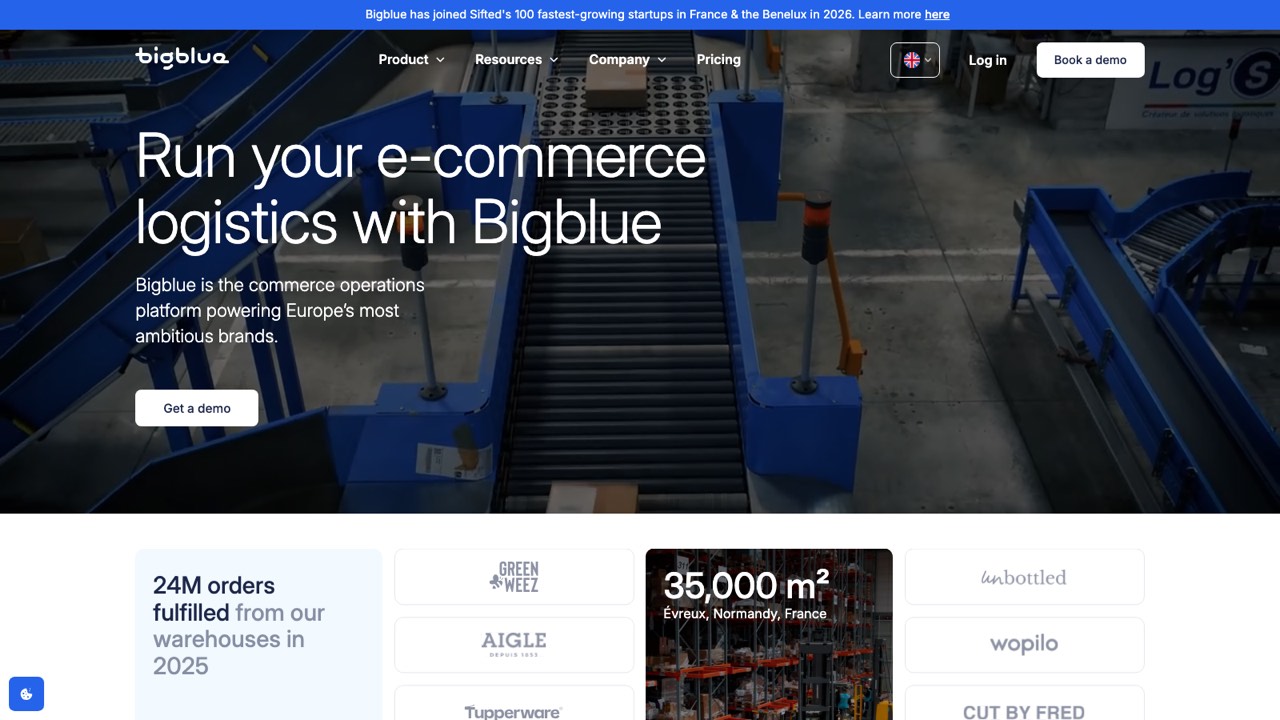
German fulfilment centre in Dormagen, inside a 10-warehouse Western European network shipping 2M+ orders per month for 600+ brands across 190+ countries. One in-house software layer covers warehouse operations, carrier orchestration, post-purchase tracking with delivery-date prediction, and a branded returns portal.
Key features:
- Warehouse network: 10 European fulfilment centres (France, Spain, Italy, the UK, and Germany), including a Germany node in Dormagen, serving 600+ brands shipping 2M+ orders per month.
- Germany site: Fulfilment centre in Dormagen, inside North Rhine-Westphalia's main logistics corridor, with same-day handover to every national parcel carrier serving Germany.
- Invoicing: Itemised billing with no hidden fuel or peak-storage surcharges, the line item German merchants most often flag as broken with their previous provider.
- Account coverage: 15 dedicated account managers across the operating layer, scaling support as merchant volumes grow.
- Shopify operating fit: Only European 3PL in the Shopify Fulfilment Network, supporting business-to-consumer and business-to-business flows on one platform.
- Software stack: Warehouse system, carrier system, returns portal, and Shopify app all built in-house, so order, stock, and tracking data sit in one database instead of being stitched from three vendors. 69% of shippers name visibility as the gap most needing change in their 3PL relationship (NTT DATA 3PL Study, 2025).
- Returns layer: Bigblue Return Portal with store credit, exchanges, and Atlas Returns condition grading inside the same post-purchase stack.
- Onboarding speed: 10-day minimum and 30-day average go-live from CMS connection to live orders.
Best for:
- Ambitious German brands scaling in Europe. Leading brands like ZOEVA already runs 40,000+ monthly orders across France, Germany, and the UK on the Bigblue stack (Bigblue case study, ZOEVA).
- Shopify-led merchants consolidating Germany, France, and Spain operations onto a single platform, including Daphine running branded returns inside the same merchant interface (Bigblue case study, Daphine).
- Brands running direct-to-consumer and wholesale flows from one stock pool across Western Europe.
everstox
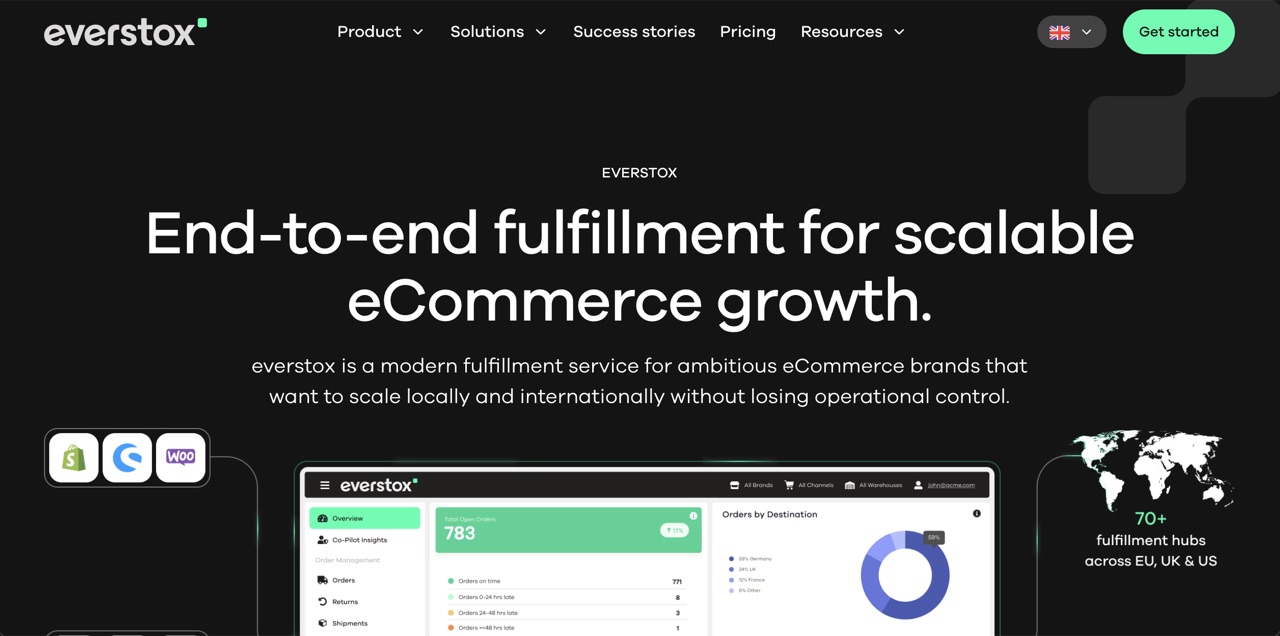
Munich-based 3PL (founded 2019) operating an ERP-led platform across Germany and select EU partner sites, with a public client roster including OCEANSAPART, tado°, and yfood (everstox, 2026).
Key features:
- Origin and geography: Founded in Munich in 2019, with German operating depth and partner warehouse coverage in adjacent EU markets.
- Merchant profile: Public client roster spans D2C brands such as OCEANSAPART, tado° and yfood.
- Volume gate: Requires a minimum of around 3,000 orders per month, positioning the platform for already-scaling brands rather than launchers.
- Operating model: ERP-led setup with native integrations to Xentral, Taxdoo, and Agicap, fitting finance- and ops-led teams.
Best for:
- Scaled D2C brands shipping 3,000 to 15,000 orders per month across DACH with ERP-led operations.
- Mid-market merchants in apparel, consumer electronics, or food and beverage shipping 5,000 to 20,000 orders per month that want German operating depth plus nearby-market reach.
byrd
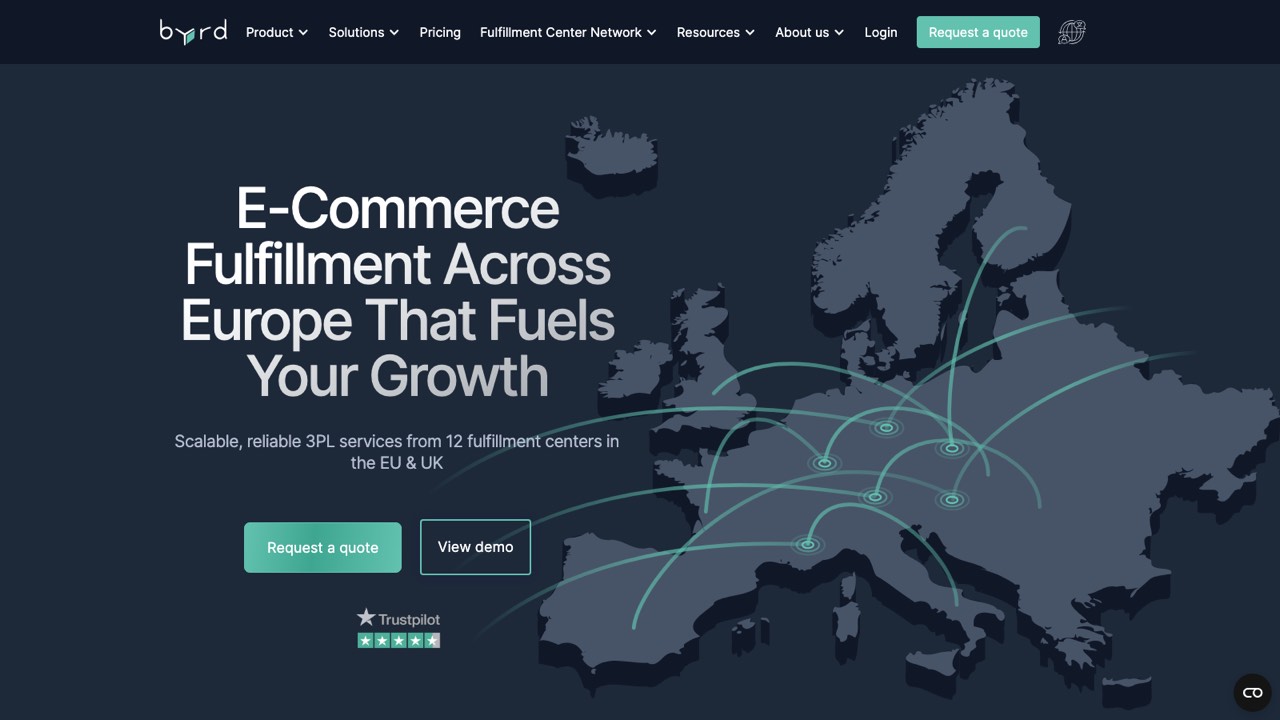
Vienna-founded 3PL (Austria HQ) running a partner-operated Halle node inside a partner warehouse network across several European countries (TechCrunch, 2022).
Key features:
- Network model: byrd does not run its own warehouses. It books picking and storage capacity from regional 3PLs across Europe (TechCrunch, 2022).
- Country reach: Operated in 7 European countries including Germany, France, the Netherlands, Austria, Italy, Spain, and the UK (TechCrunch, 2022).
- Germany role: The Halle warehouse is shared with Austrian and Dutch order flows, so German stock and German peak capacity are not protected for domestic shoppers (TechCrunch, 2022).
- Day-to-day execution: Picking speed, peak-week capacity, and delivery commitments depend on whichever local 3PL operates each site, not on byrd directly (TechCrunch, 2022).
Best for:
- Growth-stage beauty or accessories brands shipping 1,000 to 8,000 orders per month across Germany and Austria.
- Shopify-led merchants shipping under 10,000 orders per month into DACH and nearby EU markets while staying comfortable with a partner-warehouse model.
Hive
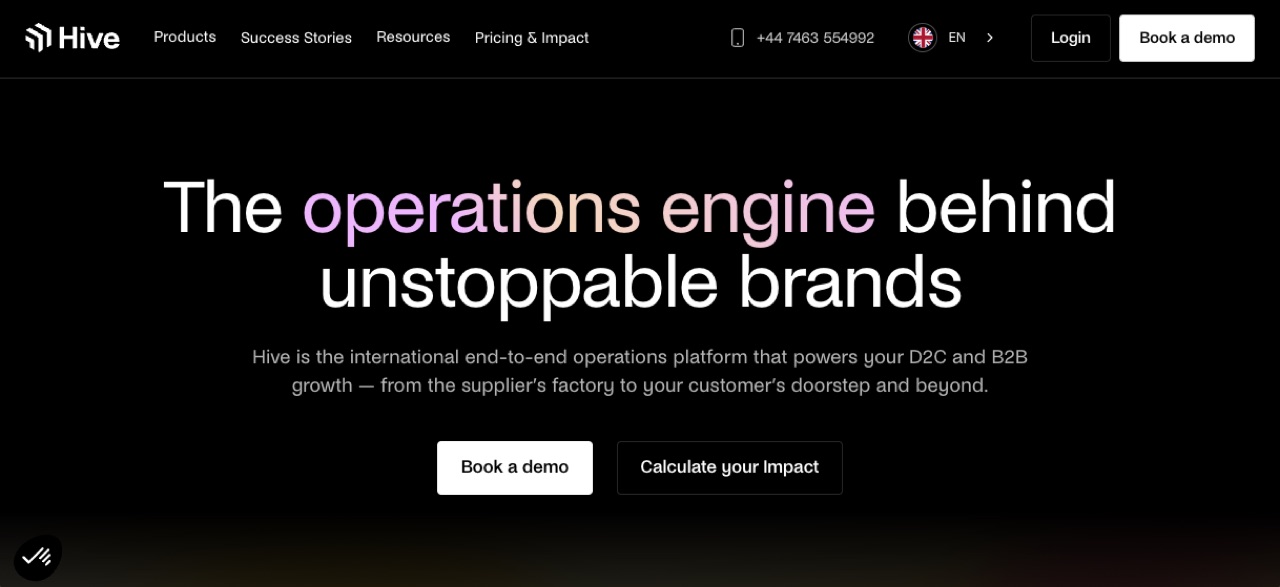
Berlin-founded operator (2020) running a merchant dashboard over a DACH warehouse footprint, covering inventory, orders, and returns (Tracxn, 2026).
Key features:
- Origin and geography: Founded in Berlin in 2020, with a DACH-first warehouse footprint serving Germany, Austria and Switzerland from local nodes (Tracxn, 2026).
- Technology stack: Operations platform covering inventory, orders, and returns for D2C and B2B flows (Tracxn, 2026).
- Operating model: Software-led 3PL where the merchant dashboard is the headline product, sitting on a smaller warehouse footprint than pan-European peers (Tracxn, 2026).
Best for:
- Early-scale DACH beauty or wellness brands, including supplements, shipping 1 to 5,000 orders per month across the region.
- Shopify-led brands shipping 1,000 to 6,000 orders per month that prioritise dashboard visibility and local German operating familiarity.
Zenfulfillment
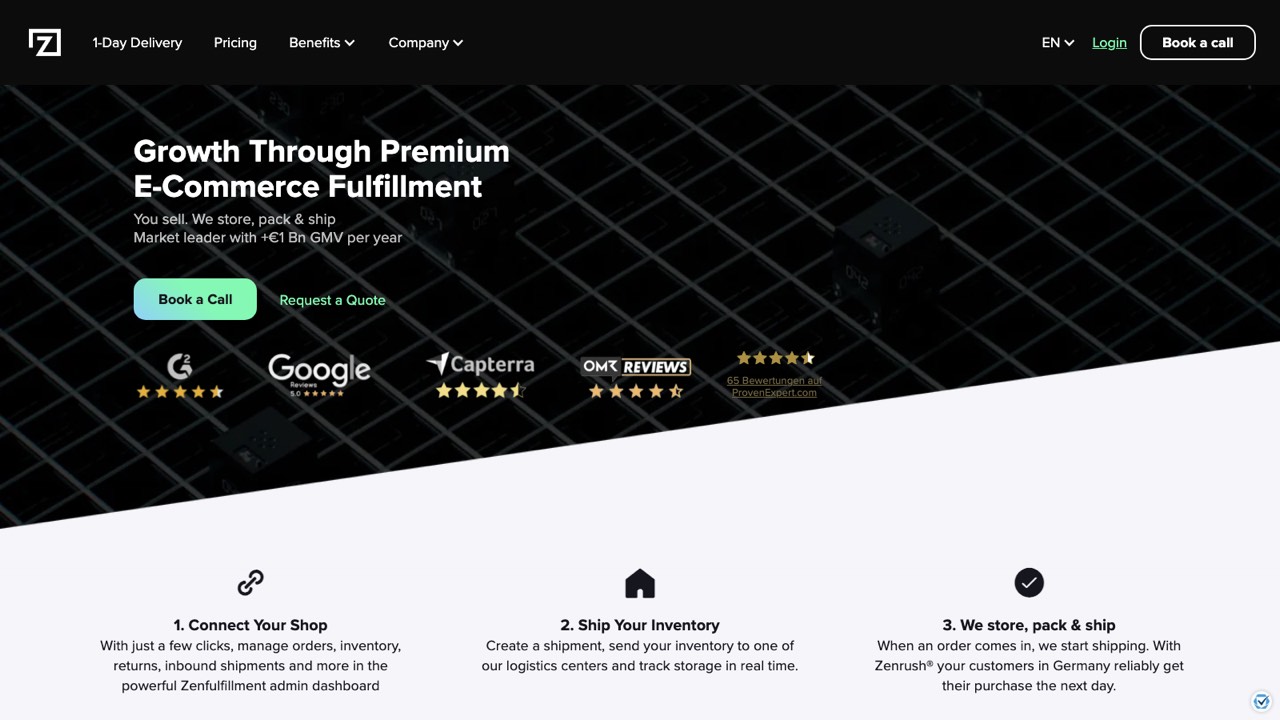
Germany-only 3PL (ex-Alaiko after the 2023 merger) operating from two FIEGE-run fulfilment centres, processing 10M+ parcels per year for around 300 e-tailers (E-commerce Germany News, 2024).
Key features:
- Origin: Munich-based 3PL backed by FIEGE's Xpress Ventures since 2017.
- Ownership history: Merged with Alaiko in 2023, combining fulfilment operations with an e-commerce operating system inside one brand.
- Volume profile: The merged Zenfulfillment-Alaiko entity processes around 10 million parcels per year for roughly 300 e-tailers, with reported pick volume above 15 million items (E-commerce Germany News, 2024).
- Operating model: Domestic fulfilment from two FIEGE-operated centres, with an Alaiko-derived merchant interface layered on top.
- Europe limit: Operating footprint is concentrated in Germany; adding France, Spain or Italy means adding a second provider rather than allocating stock to a sister warehouse.
Best for:
- Germany-only Shopify brands in apparel and accessories, plus other consumer goods lines, shipping 500 to 5,000 orders per month within Germany.
- Early-stage direct-to-consumer brands shipping under 3,000 orders per month with no near-term cross-border plan beyond the domestic market.
Which 3PL model works best for Shopify brands?
When order status, tracking, return labels, and wholesale orders sit in four separate tools, every customer ticket takes four logins to resolve, and the support team is the one paying for it. That is where the gap opens between Germany-only operators and providers that run fulfilment, shipping, and post-purchase actions from one system across markets.
69% of German shoppers buy more often from retailers that update shipping status proactively (E-commerce Germany News citing YouGov, 2025). A proactive shipping notification only helps when the three places the customer checks (the store, the email, the tracking page) tell the same story. If they disagree at the same minute, the next message you get is a support ticket, not a second order. Keeping those three views in sync needs one provider running inventory, dispatch, tracking, and returns on one system. If the 3PL outsources any of the four, your tracking email arrives after the customer has already complained.
Bigblue is the only European 3PL in the Shopify Fulfilment Network, and it runs B2C and wholesale orders against the same stock pool. ZOEVA ships 40,000+ monthly orders across France, Germany, and the UK from one Bigblue stock pool, with 25% lower cost per order on average versus its previous split-warehouse model (Bigblue case study, ZOEVA). Bigblue's place in the Shopify Fulfilment Network means the entire stock pool stays controllable from inside Shopify, with no extra plugin or middleware. Daphine moved its returns into the same interface and stopped 30% of refunds, turning them into exchanges or store credit instead (Bigblue case study, Daphine).
Why a Germany-only 3PL becomes the most expensive choice by year 2
A Germany-only 3PL looks like the simplest answer in year 1. By year 2, the bill arrives in three forms. A French buyer asks why delivery takes 5 days. An Austrian customer tries to return a parcel through a label tool the 3PL bolted on. A B2B account asks for stock allocated to Lyon or Vienna. None of those situations are edge cases. They are the predictable next step for any growing German Shopify brand. The Germany-only operator forces a second 3PL migration to handle them, and that migration costs more than the year of "simple" operations saved.
Consumers now treat 2-day delivery as the default (NTT DATA, 2025). One German warehouse can hit that promise inside Germany. Reaching France or Italy at the same speed from a single German warehouse means paying express shipping on every order, which a direct-to-consumer margin cannot absorb. Cross-border friction shows up directly in shopper behaviour: 39% of European shoppers say they avoid buying from another country because the delivery is too slow, and 41% avoid it because of unclear customs charges (DHL eCommerce, 2025). Shipping from a single German warehouse to a French or Italian shopper triggers exactly that friction, even inside the EU, because transit times stretch from 2 days to 4 or 5. The German warehouse is an asset for German shoppers and a constraint for everyone else.
Two changes are about to make cross-border fulfilment more expensive. From 1 July 2026, every low-value parcel entering the EU from a non-EU warehouse carries a flat €3 customs duty, covering 93% of small parcels currently shipped into the EU (Consilium, 2025). If your warehouse sits outside the EU today, every German order becomes €3 more expensive next summer. Returns set the second pressure point: 71% of consumers will not buy from a retailer again after a bad returns experience (NRF, 2025). A 3PL that handles German returns in-house but ships French or Austrian returns through a third-party label tool gives the French and Austrian buyer a worse experience by default. The second order never comes.
Which providers carry the lowest continuity risk over the next 12 months?
A second 3PL migration in 24 months wipes out two quarters of operational focus and several thousand euros of integration work. That cost dwarfs the difference between two providers on a per-order rate. Pick the provider you will not have to leave. This filter belongs near the top of the shortlist, not at the bottom.
3PLs that rent warehouse space from partners carry more continuity risk than 3PLs that operate their own sites. byrd's Halle node sits inside a partner warehouse contracted from a regional 3PL (TechCrunch, 2022), so a partner switching scope hits the brand's German fulfilment directly. Hive operates a smaller DACH footprint than pan-European peers. A single-site disruption (fire, IT outage, peak-week staffing gap) therefore hits a larger share of the brand's stock at once. Zenfulfillment carries the opposite risk: very solid inside Germany, no way to extend the same setup into France, Spain, or Italy without onboarding a second provider in parallel, with all the duplicate work that triggers.
Bigblue runs a German fulfilment centre in Dormagen on the same operating layer as 9 sister sites across France, Spain, Italy, and the UK. The Germany node carries no rental-partner exposure (Bigblue operates it directly), no single-site concentration risk, and no migration tax when the brand adds France or Spain.
What does Germany's packaging law mean for the 3PL shortlist?
Every brand selling packaged goods in Germany has to register with LUCID, the federal packaging register under the Verpackungsgesetz (VerpackG), and license that packaging through an approved dual system (ZSVR, 2025). The legal obligation sits with the merchant, not the 3PL, and selling without a valid LUCID number triggers fines and marketplace de-listings.
The 3PL operating the German warehouse still ends up at the centre of the workflow because it controls the packaging volumes the merchant has to declare. Buyers should pin down three points with each shortlisted provider:
- Does the German warehouse report packaging volumes back to the merchant for LUCID filings?
- Does the provider ship in packaging already licensed in a dual system, or does the merchant carry that licensing separately?
- Who pays the dual-system fees in the contract?
Most German-only operators send you a clean monthly LUCID report. Multi-country networks usually send the raw shipping data and leave your finance team to total it up before filing. A wrong contractual assumption here surfaces at the first VerpackG audit, when fines for an under-declared LUCID account land directly on the brand.
Conclusion
The cleanest answer for a German Shopify brand is Bigblue: a Germany warehouse in Dormagen plus 9 more across France, Spain, and the UK, on one operating layer that handles B2C and B2B together with branded returns. The only case where another operator wins is a brand shipping under 3,000 monthly orders entirely inside Germany, with no plan to add France, Spain, or Italy, and no wholesale ramp. Zenfulfillment fits that narrow case. everstox and byrd are credible for teams already locked into ERP-led or partner-network setups. Hive suits early-scale brands that want a merchant dashboard before they want a network.
Reliable delivery dates and returns control should rank above raw warehouse count. Europe readiness, LUCID handling, and operator continuity come next. The provider that answers all five cleanly is the one worth taking into commercial review.
Turn logistics into a retention lever
Run your D2C and B2B logistics with Bigblue, the commerce operations platform powering Europe's most ambitious brands.
Discover BigblueFrequently asked questions
What are the best e-commerce fulfilment companies in Germany?
The shortlist for a Germany-based Shopify brand usually includes Bigblue, everstox, byrd, Hive, and Zenfulfillment. Zenfulfillment operates Germany only. everstox runs an ERP-led setup for DACH brands above 3,000 orders per month. byrd operates a partner-warehouse network across several European countries. Hive runs a merchant dashboard over a DACH warehouse footprint. Bigblue is the best fit when the brand needs Germany execution plus a wider EU operating model on one platform.
Which fulfilment providers are most relevant for Shopify merchants in Germany?
Shopify merchants in Germany should start with Bigblue, Hive, everstox, and byrd. Bigblue stands out because it is the only European 3PL in the Shopify Fulfilment Network and supports both B2C and B2B on one platform. Hive is relevant for dashboard-led DACH brands. everstox and byrd matter when the team wants broader Europe reach without moving into a single unified stack immediately.
Why should German brands separate carriers from 3PLs when shortlisting providers?
A carrier sells you the truck ride from warehouse to door. A 3PL sells you stock storage, picking, packing, dispatch and returns processing. Putting both on the same shortlist forces a comparison between a one-step service and an end-to-end operation, which has no winner.
When is a Germany-only 3PL enough for a German brand?
A Germany-only 3PL is enough when the brand ships mostly domestic volume and has no near-term plan for nearby markets outside Germany. It also fits when wholesale demand beyond Germany will not land within the next year. The fit weakens once delivery promises depend on stock placement beyond Germany or once returns and B2B orders start crossing borders.
Which provider is the best fit for a German Shopify brand?
For a German Shopify brand running B2C, wholesale, or both, Bigblue is the cleanest fit. Its Dormagen fulfilment centre sits inside a 10-warehouse Western European network on one operating layer, so adding France or Spain later means allocating stock, not signing a new 3PL contract. everstox and byrd are credible options when ERP-led ops or a partner-network model are already in place. Zenfulfillment fits the narrow case of a Germany-only brand shipping under 3,000 orders per month with no near-term cross-border plan.
What makes Bigblue relevant for brands shipping B2C and B2B from Germany?
Bigblue is relevant because it combines Germany execution with one platform for B2C and B2B, rather than splitting those flows across different systems. It is the only European 3PL in the Shopify Fulfilment Network. Brands running that model handle mixed-channel volume from a single interface, avoiding the operational drag of running parallel B2C and B2B systems on separate stacks.
How should a German 3PL handle LUCID and the Verpackungsgesetz?
The 3PL operating the German warehouse should at minimum declare packaging volumes back to the merchant so the LUCID account stays accurate, and ideally ship in packaging already licensed through a dual system (ZSVR, 2025). Buyers should confirm three points in the contract: who declares, who licenses, and who pays the dual-system fees. A wrong assumption here usually surfaces at the first VerpackG audit.
Why does the dominant national parcel carrier matter when choosing a German 3PL?
DHL appears in 78.6% of German branded Shopify checkouts and is listed first in 58.4% of them (Bugaj checkout analysis, 2026). Separately, official market data shows the same carrier handles the majority of consumer parcel volume in Germany (Bundesnetzagentur Paketmarktbericht, 2024). A 3PL that cannot offer that carrier as the default option from a German warehouse forces the shopper into a less familiar choice at checkout, which directly suppresses the conversion the carrier preference protects.
How does the EU €3 customs duty from July 2026 change the Germany 3PL decision?
From 1 July 2026, parcels under €150 entering the EU carry a fixed €3 customs duty (Consilium, 2025). Shipping from a non-EU country into Germany becomes more expensive per order. Before July 2026, an EU warehouse was a speed advantage: faster delivery to German shoppers. After July 2026, it is also a unit-margin advantage. Every parcel fulfilled from inside the EU avoids the €3 duty that hits non-EU origin shipments, which is the difference between a profitable order and a loss-making one at low average-order-value.
How can Bigblue improve unit economics on Germany returns?
German shoppers return 53% of online fashion and furniture orders (Handelsblatt, 2024), and each return costs up to €10 to process (EHI Retail Institute, 2025). Returns handled inside the Bigblue Return Portal, with exchange or store-credit flows in the same interface, redirect a share of refunds into repeat revenue. Daphine reports 30% of refunds avoided and 59 minutes saved per week on returns work after consolidating onto Bigblue.
Sources
- ecommercegermany.com/blog/online-retail-germ…
- ehi.org/presse/zwischen-retouren-und-rentabi…
- nttdata.com/global/en/insights/focus/2025/lo…
- us.nttdata.com/en/-/media/nttdataamerica/fil…
- parcelperform.com/insights/germany-delivery-…
- fulfill.com/3pl/profile/monta-fulfilment
- techcrunch.com/2022/05/10/byrd-nabs-56m-to-g…
- tracxn.com/d/companies/hive/__ynyHrK3zKsYhmK…
- ecommercegermany.com/blog/list-of-fulfilment…
- changelog.shopify.com/posts/new-partners-joi…
- bigblue.co/blog/bigblue-joins-shopify-fulfil…
- consilium.europa.eu/en/press/press-releases/…
- nrf.com/research/2025-consumer-returns
- verpackungsregister.org/en
- bigblue.co/customer-stories/zoeva
- bigblue.co/customer-stories/daphine
- handelsblatt.com/unternehmen/handel-konsumgu…
- blog.uni-bamberg.de/forschung/2022/erste-eu-…
- data.bundesnetzagentur.de/Bundesnetzagentur/…
- everstox.com
.webp)