Best fulfilment companies in the UK in 2026

Best fulfilment companies in the UK in 2026

Evan Barbier

Evan Barbier

April 22, 2026

Key Takeaways

  • In 2026, the best fulfilment companies in the UK are, paradoxically, not UK-only. Scaling brands need a European fulfilment stack to not leave revenue behind: UK retail exports to the EU have fallen by £5.9 billion (!) since Brexit (InternetRetailing, 2026).
  • Shoppers explain the drop: 39% of European shoppers avoid cross-border purchases because of longer delivery times (DHL eCommerce, 2025).
  • Merchants need a provider that holds stock in the countries where they sell, so the longer delivery times pushing shoppers away shrink to local timelines.
  • Scaling brands like ZOEVA ship 40,000+ orders monthly across France, Germany, and the UK on Bigblue from one inventory and returns stack.

What should UK brands compare before choosing a fulfilment company?

How can a UK brand tell which fulfilment providers will protect repeat purchase, and which will force a second migration within a year? The best fulfilment companies in the UK separate on delivery visibility and returns capability, with European readiness as the tiebreaker for scaling brands. Warehouse count alone is never the right filter.

Execution quality sets the floor. 68% of UK parcel recipients experienced a delivery issue in the past six months, which turns reliability into a pass-or-fail shortlist gate (Ofcom, 2025). Software-led visibility and returns control now outrank warehouse count at shortlist stage.

According to Richard Lim, CEO at Retail Economics, "retailers increasingly compete on conversion, delivery, and customer experience together, not as separate functions" (BusinessWire, 2026). Software and delivery experience now sit alongside the warehouse footprint when brands build a shortlist. Fulfilment by Amazon (FBA) remains a valid marketplace channel, yet Amazon owns packaging, tracking, and the customer relationship. Brand-owned fulfilment keeps those layers under the merchant's control.

Five providers handle these criteria in different ways. Each entry below names the merchant profile each provider serves best, before the detailed breakdown that follows.

  • Bigblue fits growing multi-channel brands that want premium end-to-end operations (from fulfilment to returns, worldwide), maximize customer experience and retention, all from one stack.
  • James and James fits UK-first brands that value software-led visibility and faster SKU onboarding.
  • Huboo fits smaller local sellers doing less than 5,000 orders a month.
  • Zendbox fits smaller multi-platform UK merchants (Shopify, Magento, WooCommerce) that want AI-led stock allocation and polished unboxing on domestic-led demand.
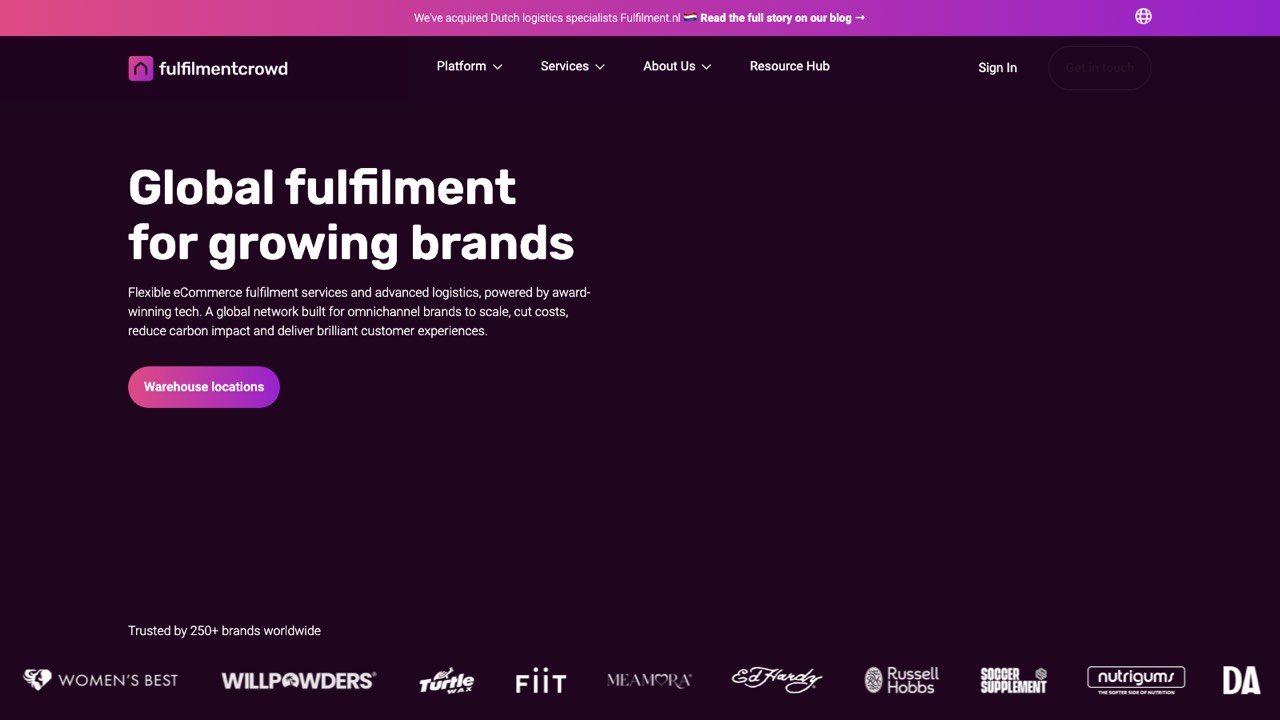
  • Fulfilmentcrowd fits brands wanting regional coverage through a partner-site network spanning the UK plus the EU, the United States, and Australia.

Detailed breakdown

Bigblue

Bigblue suits UK brands that need a provider built for repeat purchase, European warehousing, and cross-border shipping beyond a domestic pick-pack-ship setup. Growth and mid-market merchants running business-to-consumer (B2C) and business-to-business (B2B) flows together see the strongest fit, from 500 orders per month up to enterprise scale.

Key features:

  • Warehouse footprint: Ten European locations split across six France, two Spain, one UK, and one Germany, with shipping to 190+ countries.
  • Technology stack: Proprietary WMS (Atlas, runs the warehouse) and TMS (Voyager, runs shipping and returns), both built in-house. Inventory, delivery, returns, and post-purchase all sit on one system Bigblue controls end-to-end, no third-party middleware between them. Only European 3PL in the Shopify Trusted Fulfilment Network.
  • Post-purchase and returns: Fast Tags, Delivery ETA at checkout, and branded tracking at delivery, plus a returns portal bundling exchanges, Store Credit, and inventory-linked stock updates on the same stack.
  • Marketplace coverage: Wide, automated marketplace coverage including Fulfilment by Amazon (FBA), so brands keep one stock pool across D2C storefronts and major marketplaces.
  • Onboarding and support: Dedicated onboarding team (10 days minimum, ~30 days on average depending on stock volume and SKU count), named account manager, and customer support after go-live.

Best for:

  • Stage: Growth and mid-market brands, from early scaling to enterprise.
  • Category: Multi-channel brands running B2C, B2B, and marketplace flows on one platform.
  • Volume: 500 to 100,000+ orders per month.
  • Geography: Warehouses in the UK, France, Spain, and Germany, shipping to 190+ countries.

49% of consumers say personalised offers in tracking communications make them more likely to repeat purchase, while 63% of UK retailers still cannot retarget between checkout and delivery (Scurri via Retail Connections, 2025). Fast Tags and branded tracking close that gap from inside fulfilment, with Delivery ETA at checkout setting expectations before purchase.

James and James

James and James is a UK-anchored third-party logistics operator running a cloud-based software stack for merchants that value software-led visibility. The service specialises in light-weight, fast-moving product ranges and onboards brands from as few as 150 orders per month.

Key features:

  • Warehouse footprint: UK head site plus international locations in the Netherlands, the United States, Australia, Canada, and Poland following the November 2025 QLS acquisition.
  • Technology stack: CommandPort warehouse management system paired with the ControlPort merchant portal for inventory and order visibility.
  • SKU onboarding: Faster than most larger operators, suited to brands launching new ranges of light-weight products.
  • Ownership context: Acquired by QLS Netherlands in November 2025, with pricing and roadmap terms still open.

Best for:

  • Stage: Growth brands moving beyond self-fulfilment into a professional 3PL setup, from 150 orders per month.
  • Category: Light-weight, fast-moving product ranges including lifestyle and apparel.
  • Volume: 150 to 15,000 orders per month on UK-anchored demand.
  • Geography: UK-anchored with partner-country extensions, no deep European network.

Huboo

Huboo is a UK third-party logistics provider (3PL) known for a hub-based fulfilment model that segments each warehouse into small units, each run by a dedicated hub manager who also acts as the brand's day-to-day contact. The service historically targeted smaller sellers wanting a simpler onboarding path.

Key features:

  • Warehouse footprint: UK headquarters with sites in the Netherlands, Germany, and Spain carried through the 2024-2025 pre-pack sale, though strategic direction under new ownership is not yet public.
  • Operating model: Warehouses segmented into individually operated hubs, each with a dedicated manager acting as the brand's day-to-day contact.
  • Technology stack: In-house warehouse and inventory platform, without a branded post-purchase layer.
  • Ownership context: Pre-pack sale to a Baaj Capital and Atalla Capital consortium in December 2024 has left continuity and contract terms open.

Best for:

  • Stage: Early-stage sellers prioritising quick onboarding over a deep technology stack.
  • Category: Low-complexity product ranges with simple pick-pack profiles.
  • Volume: Up to 5,000 orders per month on domestic-led demand.
  • Geography: UK-led with European sites retained post-administration, though continuity under new ownership remains open.

Zendbox

Zendbox is a UK third-party logistics provider headquartered in Paddock Wood, Kent, focused on e-commerce fulfilment with AI-led stock allocation. Founded by James Khoury, the service targets multi-platform merchants that want polished packaging and smart inventory management on domestic-led demand.

Key features:

  • Warehouse footprint: Kent-based UK headquarters with cross-border fulfilment capability through partner locations, not a deep European network.
  • Target profile: Multi-platform merchants on Shopify, Magento, WooCommerce, and major marketplaces.
  • Technology stack: In-house platform with AI-driven inventory management, without Shopify Fulfilment Network partnership.
  • Brand presentation: Polished unboxing and carrier management as a core service promise.

Best for:

  • Stage: Growth brands beyond self-fulfilment looking for smart stock allocation.
  • Category: Multi-platform merchants prioritising unboxing and AI-driven inventory.
  • Volume: 1,000 to 20,000 orders per month on UK-led demand.
  • Geography: UK-led from Kent, with cross-border reach through partners but no deep European infrastructure.

Fulfilmentcrowd

Fulfilmentcrowd is a UK-headquartered third-party logistics provider built on a partner-site network model, with UK centres plus additional locations across the EU, the United States, and Australia. Its proprietary fulfilmentcrowd platform provides merchant controls, though the fit narrows once bundled returns and branded post-purchase tooling become shortlist filters.

Key features:

  • Warehouse footprint: UK partner sites plus additional locations across the EU, the United States, and Australia for regional coverage.
  • Operating model: Partner-site network, with platform-style merchant controls across the proprietary fulfilmentcrowd platform.
  • Technology stack: Proprietary fulfilmentcrowd platform, without a bundled branded post-purchase layer.
  • Returns handling: Standard returns processing, without bundled exchanges or Store Credit.

Best for:

  • Stage: Growth brands wanting regional coverage through a partner network.
  • Category: Product ranges where distributed regional fulfilment matters more than a branded post-purchase stack.
  • Volume: 1,000 to 15,000 orders per month.
  • Geography: UK-led, with partner extensions in the EU, the United States, and Australia.

Which fulfilment company fits which merchant profile?

Which provider fits a brand depends less on network size and more on brand stage and geographic reach. 85.7% of UK shoppers expect diverse delivery choices and smooth returns bundled into their shopping experience, so UK fulfilment companies that keep those layers disconnected leave conversion on the table (Metapack, 2025).

For scaling brands that want UK execution today plus European optionality later, a unified multi-country stack is the stronger fit.

<table style="width:100%; border-collapse:collapse; font-family:inherit; font-size:15px;">
 <thead>
   <tr style="background-color:#f5f5f5; text-align:left;">
     <th style="padding:12px; border:1px solid #e0e0e0;">Provider</th>
     <th style="padding:12px; border:1px solid #e0e0e0;">Warehouse network</th>
     <th style="padding:12px; border:1px solid #e0e0e0;">Shopify Fulfilment Network</th>
     <th style="padding:12px; border:1px solid #e0e0e0;">Proprietary fulfilment software</th>
     <th style="padding:12px; border:1px solid #e0e0e0;">Branded post-purchase stack</th>
     <th style="padding:12px; border:1px solid #e0e0e0;">Returns bundled in fulfilment</th>
     <th style="padding:12px; border:1px solid #e0e0e0;">B2C and B2B on one platform</th>
   </tr>
 </thead>
 <tbody>
   <tr>
     <td style="padding:12px; border:1px solid #e0e0e0;">Bigblue</td>
     <td style="padding:12px; border:1px solid #e0e0e0;">10 EU sites (UK, FR, ES, DE), ships to 190+ countries</td>
     <td style="padding:12px; border:1px solid #e0e0e0;">Yes</td>
     <td style="padding:12px; border:1px solid #e0e0e0;">Atlas WMS + Voyager TMS</td>
     <td style="padding:12px; border:1px solid #e0e0e0;">Yes</td>
     <td style="padding:12px; border:1px solid #e0e0e0;">Yes</td>
     <td style="padding:12px; border:1px solid #e0e0e0;">Yes</td>
   </tr>
   <tr>
     <td style="padding:12px; border:1px solid #e0e0e0;">Fulfilmentcrowd</td>
     <td style="padding:12px; border:1px solid #e0e0e0;">UK partner sites plus EU, USA, Australia</td>
     <td style="padding:12px; border:1px solid #e0e0e0;">No</td>
     <td style="padding:12px; border:1px solid #e0e0e0;">fulfilmentcrowd platform</td>
     <td style="padding:12px; border:1px solid #e0e0e0;">Tracking only, no branded stack</td>
     <td style="padding:12px; border:1px solid #e0e0e0;">Returns only, no exchanges</td>
     <td style="padding:12px; border:1px solid #e0e0e0;">B2C primary</td>
   </tr>
   <tr>
     <td style="padding:12px; border:1px solid #e0e0e0;">Huboo</td>
     <td style="padding:12px; border:1px solid #e0e0e0;">UK plus NL, DE, ES (continuity under review)</td>
     <td style="padding:12px; border:1px solid #e0e0e0;">No</td>
     <td style="padding:12px; border:1px solid #e0e0e0;">In-house WMS</td>
     <td style="padding:12px; border:1px solid #e0e0e0;">Tracking only, no branded stack</td>
     <td style="padding:12px; border:1px solid #e0e0e0;">Returns only, no exchanges</td>
     <td style="padding:12px; border:1px solid #e0e0e0;">B2C primary</td>
   </tr>
   <tr>
     <td style="padding:12px; border:1px solid #e0e0e0;">James and James</td>
     <td style="padding:12px; border:1px solid #e0e0e0;">UK plus NL, USA, Australia, Canada, Poland</td>
     <td style="padding:12px; border:1px solid #e0e0e0;">No</td>
     <td style="padding:12px; border:1px solid #e0e0e0;">CommandPort WMS + ControlPort portal</td>
     <td style="padding:12px; border:1px solid #e0e0e0;">Portal tracking, no branded stack</td>
     <td style="padding:12px; border:1px solid #e0e0e0;">Returns only, no exchanges</td>
     <td style="padding:12px; border:1px solid #e0e0e0;">B2C primary</td>
   </tr>
   <tr>
     <td style="padding:12px; border:1px solid #e0e0e0;">Zendbox</td>
     <td style="padding:12px; border:1px solid #e0e0e0;">UK (Kent HQ), cross-border via partners</td>
     <td style="padding:12px; border:1px solid #e0e0e0;">No</td>
     <td style="padding:12px; border:1px solid #e0e0e0;">In-house WMS with AI inventory</td>
     <td style="padding:12px; border:1px solid #e0e0e0;">Unboxing only, no tracking stack</td>
     <td style="padding:12px; border:1px solid #e0e0e0;">Returns only, no exchanges</td>
     <td style="padding:12px; border:1px solid #e0e0e0;">B2C primary</td>
   </tr>
 </tbody>
</table>

Conclusion

A UK fulfilment shortlist should match how buyers actually decide. Warehouse count alone is never the right filter. Delivery execution, returns control, post-purchase tooling, and European readiness separate providers whose value holds at scale from those whose ceiling appears within a year. UK-only specialists still fit domestic-first brands, yet mid-market merchants planning growth into Europe benefit from a stack built for multi-country orchestration from day one.

FAQ

What should UK brands compare before choosing a fulfilment company?

Delivery reliability, returns capability, European readiness, and post-purchase depth matter more than headline pricing or warehouse count. Provider tech stack and returns workflow decide what happens after checkout, with carrier relationships governing the in-transit window. Software-led visibility and returns bundling separate providers that protect repeat purchase from vendors that only move parcels.

Which fulfilment company is best for a UK brand planning to expand into Europe?

Providers with in-country European infrastructure fit scaling UK brands with continental ambitions. 39% of European shoppers avoid cross-border purchases because of longer delivery times, so multi-country setups protect repeat purchase (DHL eCommerce, 2025). Bigblue's ten European locations across the UK, France, Spain, and Germany keep inventory, returns, and delivery unified.

Is Amazon FBA the same as using a 3PL?

No. Amazon FBA is a marketplace fulfilment service that delivers Amazon orders under Amazon branding and packaging. A third-party logistics provider ships orders across the brand's own channels under the brand's identity, tracking, and returns experience. Merchants running their own direct-to-consumer (D2C) storefronts usually need both capabilities separately.

When is a UK-only fulfilment specialist still enough?

A UK-only partner still fits brands that do not sell internationally and have no plan to in the next twelve months. UK domestic execution is strong: recipient-side issues ran at 3.11% against 1.64% carrier-side issues in Q2 2025 (Parcel Perform, 2025). The moment international sales enter the roadmap, the UK-only ceiling shows up quickly.

Which provider fits fashion brands with heavier returns pressure?

UK non-food returns sit near 19.5% in 2025, and 80% of young fashion retailers now charge for returns (Retail Economics x ZigZag, 2025). Providers that bundle returns, exchanges, and Store Credit inside fulfilment protect margin. Specialist returns apps add depth on their own surface but run as a second integration with a separate dashboard, and returned stock only reappears once both systems sync. Bigblue's returns portal sits natively on the fulfilment stack, so exchange stock reappears in the same inventory view the moment the return is processed.

What proof shows a fulfilment partner can improve repeat purchase?

62% of consumers say they buy more after a positive returns experience, and instant returns lift 30-day repurchase rates by 23% (Signifyd, 2025). Providers that bundle returns inside fulfilment turn that behaviour into repeat revenue at merchant scale.

Which UK fulfilment providers are real 3PLs versus carriers or marketplaces?

The best fulfilment companies in the UK are true third-party logistics providers that warehouse inventory and ship orders under the brand's own identity. Carriers such as DHL, UPS, and Royal Mail move parcels as shipping partners, not as fulfilment operators. Amazon FBA is a marketplace fulfilment service where Amazon owns the customer experience.

What signs show a provider can handle the next growth step?

Look for unified post-purchase tooling and returns workflow inside one platform, with multi-country orchestration built in. 90% of businesses report that customers now expect faster delivery and more tailored experiences, so a unified stack that joins post-purchase tooling with returns and multi-country orchestration closes that gap (Metapack, 2025).

Sources

Frequently asked questions
Everything you need to know.
No items found.